
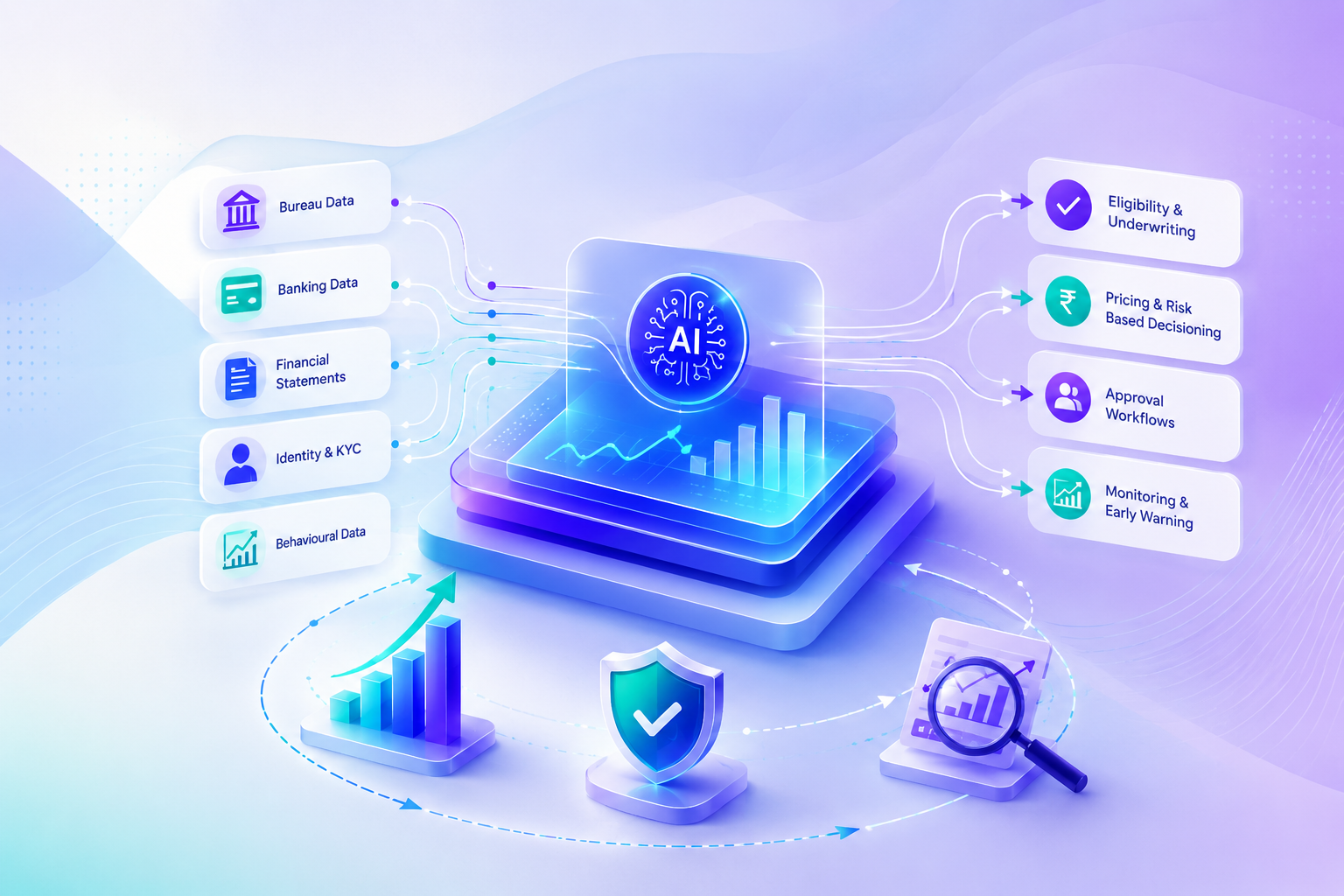
Credit risk software is no longer simply a tool for calculating whether a borrower is likely to repay. As lending becomes faster, more data driven and increasingly digital, lenders need to connect risk signals, policy, decisions and ongoing monitoring. The real shift is from assessing risk at one point in time to building continuous credit intelligence across the lending lifecycle.
1. What Modern Credit Risk Software Actually Does
Traditional credit assessment often follows a familiar path: collect borrower information, check bureau data, calculate a score and make a decision. Modern credit risk software expands that model.
It brings together bureau, banking, financial, identity and alternative data; applies analytics and policy logic; supports automated decisions; and continues to monitor risk after origination.
The model is simple:
Data → Assess → Decide → Monitor → Act
That makes credit risk software less of a standalone scoring application and more of a connected risk layer between data, lending systems and business policy.
2. Six Capabilities That Define Modern Credit Risk Software
1. Connected risk data
A lender’s risk picture rarely sits in one source. Modern platforms can combine bureau information with bank statements, financial data, tax information, repayment history, identity signals and alternative data. The objective is not simply more data, but more usable context for a decision.
2. AI powered risk assessment
Credit risk analytics is moving beyond static scorecards. AI and machine learning can support financial analysis, borrower segmentation, fraud detection, underwriting and predictive risk assessment.
Experian’s 2026 research on machine learning in Indian lending found that 93% of lenders using machine learning for vehicle loans reported higher approvals, while 90% reported reduced bad debt in credit cards. The research also found that 79% believed machine learning could help them responsibly serve new customer segments.
3. Governed credit decisioning
Risk intelligence only becomes valuable when it can influence action. Credit risk scoring can feed eligibility, risk bands, pricing, approval routes and exception handling through governed policy logic.
This is where a decision engine becomes important. Instead of embedding policy inside code, lenders can make rules, score logic and decision paths configurable, testable and version controlled. Decision.ezee, for example, positions its policy layer between connected data and lending systems, with rules, flows, versioning and audit trails.
4. Continuous risk monitoring
A loan approval is not the end of credit risk. Borrower behaviour, financial conditions and portfolio exposure can change after disbursement.
Modern credit risk management software can support early warning indicators, portfolio monitoring, risk segmentation and behavioural signals so lenders can identify deterioration earlier and intervene before a problem becomes a larger loss.
5. Explainability and control
The more AI enters lending, the more important governance becomes. A decision needs to be understandable, traceable and reproducible.
That means capabilities such as decision reasons, audit trails, policy versioning, access controls, testing, challenger models and execution logs are becoming part of the technology conversation. Decision.ezee’s architecture incorporates these controls around policy execution and AI connected decisioning.
6. Integration and scalability
Risk cannot operate in isolation. It needs to connect with LOS, LMS, CRM, core systems, data providers and collections.
The value of credit risk software therefore depends partly on how easily it can become part of the existing lending architecture rather than creating another technology silo.
3. From Faster Decisions to Better Risk Economics
The business case for credit risk technology is broader than speed.
Better data and analytics can improve risk selection. Governed automation can reduce manual work. Faster decisions can reduce customer drop off. More accurate risk assessment can support pricing and portfolio quality. Continuous monitoring can enable earlier intervention.
The result is a more useful equation:
Better risk intelligence → faster execution → lower operating effort → earlier intervention → more controlled credit growth.
This is where modern credit risk software becomes strategically relevant: its value comes from improving the economics of lending, not simply automating individual tasks.
PwC’s European Credit Risk Survey 2026 found that reducing manual workload and operational risk was the leading expected benefit of advanced credit risk technology at 22%, followed by faster and more consistent credit decisions at 21% and improved predictive accuracy and early detection of distress at 19%.
These priorities show that technology investment is increasingly being judged by measurable business outcomes, not by the number of features a platform contains.
4. Why Continuous Risk Intelligence Matters After Approval
One of the biggest changes in modern lending is the recognition that risk does not remain static.
A borrower can move from healthy to vulnerable because of changes in cash flow, repayment behaviour, utilisation, industry conditions or other signals. A portfolio can also change even when individual applications appear healthy.
This is where credit risk software can move beyond application scoring into continuous risk intelligence.
Early warning systems can flag emerging concerns. Behavioural analytics can reveal patterns that a traditional score may not capture. Portfolio views can identify concentrations or segments that need attention.
The objective is not simply to predict default. It is to give the lender enough context and enough time to act.
This lifecycle approach is also reflected in ezee.ai’s Agentic AI architecture, where portfolio risk monitoring and collections intelligence continue beyond origination rather than treating approval as the end of the journey.
5. AI Makes Credit Risk Smarter. Governance Makes It Usable.
AI credit risk assessment is becoming more practical, but adoption is not simply about choosing a more sophisticated model.
The PwC 2026 survey found that AI is most commonly being applied or explored in early warning signal detection at 29%, document analysis and data extraction at 28%, and credit scoring and underwriting at 27%. At the same time, data quality and availability, legacy integration, model explainability and regulatory compliance remain major barriers.
That tension matters.
A strong ai credit risk assessment framework needs intelligence and control together. AI can identify patterns, analyse documents, support underwriting and surface risk signals. Policy logic can define what is permitted. Governance can determine who can change it. Testing can validate changes before production. Audit trails can show what happened and why.
This is the direction reflected in decision.ezee, where policy logic sits between connected data and lending systems, with versioning, testing, shadow testing, challenger management and audit controls.
Better Credit Decisions Start With Better Risk Intelligence
Credit risk does not end with approval. Borrower behaviour, financial conditions and portfolio exposure continue to change, making timely risk intelligence essential to sustainable lending.
Modern credit risk software connects data, credit risk analytics, scoring, policy and monitoring to help lenders make faster, more consistent and better informed decisions. The value lies not just in predicting risk, but in turning risk signals into timely action while maintaining control.
Decision.ezee by ezee.ai strengthens this decisioning layer by connecting data sources, business rules, AI driven insights and lending systems within a governed framework. It supports eligibility, scoring, pricing and approval logic, while providing policy versioning, testing, challenger management and audit trails. This enables credit risk management software to move from assessment to controlled execution, with explainable AI credit risk assessment built into the decision process.
The outcome is simple: better risk intelligence, stronger decision control and more confident credit growth.
Frequently Asked Questions
Credit risk software assesses borrower risk using application data, credit bureau information, financial data and lending policies. It automates checks such as eligibility, affordability and risk assessment, helping lenders make faster, more consistent credit decisions while maintaining an auditable decision process.
Credit scoring software primarily calculates a borrower’s risk score, while credit risk software uses that score alongside bureau data, policy rules, affordability checks and workflow decisions. In sophisticated SME lending, 70–80% of decisions can be automated, with complex cases referred for review.
Credit risk software speeds decisions by automating data retrieval, validation, bureau checks and policy evaluation instead of routing every application through manual review. One bank reduced decision time to under a minute while achieving 70% straight through processing.
Credit risk software improves management by applying consistent policies, monitoring borrower signals and identifying emerging risks earlier. Machine learning enhanced early warning systems have improved prediction of late payments by 70–90% in one SME lending.
Credit risk software is best suited to banks, NBFCs, fintech lenders and other credit providers managing significant application volumes or complex lending policies. It is particularly relevant when manual underwriting limits decision speed, consistency, scalability or visibility into risk decisions.
Credit risk software connects data sources through APIs, applies AI models to identify risk patterns and uses rule engines to evaluate lending policies. Platforms such as ezee.ai can orchestrate these inputs within a single decision flow, supporting automated approvals, declines and referrals.
References
- https://www.pwc.pt/en/issues/credit-risk-management-maturity-survey.html
- https://www.experian.in/2026/01/13/machine-learning-improving-lending-decisions-india-experian/
- https://www.emagia.com/resources/glossary/how-does-credit-risk-management-software-help-banks/
- https://riskpublishing.com/the-benefits-of-credit-risk-management-software/
- https://www.abrigo.com/software/lending-and-credit-risk/sageworks-credit-risk-software/
- https://www.canopyservicing.com/blog/credit-risk-management-software/
- https://rbi.org.in/scripts/BS_ViewBulletin.aspx?Id=22851
- https://m.rbi.org.in/Scripts/BS_ViewPublicationReport.aspx
- https://kpmg.com/in/en/insights/2026/05/basel-iii-standardised-approach-for-Indian-banks.html
- https://www.ey.com/en_us/insights/banking-capital-markets/ey-iif-global-bank-risk-management-survey
- https://integraliq.crisil.com/en/homepage/what-we-do/credit-risk-services/ai-and-automation.html
- https://www.moodys.com/web/en/us/solutions/lending/loan-origination/spreading-scoring.html
