
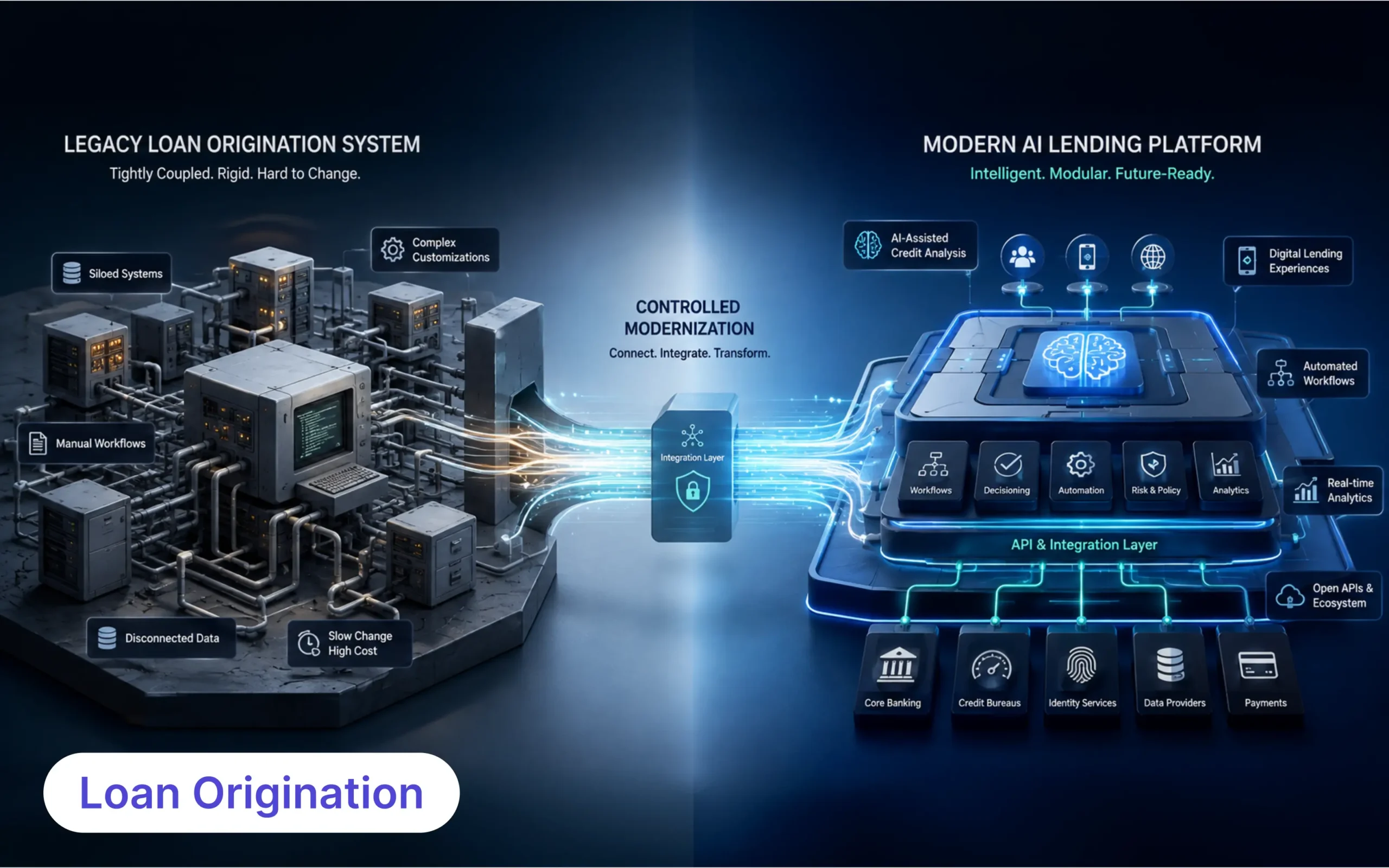
A legacy loan origination system was once the foundation of efficient lending operations. It enabled banks to standardise loan processing, improve operational control, and manage growing lending portfolios. However, the lending landscape has evolved significantly. Borrowers increasingly expect digital onboarding, faster lending decisions, and consistent experiences across channels. At the same time, banks must navigate stricter regulations, rising competition from digital lenders, and increasing pressure to improve operational efficiency.
The challenge is no longer simply about digitising loan applications. It is about building intelligent lending operations that can support faster, more consistent, and data-driven decisions. According to McKinsey & Company, banks that successfully integrate AI across core business processes can improve productivity while enhancing customer experience and decision quality.
As a result, many financial institutions are reassessing whether their legacy loan origination system can continue supporting modern lending requirements or whether they should pursue lending modernization through an AI lending platform. This guide examines the key differences between legacy loan origination systems and modern AI lending platforms, the capabilities banks should evaluate, and how institutions can modernize lending without necessarily replacing their existing core banking infrastructure.
Why Legacy Loan Origination Systems Are Holding Banks Back
Many banks continue to rely on a legacy loan origination system because it has supported lending operations for years. While these systems can remain reliable for established lending processes, many were designed around technology architectures and operating models that are less suited to today’s demands for speed, agility, intelligent automation, and connected lending operations.
The Cost of Rigid Architecture
One of the biggest limitations of a legacy loan origination system can be an inflexible architecture. Over time, extensive customisation and tight integrations with surrounding applications can make even relatively small policy or product changes time consuming and expensive.
Launching a new loan product, modifying eligibility criteria, or updating approval workflows often requires extensive IT involvement, lengthy testing cycles, and vendor support. As lending products become more personalised and regulatory requirements evolve more frequently, this dependence on development teams slows innovation and delays time to market.
Instead of responding quickly to changing customer expectations, banks often find themselves constrained by technology that was designed for stability rather than adaptability.
Disconnected Lending Operations
Modern lending involves far more than processing applications. Customer onboarding, document verification, identity checks, fraud detection, financial analysis, underwriting, approval, compliance, and disbursement all need to work together as part of a connected lending journey.
A legacy loan origination system typically manages only part of this process. The remaining activities are often handled through separate applications, spreadsheets, emails, or manual interventions. As information moves across disconnected systems, operational inefficiencies multiply.
These fragmented workflows create several challenges:
- Longer loan processing times
- Duplicate data entry across systems
- Increased operational costs
- Higher risk of manual errors
- Limited visibility into application status
Rather than enabling end to end lending, banks spend valuable time coordinating between systems instead of focusing on better credit decisions and customer service.
Compliance, Governance, and Auditability
As lending becomes more digital and automated, financial institutions need stronger controls around policy execution, auditability, decision traceability, and AI governance. The specific regulatory requirements vary by market and lending product, but the underlying need for consistent controls and defensible decision processes is increasingly important.
Many legacy loan origination systems were not designed to provide explainable decisioning, version-controlled business rules, or detailed execution logs. As regulatory scrutiny increases, maintaining compliance through manual controls becomes both costly and difficult to scale.
This growing operational complexity explains why banks are increasingly evaluating modern lending platforms that combine automation with stronger governance. Rather than simply replacing ageing technology, institutions can focus on modernising the lending layer to improve operational agility, strengthen controls, and create the flexibility required for long-term digital transformation.
What Makes an AI Lending Platform Different?
Replacing a legacy loan origination system is not simply about moving to newer software. It is about adopting a more connected approach to lending that combines workflow automation, AI-assisted analysis, and governed decisioning across the credit lifecycle. For a broader understanding of the technology involved, see our loan origination software guide.
Modern AI lending platforms are designed to reduce operational silos by connecting customer onboarding, credit assessment, underwriting, approvals, and post-sanction activities through a more unified architecture. Instead of relying on isolated processes, connected workflows can share data, business rules, and decision context, helping lending teams work with more consistent information across the credit journey.

AI can support analysis and decisioning across the lending workflow while remaining within governed processes.
Intelligence Beyond Automation
Automation has existed in lending for years, but AI-enabled platforms can extend automation beyond predefined workflows. Depending on the implementation, AI can analyse information, surface potential risks, recommend next actions, and support credit teams with data-driven insights.
Capabilities such as intelligent document processing, fraud detection, financial statement analysis, eligibility assessment, and automated underwriting software can reduce repetitive manual work while helping improve consistency across lending operations. Credit teams remain responsible for applying their expertise to complex lending decisions, while AI can support them with analysis, prioritisation, and workflow assistance.
When implemented with appropriate controls, this combination of human expertise and AI-driven intelligence can help banks handle higher application volumes while maintaining visibility, governance, and a consistent customer experience.
Designed for Agility, Not Complexity
Another defining characteristic to evaluate in a modern lending platform is flexibility. Low-code and no-code loan automation can allow business teams to adapt lending processes through configurable workflows and tools without relying on extensive software development for every change.
When evaluating a modern lending platform, decision makers should look beyond core functionality. They should evaluate how easily a platform integrates with existing core banking systems, third-party data providers, credit bureaus, and digital channels while supporting future changes in products, policies, and lending processes.
Equally important are capabilities such as configurable decision engines, explainable AI, embedded analytics, real-time monitoring, and policy-driven workflow orchestration. These capabilities can help banks launch products faster, adapt lending policies more efficiently, and create more consistent digital lending experiences.
Legacy Loan Origination System vs Modern AI Lending Platform: Key Differences
Choosing between a legacy loan origination system and a modern AI lending platform is no longer just a technology decision. It is a strategic investment that can influence operational efficiency, customer experience, risk management, and future growth. While traditional systems were primarily designed to digitise and manage lending processes, modern platforms can connect workflows, data, integrations, and AI-assisted capabilities across the lending journey.

Modern lending platforms can introduce a connected lending layer alongside existing core banking infrastructure.
The following comparison highlights the key differences.
| Capability | Legacy Loan Origination System | Modern AI Lending Platform |
|---|---|---|
| Architecture | Tightly coupled or heavily customised | Modular, API-first architecture |
| Loan Processing | Sequential workflows and manual handoffs | Configurable workflows with automation and AI-assisted processing |
| Decisioning | Rules-based decisioning with manual underwriting | AI-assisted and explainable decision support |
| Product Configuration | Often dependent on technical teams | Greater business-user configuration through no-code or low-code tools |
| Integrations | Point-to-point or tightly coupled integrations | API-first connectivity with core and third-party systems |
| Compliance | Fragmented or manually coordinated controls | Configurable policy controls, audit trails, and decision traceability |
| Customer Experience | Fragmented journeys and limited status visibility | Connected digital journeys and real-time status visibility |
| Scalability | Scaling may require significant technical changes | Designed for configurable scaling and evolving lending volumes |
The differences extend beyond individual features. A legacy loan origination system may continue to manage core application workflows effectively, but a modern AI lending platform can connect workflows, data, integrations, and decisioning capabilities across more of the lending journey. This can reduce the need to reconcile information across disconnected applications and give lending teams greater visibility into application and borrower data.
The other major distinction is adaptability. When products, policies, or regulatory requirements change, heavily customised legacy environments may require significant technical effort to update. Configurable workflows, policies, and decision rules can give business teams greater control over these changes while reducing dependence on development teams. For banks evaluating modernization, the key question is whether the lending platform can improve business agility without creating another technology dependency.
Five Capabilities to Look for in a Modern Loan Origination Platform
A loan origination platform evaluation should consider not only the functions a platform provides today, but also how well it supports changing lending products, workflows, data sources, and governance requirements. The following five capabilities provide a practical framework for evaluating whether a platform can support lending modernization at enterprise scale.

Five capabilities help banks evaluate whether a modern lending platform can support long-term lending modernization.
1. AI-Powered Credit Analysis
AI can help analyse borrower profiles, financial information, transaction data, credit history, and other relevant data sources to identify patterns, inconsistencies, and potential risks. When appropriately designed and validated, these capabilities can support credit teams with faster analysis while complementing existing rules, scorecards, and underwriting expertise.
2. No-Code Product Configuration
In heavily customised environments, even relatively small workflow or product changes can require technical involvement. No-code or low-code configuration can give authorised business users greater control over workflows, eligibility criteria, product parameters, and business rules without requiring software development for every change.
3. API-First Integration
A modern lending platform should support API-first integration with the systems that form part of the institution’s lending ecosystem, including core banking systems, credit bureaus, identity and verification services, payment infrastructure, CRM platforms, and digital channels. Strong integration capabilities can reduce point-to-point dependencies and make it easier to introduce new data sources or services as lending requirements evolve.
4. Explainable Decisioning and Governance
Financial institutions need to understand how lending decisions are reached, particularly when AI contributes to analysis or recommendations. A modern platform should provide appropriate audit trails, decision traceability, policy and rule versioning, and controls that help authorised teams review how decisions were generated and applied.
5. Real-Time Analytics and Continuous Optimisation
Modern lending platforms should provide timely visibility into application volumes, processing stages, decision outcomes, exceptions, and operational performance. This data can help lending teams identify bottlenecks, monitor outcomes, refine workflows, and improve processes over time.
Together, these capabilities form the foundation of a modern digital lending platform: intelligent analysis, configurable processes, connected data and systems, governed decisioning, and actionable operational insight. For banks evaluating lending modernization, the key question is not simply whether a platform offers these capabilities, but how well they work together within the institution’s existing technology and governance environment.
Modernizing Lending Without Replacing the Core
Lending modernization does not necessarily require a bank to replace its core banking system. In many cases, institutions can modernize the lending layer while allowing the existing core to continue supporting the systems and transactions for which it remains fit. This approach is part of broader digital transformation in lending, helping modernize customer onboarding, automate underwriting, improve decisioning, and streamline workflows through APIs and other integration mechanisms while preserving the stability of core banking infrastructure.

Lending modernization can add digital workflows, AI-assisted decisioning, and automation while existing core systems continue to perform their established roles.
When Should a Bank Consider Lending Modernization?
A bank should consider modernizing its lending technology when the existing environment makes meaningful business change increasingly difficult. Common indicators include:
- New loan products or policy changes require significant technical development.
- Lending workflows depend on multiple disconnected systems or manual handoffs.
- Customer and application data must be repeatedly entered or reconciled across systems.
- Integrating new data providers, digital channels, or third-party services is slow or complex.
- Credit decisions rely heavily on manual analysis despite growing application volumes.
- Governance, auditability, or decision traceability requires extensive manual effort.
- Business teams have limited ability to adapt lending processes without IT intervention.
These indicators do not automatically mean that the existing LOS must be replaced. They can instead help institutions determine whether an incremental modernization approach could deliver greater business agility with less disruption.
This modernization approach is also reflected in a modern loan origination system, which provides configurable lending workflows, API-based integrations, and digital capabilities that can operate alongside existing technology environments. For banks evaluating modernization, the more important consideration is how effectively a platform addresses specific lending constraints while fitting the institution’s broader architecture and governance model.
Conclusion
A legacy loan origination system is not automatically a problem simply because it is older. The more important question is whether the existing lending environment can support the speed, flexibility, connectivity, intelligence, and governance that modern lending requires.
For banks evaluating lending modernization, the decision should therefore go beyond replacing one software platform with another. A modern lending platform should be assessed on how effectively it connects lending workflows, integrates with the existing technology environment, supports AI-assisted decisioning, enables controlled configuration, and provides the governance and visibility required for sustainable operations.
Modernization also does not necessarily mean replacing the core banking system. In many cases, institutions can introduce a modern lending layer alongside existing infrastructure, allowing them to address specific lending constraints while preserving systems that continue to provide value.
Ultimately, the right modernization strategy depends on the institution’s existing architecture, lending processes, technology constraints, and business priorities. The goal is not simply to replace a legacy loan origination system, but to create a lending environment that can adapt as products, customer expectations, data, technology, and regulatory requirements evolve.
Frequently Asked Questions
A legacy loan origination system is an older lending technology platform that supports processes such as application intake, credit assessment, underwriting, approval, and related workflows. These systems can continue to support established lending operations, but heavily customised or tightly coupled architectures may make it harder to introduce new products, integrate new data sources, automate processes, or adapt lending policies efficiently.
An AI lending platform can extend traditional loan origination workflows with AI-assisted analysis, configurable automation, connected integrations, and governed decision support. A legacy loan origination system may continue to manage core application workflows effectively, but its architecture and degree of customisation can make changes and integrations more difficult. The key difference is therefore not simply age, but how effectively the lending environment supports data, workflows, decisioning, integration, and governance.
Yes. Lending modernization does not necessarily require replacing the core banking system. Banks can introduce a modern lending layer that works alongside existing infrastructure through APIs and other integration mechanisms. This approach can modernize customer journeys, workflows, decisioning, and automation while allowing the existing core to continue supporting the systems and transactions for which it remains fit.
Banks should evaluate a modern loan origination platform based on more than its current feature set. Important capabilities include AI-assisted credit analysis, configurable workflows and products, API-first integration, explainable decisioning, governance and auditability, and real-time operational analytics. Institutions should also assess how well the platform fits their existing architecture and how easily it can adapt to changing lending products, policies, data sources, and regulatory requirements.
Common indicators include lengthy technical effort for product or policy changes, disconnected lending workflows, repeated data entry, difficult integration with new data sources or digital channels, heavy reliance on manual credit analysis, and significant effort required for governance or decision traceability. These indicators do not automatically mean that the existing loan origination system must be replaced; they can help the institution determine whether an incremental modernization approach would improve agility and operational efficiency.
References
- https://www.mckinsey.com/featured-insights/mckinsey-explainers/banking-and-ai-when-the-tech-starts-doing-the-work-not-just-assisting-it
- https://www.backbase.com/blog/ai-loan-origination-in-banks
- McKinsey & Company. The AI Powered Bank: Rewiring for Excellence in Customer Care.
- IBM Institute for Business Value. Global Outlook for Banking and Financial Markets.
