Omnichannel Collections are changing how businesses approach debt recovery. For decades, debt recovery for businesses was built around a simple formula: make more calls, add more agents, and increase follow ups.
That approach is becoming increasingly difficult to sustain.

Borrowers today interact differently, making digital communication in debt collection increasingly important. They respond to WhatsApp messages between meetings, engage with app notifications during commutes, and check emails on demand.
At the same time, collection leaders face growing pressure to reduce cost to recover, improve portfolio performance, strengthen compliance, and preserve customer relationships. Deloitte research highlights that modern collections must evolve from traditional recovery functions into customer centric resolution frameworks supported by better processes, technology, and decision making.
The challenge is not a lack of outreach.
It is a lack of orchestration.
Many digital lending platforms still operate through disconnected channels, fragmented workflows, and inconsistent borrower experiences. The result is higher costs, lower engagement, and slower recoveries.
Leading lenders are responding by redesigning the debt recovery process around omnichannel collections, behavioural intelligence, and workflow automation.
This shift is changing how debt collection operates across banks, NBFCs, and digital lenders.
From Calls to Omnichannel: The Evolution of Debt Recovery
Multichannel vs. Omnichannel Collections
The biggest misconception in collections is that multichannel and omnichannel mean the same thing.
They do not.
Multichannel simply means communicating through multiple channels.
A borrower might receive:
- A phone call on Monday
- An SMS on Wednesday
- An email on Friday
Each interaction operates independently.
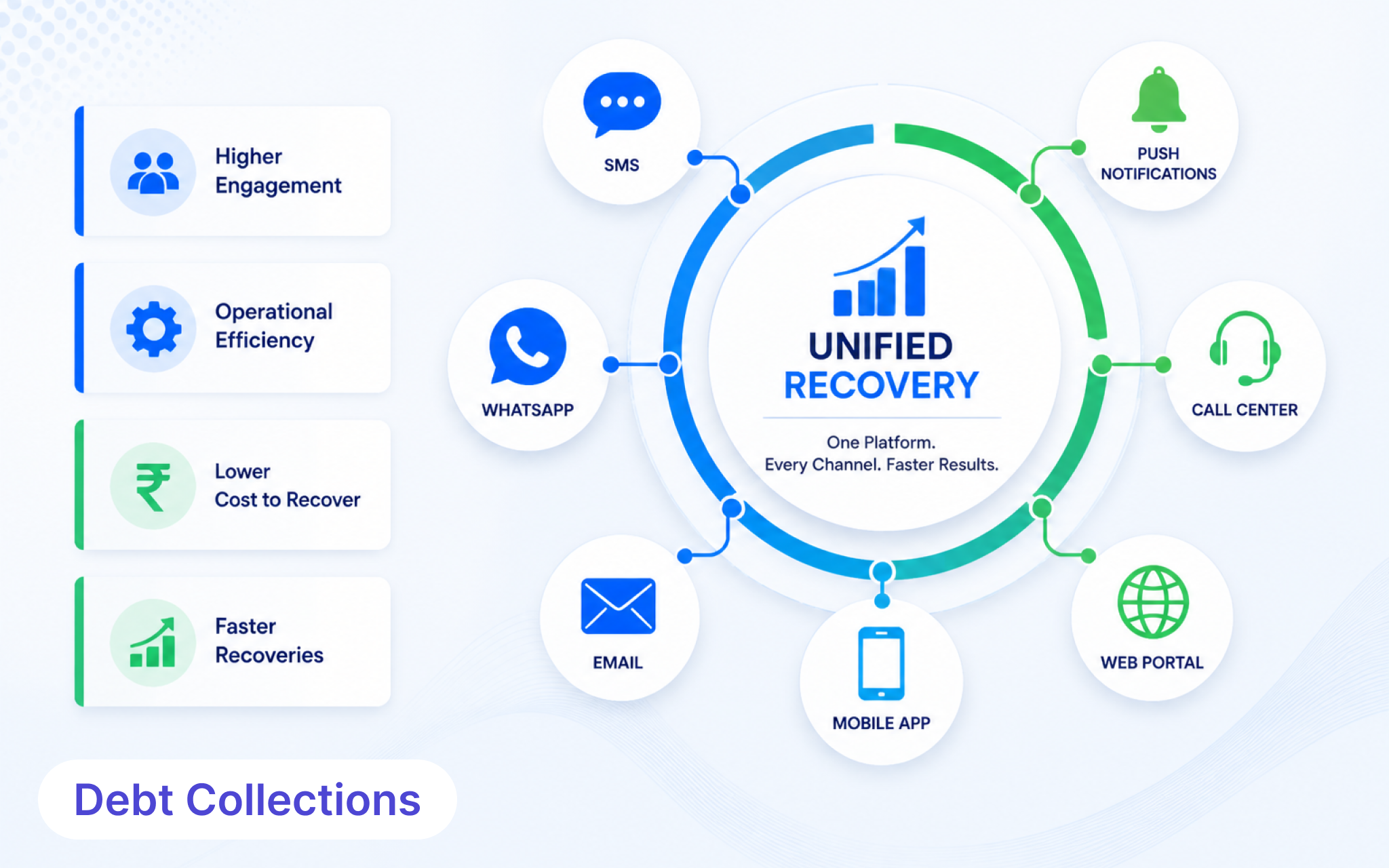
Omnichannel debt collection works differently.
Every interaction is connected, sequenced, and informed by previous borrower behaviour.
A borrower may receive:
- A mobile notification after a missed payment
- An SMS with repayment options
- A WhatsApp reminder containing a payment link
- An agent call only if engagement remains low
Each step builds on the previous one.
This coordinated approach creates a smoother borrower experience while improving operational efficiency.
More importantly, it aligns with how customers actually communicate today.
For lenders, the benefit is clear.
Rather than relying solely on expensive agent driven outreach, institutions can engage borrowers through their preferred channels while reserving human intervention for cases that genuinely require it.
This is why many of the best debt recovery strategies now begin with digital engagement and escalate intelligently based on borrower response.
The Three ROI Drivers Behind Omnichannel Collections

The business case for omnichannel recovery extends far beyond convenience.
It directly influences recovery performance, operating costs, and customer experience.
1. Faster Debt Recovery Through Higher Engagement
Engagement remains one of the strongest predictors of repayment.
McKinsey research shows digitally engaged customers make significantly more payments than those contacted solely through traditional collection channels, while lenders often see measurable improvements in recovery rates alongside lower collection costs.
The reason is straightforward.
Borrowers are more likely to engage through channels they already use daily.
WhatsApp, SMS, email, mobile apps, and self service portals remove friction from the repayment journey.
A leading NBFC in India redesigned its collection approach around sequential omnichannel engagement:

- Day 1: App notification and SMS
- Day 2: Email with repayment options
- Day 4: WhatsApp reminder and account update
- Day 6: Agent outreach only if required
Within six weeks the organisation reported:
- 27% improvement in recovery rates
- 31% increase in first contact resolution
- 41% reduction in call volumes per account
The lesson is simple.
The most effective collection strategy examples focus on engagement quality rather than outreach volume.
2. Lower Friction and Reduced Operating Costs
Every manual follow up carries a cost.
Calls require agents.
Escalations require supervision.
Disputes consume operational resources.
A well designed debt recovery process reduces this burden through automation and intelligent routing.
Key capabilities include:
- Embedded payment links
- Self service repayment options
- Automated reminders
- Rule based escalation
- Centralised borrower visibility
Instead of chasing every borrower manually, institutions focus resources where they generate the highest value.
An Australian fintech lender redesigned its early stage collections journey using automated nudges, digital repayment options, and targeted escalation paths.
The outcome:
- 47% reduction in call volumes
- 22% increase in repayments
- Lower cost per account recovered
This is why operational efficiency has become a critical component of debt recovery for businesses.
3. Better Borrower Experience Creates Long-Term Value
Collections has historically been viewed as a recovery function.
Leading institutions increasingly see it as a customer experience function as well.
The tone, timing, and relevance of communication directly influence borrower perception.
Traditional recovery models often create frustration through:
- Repetitive outreach
- Generic messaging
- Inconsistent communication
- Poor timing
Omnichannel recovery addresses these issues through personalised and context aware engagement.
Forrester research has shown that organisations delivering consistent cross channel experiences significantly outperform those relying on isolated customer interactions.
A global bank redesigned its collections communication strategy around personalised messaging and structured digital engagement.
Results included:
- Higher email engagement
- Fewer complaints
- Improved audit readiness
- Stronger customer satisfaction outcomes
In today’s environment, protecting borrower relationships is often as important as recovering payments.
Building an Omnichannel Debt Recovery Framework
Successful recovery strategies do not begin with channels.
They begin with intelligence.
Step 1: Start with Data
The strongest debt recovery strategies analyse:
- Borrower engagement behaviour
- Preferred communication channels
- Repayment patterns
- Response timing
- Collection outcomes
Understanding these behaviours creates the foundation for personalised recovery journeys.
Step 2: Segment Before You Engage
Not every borrower requires the same treatment.
Low risk borrowers may respond to digital reminders.
Higher risk accounts may require human intervention earlier.
Effective segmentation ensures communication aligns with borrower behaviour rather than organisational convenience.
Step 3: Eliminate Fragmentation
Many collection teams still operate across disconnected systems.
Communication tools, payment systems, borrower records, and escalation workflows often function independently.
A unified platform creates consistency, improves visibility, and reduces operational friction.
Step 4: Continuously Measure Performance
The collections effectiveness index should extend beyond recovery rates alone.

High performing lenders monitor:
- Engagement rates
- Repayment conversion
- Channel effectiveness
- Escalation ratios
- Cost to recover
These metrics help organisations optimise quickly and continuously improve outcomes.
A large NBFC operating across multiple markets redesigned its omnichannel framework using behavioural segmentation, channel optimisation, and continuous performance monitoring.
Without increasing headcount, the institution achieved a 10% improvement in recoveries simply by improving orchestration and communication design.
The Future of Collections Is Orchestration, Not Persistence
The economics of collections are changing.
Success is no longer determined by the number of calls placed or reminders sent.
It is determined by how intelligently institutions engage borrowers, automate decisions, and adapt to changing behaviour.
Modern collections require connected systems that combine communication, payments, analytics, decisioning, and workflow automation into a single operating model.
This is where platforms such as Collect.ezee fit into the conversation. By bringing together AI powered automation, omnichannel engagement, workflow orchestration, borrower intelligence, and analytics driven decisioning, ezee.ai enables lenders to modernise the debt recovery process without adding operational complexity.
The strongest recovery organisations are no longer chasing harder.
They are orchestrating smarter.
And as borrower expectations continue to evolve, that difference will increasingly determine who recovers faster, operates more efficiently, and builds stronger customer relationships over the long term.
Frequently Asked Questions
Businesses can automate debt recovery by configuring workflows that coordinate reminders, digital communication, payment options, prioritization, and escalation across channels. By connecting borrower interactions and collection workflows, lenders can reduce manual follow-ups and route cases to the appropriate digital or human intervention based on borrower behaviour.
Omnichannel collections can help improve cash flow by making repayment communication more timely and convenient across channels. Coordinated reminders, self-service payment options, and appropriate escalation can reduce delays in borrower responses and help collection teams focus on accounts that require additional intervention.
Digital communication in debt collection can improve efficiency by enabling timely reminders, self-service repayment options, and coordinated follow-ups through channels such as SMS, email, WhatsApp, mobile apps, and portals. When these interactions are connected to borrower data and collection workflows, teams can reduce repetitive manual outreach and focus human intervention on cases that require it.
Effective omnichannel debt recovery strategies combine borrower segmentation, coordinated communication, convenient repayment options, workflow automation, and behaviour-based escalation. The objective is to determine the appropriate channel, timing, and level of intervention for each borrower rather than relying on repeated outreach through a single channel.
Businesses should evaluate an omnichannel collections platform based on its ability to connect communication channels, borrower data, payment journeys, segmentation, workflow automation, escalation, and performance analytics. They should also consider integration requirements, operational visibility, compliance needs, reporting capabilities, scalability, and the ability to measure recovery performance across channels.
Omnichannel debt collection platforms coordinate borrower follow-ups across channels such as SMS, email, WhatsApp, calls, IVR, and self-service options. Workflow rules can use borrower responses, repayment status, and other relevant signals to determine the next communication or escalation, while maintaining a connected record of interactions.
Dashboards can help collection teams monitor metrics such as recovery performance, ageing, engagement, repayment conversion, promise-to-pay fulfilment, channel effectiveness, escalation ratios, and team performance. Automated updates and connected reporting can make it easier to identify changes in performance and adjust collection strategies accordingly.
