
Why Traditional Debt Collection Strategy Is Breaking Down

Collections has become one of the most critical functions in modern lending.
For banks and NBFCs, it is no longer just about recovering overdue payments. It is about protecting liquidity, maintaining portfolio quality, controlling risk, and preserving customer relationships. Deloitte’s research highlights that collections must evolve from simple recoveries into customer focused resolution frameworks supported by technology, process transformation, and intelligent decision making.
Yet many collection teams continue to face familiar challenges:
- Rising delinquency buckets
- Falling contact rates
- Increasing cost to recover
- Manual exception handling
- Growing compliance pressure
The issue is rarely a lack of data. Most lenders already have dashboards, reports, and performance metrics.
The real challenge is speed.
Borrower behaviour changes daily, but collection actions often move through static workflows, disconnected systems, and manual approvals. By the time action is taken, debt recovery opportunities may already be slipping away.
This explains why many traditional debt collection strategies feel reactive despite significant investments in technology and manpower.
The highest performing lenders have taken a different approach.
Rather than adding more agents or increasing call volumes, they are building intelligence into the debt collection process itself. Their operations are driven by systems that analyse borrower behaviour, automate decisions, and adapt engagement strategies in real time.
This shift is what separates recovery operations from recovery intelligence.
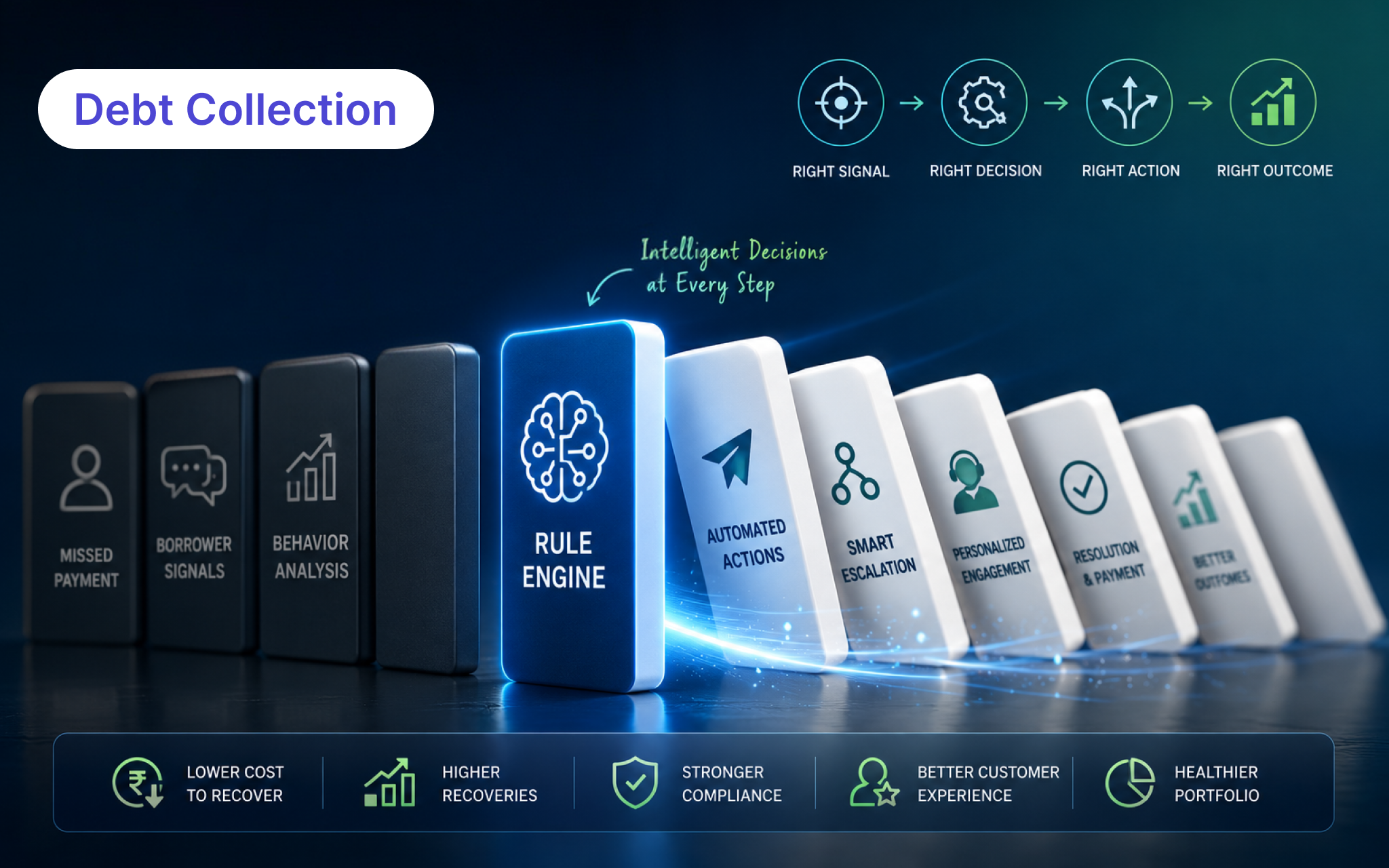
The Rule Engine: The Brain Behind Modern Collections

At the centre of every effective debt collection strategy sits a rule engine.
A rule engine acts as the decision layer that continuously evaluates borrower behaviour and determines the most appropriate next action.
Unlike traditional collection workflows that rely on fixed timelines, modern rule engines analyse real time signals such as:
- Missed or delayed payments
- Repayment history
- Channel responsiveness
- Risk classification
- Previous collection outcomes
These signals trigger intelligent workflows automatically.
For example:
- Day 1 missed payment triggers a friendly reminder.
- No response within 48 hours triggers a WhatsApp follow up.
- Partial payment pauses escalation and initiates balance recovery.
- Repeated missed payments route the account to a senior collections officer.
The difference is significant.
Instead of treating every borrower identically, the system adapts based on behaviour and context.
Rule engines also bring consistency and governance to collection operations.
Every decision becomes:
- Traceable
- Auditable
- Repeatable
- Policy compliant
For institutions managing thousands of accounts across multiple products, this level of orchestration is becoming essential rather than optional.
From Generic Outreach to Intelligent Borrower Engagement

One of the biggest weaknesses of traditional collection approaches is generic communication.
Many lenders still segment customers primarily by DPD buckets. While useful, DPD alone tells only part of the story.
Two borrowers may both be 30 days overdue while facing entirely different circumstances.
One may have missed a payment due to a temporary cash flow issue.
The other may be showing early signs of chronic delinquency.
Treating both borrowers identically often reduces recovery effectiveness and damages customer experience.
This is where behavioural segmentation becomes critical.
Modern debt collection strategies increasingly rely on borrower intelligence that evaluates:
- Payment history
- Communication behaviour
- Risk profile
- Transaction patterns
- Product type
McKinsey research suggests that effective collections segmentation enables organisations to identify customers who require human intervention versus those who respond effectively to automated engagement, improving both recovery outcomes and operational efficiency.
The result is more personalised communication.
Instead of sending generic reminders, lenders can deliver messages that match borrower circumstances, preferred channels, and likelihood of repayment.
A mid sized NBFC incorporated behavioural segmentation into its early stage collections process.
When a borrower missed an EMI, the system sent a contextual WhatsApp reminder with a payment option rather than escalating immediately to a call centre interaction.
The borrower cleared the payment within 48 hours.
No escalation.
No agent involvement.
No unnecessary friction.
This illustrates an important reality.
Empathy and automation are not competing concepts. When implemented correctly, automation becomes one of the most scalable forms of empathy.
How Event-Driven Workflows Improve the Debt Collection Process

Even the best borrower intelligence has limited value without efficient execution.
Many collection teams still operate through fragmented workflows where borrower actions and system responses remain disconnected.
A missed payment may trigger a reminder, but follow up actions often depend on manual reviews, spreadsheet tracking, or delayed reporting cycles.
This creates operational drag.
Modern collection operations are replacing static processes with event driven workflows.
Every borrower action immediately influences the next system response.
For example:
- Missed payment triggers a reminder instantly.
- No response triggers a digital follow up.
- Partial payment initiates a revised recovery journey.
- High risk accounts route automatically to specialised teams.
The result is faster decision making and better resource utilisation.
In practice, rule-driven workflows can help collections teams respond earlier to borrower events, reduce unnecessary manual intervention, and route accounts to the appropriate treatment path.
Intelligent escalation is another important component.
Traditional escalation frameworks are typically time based.
Modern systems evaluate:
- Borrower intent
- Risk level
- Repayment behaviour
- Engagement history
- Loan characteristics
This ensures that low risk borrowers receive support while high risk accounts receive immediate attention.
The outcome is a stronger collections effectiveness index across recovery rates, operational efficiency, and compliance performance.
Closing the Loop: Turning Recovery Data into Lending Intelligence

Perhaps the most overlooked opportunity in collections is its ability to improve lending decisions.
Most organisations treat collections as the final stage of the customer lifecycle.
In reality, it should be a source of continuous learning.
Every borrower interaction provides valuable insight into repayment behaviour.
Collection systems can identify:
- Preferred communication channels
- Response patterns
- Payment intent indicators
- Escalation triggers
- Behavioural risk signals
These insights can be fed back into credit decisioning, underwriting, and portfolio management.
A leading NBFC specialising in SME lending identified a segment of borrowers who performed well during onboarding but consistently slipped into early stage delinquency.
Collections data revealed that these borrowers responded strongly to human interactions while largely ignoring digital communications.
Using this insight, the lender:
- Updated underwriting rules
- Enhanced borrower segmentation
- Adjusted engagement strategies
Within months, recovery rates improved by 11 percent while early stage delinquency declined.
This creates what many lenders are now pursuing: a self improving credit ecosystem.
Collections intelligence improves underwriting.
Underwriting improves portfolio quality.
Better portfolio quality improves recovery outcomes.
The cycle continues.
In this model, collections becomes more than a recovery function.
It becomes a strategic source of business intelligence.
The Future of Debt Collection Strategy
The most successful lenders are no longer building collections operations around call volumes, manual escalations, or larger recovery teams.
They are building them around intelligence.
Modern debt collection strategies combine behavioural segmentation, rule driven decisioning, workflow automation, and real time borrower insights to create recovery operations that are faster, more scalable, and more customer centric.
This is where platforms such as Collect.ezee can support the transformation journey. By bringing recovery automation, workflow orchestration, borrower intelligence, omnichannel engagement, and analytics-driven decisioning into the collections process, lenders can move from reactive collections toward more proactive portfolio management. These capabilities can help collections teams apply consistent strategies, respond to borrower behaviour, and improve visibility across recovery operations.”
As lending becomes increasingly digital and customer expectations continue to rise, the institutions that recover more will not necessarily be the ones that work harder.
They will be the ones that think smart.
Frequently Asked Questions
Modern debt collection strategies typically combine borrower segmentation, rule-driven decisioning, workflow automation, and appropriate communication channels. Rule engines can help lenders apply different treatment paths based on factors such as delinquency stage, borrower behaviour, repayment activity, and engagement.
Cost-to-recover can be improved by automating repeatable collection activities, prioritizing accounts based on borrower and repayment signals, and reserving agent intervention for cases that require human judgment. Rule-driven workflows can help apply these strategies consistently across larger portfolios.”
A debt collection strategy can be structured around delinquency stages, borrower characteristics, repayment behaviour, and the level of intervention required. Early-stage accounts may receive automated reminders and digital engagement, while accounts showing higher risk or limited engagement can be routed to agents or more specialized treatment paths. Escalation should follow the lender’s policies and applicable regulatory requirements.
A champion-challenger strategy compares an existing collection approach with an alternative rule, workflow, or outreach treatment. Lenders can use controlled testing across suitable borrower segments to evaluate which approach performs better before adopting a new strategy more broadly.
Effective collection strategies generally focus on better borrower segmentation, appropriate channel selection, timely intervention, and intelligent prioritization. Rule engines can help lenders translate these strategies into consistent actions based on borrower behaviour, repayment signals, and delinquency status.
Lenders should design collection strategies around applicable regulatory requirements and internal policies, including requirements governing borrower communications and recovery-agent conduct. The strategy should support appropriate escalation, maintain records of collection activity, and provide sufficient governance and auditability to help teams demonstrate adherence to applicable requirements.
Platforms such as Collect.ezee can support lenders by applying configurable rules to collection workflows, segmenting borrowers, automating actions, and routing accounts based on defined decision criteria. This can help collections teams manage treatment strategies more consistently while improving visibility and governance across recovery operations.
References
- The customer mandate to digitize collections strategies — McKinsey & Company
- The analytics-enabled collections model — McKinsey & Company
- The seven pillars of collections wisdom — McKinsey & Company
- Outsourcing of Financial Services: Responsibilities of Regulated Entities Employing Recovery Agents — Reserve Bank of India
- Creating Helpful, Reliable, People-First Content — Google Search Central
