
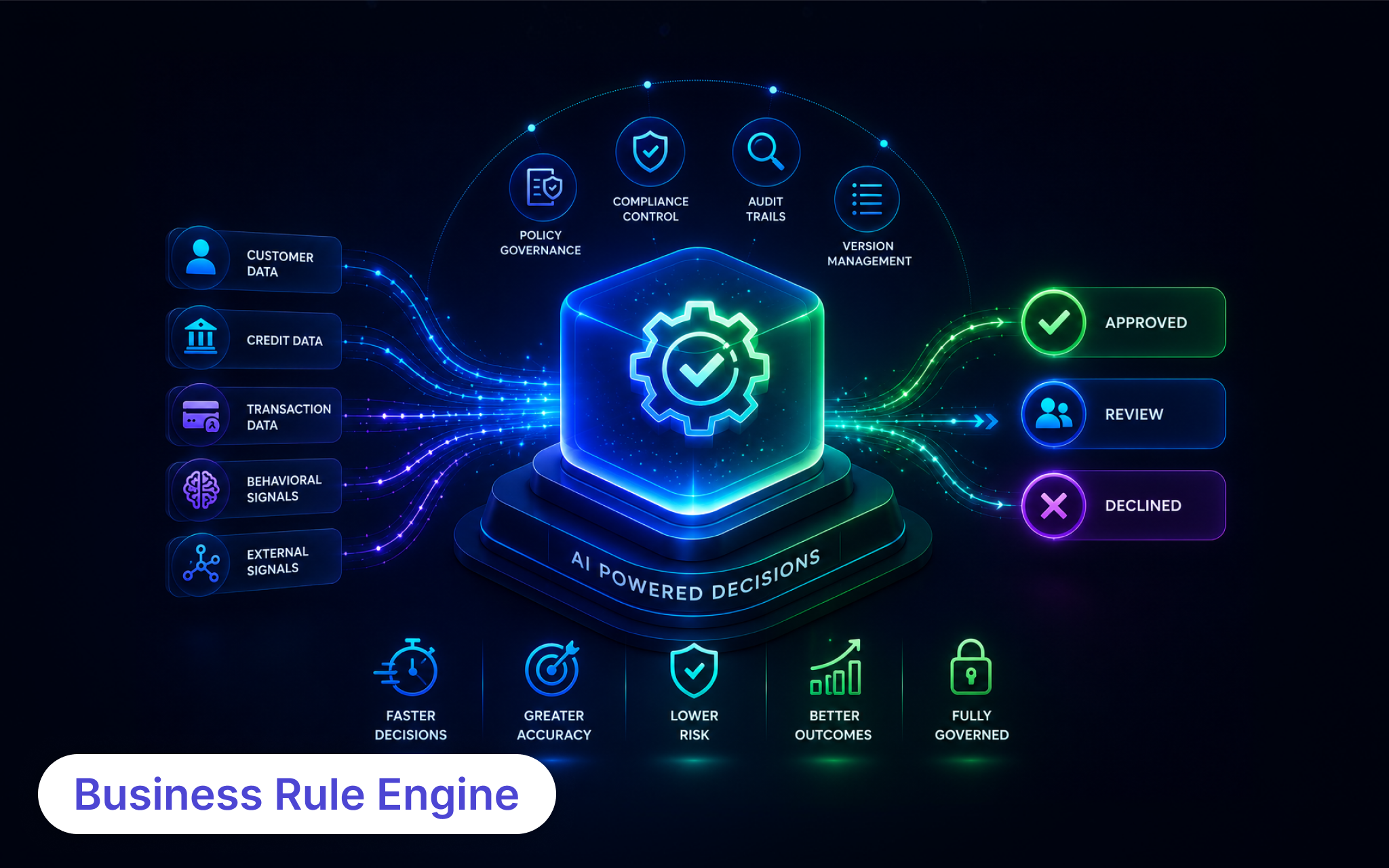
Automated underwriting is changing how financial institutions evaluate credit applications, make lending decisions, and manage risk at scale. By combining business rules, data, automated decisioning, and increasingly AI-driven analysis, automated underwriting software can evaluate applications faster and more consistently while maintaining the controls required for responsible lending.
But automation alone is not enough. Banks, NBFCs, credit unions, and other lenders need underwriting systems that can adapt to changing credit policies, explain how decisions are reached, support human oversight, and provide the governance and auditability required in regulated environments.
This is where modern automated underwriting moves beyond simple workflow automation. The underlying decisioning infrastructure, including business rules, AI models, testing, simulation, version control, and integration with existing lending systems, determines how effectively an institution can automate underwriting without losing control of its credit policies.
This article examines how automated underwriting works, the technologies that support it, and the capabilities lenders should consider when building or modernizing an enterprise underwriting environment.
The Credit Conundrum: Volume, Complexity, and the Need for Speed

Lenders today have access to more data than ever before, from transaction patterns and behavioural signals to alternative data sources and real time financial activity. Yet underwriting decisions often remain slow, fragmented, and difficult to scale.
The problem is not a lack of data. It is the inability to convert insight into consistent, explainable, and real time decisions.
Across many institutions:
- Decision logic remains buried in code, making policy changes slow and IT dependent.
- Rules are scattered across spreadsheets, emails, and disconnected systems.
- Legacy platforms struggle to support new products, customer segments, and regulatory requirements.
- Manual reviews and exception handling continue to create operational bottlenecks.
At the same time, risk conditions are changing faster than ever. Economic uncertainty, shifting borrower behaviour, and evolving regulatory expectations require lenders to adapt credit policies continuously. Customers expect instant decisions, regulators demand explainability, and business teams need the agility to launch and refine products quickly.
This is why automation alone is no longer enough.
Many lenders have automated workflows, but they still struggle with opaque decision logic, complex approval paths, and limited governance. Speed without transparency simply creates new forms of risk.
A more mature approach is to place governed decision logic at the centre of underwriting. This requires structured credit risk assessment capabilities so lenders can translate borrower information and risk thresholds into consistent underwriting decisions.
This means:
- Centralised and transparent credit policies.
- Business led rule management without coding dependency.
- Simulation and testing before deployment.
- Traceability for audits, compliance, and risk oversight.
- Controlled handling of exceptions and policy variations.
In this model, automation becomes the outcome, not the strategy.
The challenge, then, is not simply processing more applications faster. Lenders need to automate underwriting decisions while retaining control over credit policy, risk thresholds, exceptions, and auditability. That requires decisioning infrastructure that can translate changing underwriting policies into consistent, executable logic—without making every policy change a technology project.
The Business Rules Engine Behind Automated Underwriting

Modern decisioning replaces fragmented hardcoded logic with configurable, reusable, and governed business rules.
For years, credit policy lived in code, spreadsheets, and disconnected systems. Risk models sat in one platform, eligibility rules in another, while exceptions were managed through emails and manual workarounds.
That approach can no longer support the speed and complexity of modern lending.
Today, lenders must respond quickly to changing risk conditions, regulatory requirements, and customer expectations. If every policy change requires developer intervention, decision making becomes a bottleneck. This is why modern automated underwriting software is increasingly built around flexible decision layers rather than hardcoded workflows.
Putting Credit Policy Back in Business Hands
A modern Business Rules Engine allows credit and risk teams to build, test, and deploy policies without coding.
Instead of waiting weeks for changes:
- Rules can be configured and updated directly by business users.
- New product variants can be tested before deployment.
- Policy changes move from weeks to hours.
Credit scoring software can complement this rule-management layer by applying scoring models and borrower risk signals within the broader underwriting process.
The result is greater agility without compromising governance.
Automated underwriting is therefore not only about automating individual underwriting tasks. It is about governing the decision logic that determines how applications are evaluated, routed, approved, declined, or escalated. Credit decisioning software can provide the governed decision layer needed to apply these policies consistently across lending workflows.
Making Credit Decisioning Transparent
Legacy systems often make it difficult to explain why a lending decision was made.
Modern decision platforms provide:
- Complete visibility into decision logic.
- Version controlled policies and rule changes.
- Traceable overrides and audit trails.
- Explainable outcomes for regulators and internal stakeholders.
This transforms credit decisioning from a black box into a governed business capability.
Replacing Spreadsheets with Executable Logic

Executable decision logic provides a controlled alternative to fragmented spreadsheet-based credit policy management.
Many institutions still rely on spreadsheets to manage critical credit policies. Industry research suggests more than 60 percent of banks continue to use spreadsheets for core decision logic, creating challenges around consistency, governance, and scalability.
Modern automated underwriting software replaces these static processes with executable logic that operates in real time. Policies are versioned, approvals are governed, and every decision follows a single source of truth.
Building Strategic Lending Infrastructure
Many institutions are increasingly treating decision engines as strategic infrastructure rather than standalone technical features. They can support faster product launches, stronger governance, and more consistent lending outcomes.
The shift from policy in spreadsheets to policy as configuration represents more than a technology upgrade. It enables lenders to combine agility, control, and intelligence at scale, turning data into faster, smarter, and more explainable decisions.
AI-Assisted Automated Underwriting: Pre-Built Models, Rule Suggestions & Human Control

AI-assisted underwriting can combine pre-built models and rule suggestions with human oversight across credit decisioning.
Modern automated underwriting increasingly combines pre-built decisioning expertise, AI-assisted analysis, and human oversight. The objective is not to replace underwriting judgment, but to give credit teams a more efficient way to apply policy, identify patterns, evaluate changes, and govern decisions at scale.
Pre-Built Models: Accelerating Underwriting Configuration
Leading rule engines, integrated with pre-integrated lending platforms with built-in intelligence, now come with industry-specific templates and pre-configured rule sets that dramatically accelerate implementation. Instead of building credit logic from zero, risk teams can start with pre-configured models that reflect:
- Product-specific eligibility frameworks (personal loans, auto loans, credit cards)
- Industry benchmarks for income verification and affordability checks
- Regulatory-compliant documentation and KYC rule sets
- Common exception handling pathways for edge cases
This allows institutions to customize rather than create, potentially reducing implementation time while maintaining control over the final configuration.
AI Rule Suggestions: Augmented Intelligence in Action
The next frontier in automated underwriting combines human expertise with machine intelligence. Today’s advanced platforms offer:
- Pattern detection across historical approvals and denials
- AI-suggested rule refinements based on portfolio performance
- Predictive rule execution that improves accuracy over time
- Machine learning that fine-tunes rules based on outcomes and feedback
This does not replace human judgment; it enhances it. Automated underwriting software allows credit teams to review suggestions, test combinations, and implement only what aligns with institutional risk appetite and strategy.
Where lenders also use non-traditional financial signals, alternative credit scoring can provide additional inputs for evaluating borrowers within the governed underwriting process.
Human Oversight and Governance
Even as automation advances, the most sophisticated lenders recognize that human oversight remains essential. Modern rule engines provide:
- Clear visibility into every decision path
- Ability to override automated decisions when necessary
- Simulation environments to test rule changes before deployment
- Granular version control to track who changed what and when
This governance layer ensures that while machines may suggest and execute, humans remain firmly in control of credit strategy and policy direction.
The Automated Underwriting Workflow: Rules, AI and Human Oversight
The most effective lending institutions have moved beyond the false choice between human or machine intelligence. Instead, they’ve created a new paradigm:
- Credit experts define strategy and risk appetite
- Pre-built models provide the foundational rule structure
- AI continuously suggests refinements based on outcomes
- Human teams review, test, and govern the evolving system
This approach combines the scalability and consistency of automation with human oversight, allowing lenders to improve decisioning efficiency without removing accountability from the underwriting process.
The objective is not to replace underwriting judgment with automation, but to use technology to amplify human expertise while maintaining appropriate control over credit policy and decisioning.
Explainability in Automated Underwriting: Making Lending Decisions Transparent

A traceable decision framework records the data, rules, logic, and audit history behind an automated underwriting outcome.
Lending decisions are judged not only by speed, but also by how clearly institutions can explain the factors and logic behind each decision.
Customers expect fair and understandable decisions. Regulators and internal governance teams require appropriate transparency and oversight. Business and risk leaders need confidence that automated decisions are consistent, explainable, and governed. OECD research on AI in finance highlights explainability, governance, transparency, and human oversight as critical requirements for financial institutions deploying automated decision systems.
This is why explainability has become a core requirement of modern credit decisioning.
Why Explainability Matters
As lending becomes more automated, many institutions struggle to trace the logic behind approvals, declines, and exceptions. Rules evolve, products multiply, and decision paths become harder to monitor.
The risk is clear: what starts as efficiency can quickly become an audit, compliance, or customer trust issue.
Regulatory and legal requirements around fair lending, consumer rights, data protection, recordkeeping, and explainability vary by jurisdiction. For financial institutions, automated underwriting therefore needs appropriate controls for decision traceability, documentation, human oversight, and regulatory review. Industry research also shows that 81 percent of financial institutions now rank explainability among their top technology priorities.
What Real Explainability Looks Like
A governed Business Rules Engine makes decision logic visible and accountable.
Key capabilities include:
- Version controlled rules with complete change history.
- Transparent logic accessible to business and risk teams.
- Traceable approvals, declines, and overrides.
- Automated audit trails with user, timestamp, and decision records.
- Simulation and testing environments before deployment.
- Full reproduction of decisions using the original data and rule set.
Instead of living in code or spreadsheets, decision logic becomes a governed asset. Credit decision software can support this approach by making decision logic, rule versions, approvals, overrides, and audit information easier to manage within the lending decision process.
The Business Impact
Explainability delivers value far beyond compliance.
- Risk teams can identify and improve underperforming rules.
- Product teams can test policy changes with confidence.
- Operations teams can resolve customer queries faster.
- Compliance teams can respond to audits without manual investigation.
Improved decision visibility and outcome-level traceability can also help institutions resolve borrower queries more efficiently by making the factors behind decisions easier to review.
From Compliance Requirement to Competitive Advantage
When decision logic is transparent, governed, and measurable, institutions gain more than audit readiness. They gain trust, agility, and control.
As lenders expand digital products, introduce dynamic pricing, and adopt advanced automation, the ability to explain every decision becomes a strategic advantage.
In modern lending, explainability is not a feature layered onto automation.
It is the foundation that makes automation trustworthy.
Testing, Simulation, and Shadow Decisioning in Automated Underwriting
In lending, policy should never be tested on customers.
As institutions deploy new underwriting strategies across products, regions, and customer segments, the challenge is balancing speed with control. This is why simulation, variant testing, and shadow decisioning are important components of governed automated underwriting.
Why Validation Matters
Legacy environments often pushed rule changes directly into production with limited visibility into their impact. That approach is increasingly risky in a world of stricter regulation, higher customer expectations, and more complex credit portfolios.
Mature decisioning environments validate new rules before deployment by:
- Testing against historical data.
- Comparing outcomes against existing logic.
- Stress testing different risk scenarios.
- Reviewing results with risk, product, and compliance teams.
This reduces uncertainty and improves confidence in every policy change.
Simulation in Action
A large bank expanding unsecured lending into new markets created region specific rule variants covering eligibility, documentation, and credit thresholds.
By simulating these rules against historical applications, the bank identified a potential increase in rejection rates for a key borrower segment before launch. The issue was corrected before deployment, avoiding customer impact and costly post-launch changes.
The Power of Shadow Decisioning
Shadowing allows lenders to run new decision logic alongside live production rules without affecting customer outcomes.
One digital lender tested a new risk segmentation strategy through a parallel decision path. The analysis provided evidence on how the new logic could affect default rates without materially changing approval outcomes.
With evidence in hand, the institution deployed the strategy confidently and with full stakeholder support.
Controlled Experimentation at Scale
A/B testing allows lenders to evaluate new data sources, policies, and underwriting approaches in a controlled environment.
In one case, a fintech tested alternative data for younger borrowers. Compliance considerations limited broader deployment, but the experiment provided evidence for targeted use cases.
Governance Enables Agility
The most mature lenders understand that speed comes from discipline, not shortcuts.
Simulation, testing, and shadowing create a safety net that allows institutions to innovate faster, deploy policies with confidence, and continuously improve underwriting outcomes.
In modern automated underwriting software, governance is not a barrier to agility. It is what makes agility possible.
Agile Product Rollouts in Automated Underwriting: Rule Variants
In an industry where product cycles have traditionally been measured in months, the ability to launch and fine-tune credit offerings more quickly can provide a significant operational advantage.
Modern lenders are no longer treating credit products as monoliths. They are designing them as modular structures, governed by business rules that can be adjusted, duplicated, and adapted in real time. At the core of this agility is the ability to build and deploy rule variants.
Rule variants allow institutions to respond to regulatory shifts, market changes, and segment-specific requirements, without rewriting or rebuilding from scratch. And for banks and NBFCs operating across geographies or customer types, this capability is becoming central to growth.
The Case for Variants: More Than Just Speed
Every credit product, whether it is a personal loan or a working capital line, faces three realities:
- Regulations vary by region
- Customer expectations differ by demographic
- Internal thresholds shift with evolving risk appetite
Managing all of these through a single rule set can become difficult at scale. But maintaining separate logic stacks creates overhead, duplication, and inconsistency.
That is where variants come in. They allow institutions to:
- Reuse core rules while layering contextual changes
- Create segment-specific paths for pricing, eligibility, and documentation
- Test and deploy new rule versions without affecting live flows
- Roll out limited pilots and scale only when results are proven
And most importantly, they can do this without requiring changes to the underlying platform for every policy variation.
Use Case 1: Launching Region-Specific Lending in 48 Hours
A bank preparing to expand its digital loan offering into three new states using low-code platforms enabling rapid deployment was able to roll out customised variants for each geography – adjusting only the regulatory rules and alternate data requirements. The core risk logic, documentation checks, and approval flows remained unchanged.
Using governed automated underwriting software with variant management, each rollout was completed in under 48 hours — including internal review and simulation testing. What would have taken weeks of reengineering was now handled as a controlled configuration update.
Use Case 2: Creating a New Product Line Without Disrupting the Stack
An NBFC servicing MSMEs wanted to introduce a fast-track credit line for repeat borrowers with good repayment history. Rather than build a new product, they created a variant of their existing underwriting logic with adjusted eligibility, auto-approval conditions, and lighter documentation rules.
The entire variant was deployed into a pilot flow without touching the main rule set — and with full audit visibility and rollback controls. Based on pilot success, the variant was then scaled to other qualified segments. The institution avoided duplication and maintained unified governance across both product paths.
Use Case 3: Testing Rule Sensitivity Before Go-Live
A credit card issuer developed two new variants of its decision logic for younger applicants — one more lenient on income history, another more aggressive on spending thresholds. Rather than choose one, they deployed both into parallel test environments and simulated outcomes across historical data.
After comparing predicted approval rates, projected credit loss, and operational load, the team chose the best-fit variant and deployed it with confidence — all within a week. The agility came not from building faster, but from testing and governing the decision logic before deployment.
From Speed to Strategy
Agile rollout is not just about moving fast. It is about moving intelligently, with safeguards in place.
- Variant rules are tracked, versioned, and tied to outcomes
- Business teams can create, test, and update logic without writing code
- Compliance has full visibility into which rule was applied and why
- Product teams can scale pilots only after performance is validated
This capability is especially important as customer preferences, regulatory landscapes, and economic conditions shift rapidly. Institutions that cannot adapt their logic efficiently may face costly delays or increased reliance on manual workarounds.
Those that can adapt through governed rule variants are better positioned to respond to changing lending requirements.
Bridging LOS, Core, and CRM: The Role of a Universal Business Rules Engine
One of the biggest challenges in modern lending is not creating smarter rules. It is ensuring those rules are applied consistently across every system.
Most institutions operate with a Loan Origination System (LOS), Core Banking System, and CRM. Yet decision logic often remains fragmented across these platforms, creating inconsistencies, manual intervention, and compliance risk.
Where Decisions Break Down
Consider a business loan application.
The LOS evaluates eligibility using one set of rules, the core system applies different risk parameters, while the CRM continues promoting offers based on outdated customer information.
The result is conflicting decisions, poor customer experiences, operational inefficiencies, and audit challenges.
Even strong policies fail when they are executed differently across systems.
The Case for a Universal Business Rules Engine
A universal Business Rules Engine creates a single decision layer across LOS, Core, and CRM. A credit decision engine can operate within this architecture to apply eligibility criteria, risk parameters, and decision policies consistently across connected lending systems.
This enables:
- Centralised decision logic across channels and products.
- Real-time rule updates across connected systems.
- Consistent outcomes regardless of touchpoint.
- Alignment between customer engagement, underwriting, and compliance.
Instead of multiple systems making isolated decisions, the institution operates from one governed source of truth.
Business Impact
The benefits extend far beyond technology.
Consistent customer experience
Customers receive the same outcome whether they engage through a branch, mobile app, partner channel, or campaign.
Faster policy deployment
Policy updates can be implemented once and propagated across connected systems through the central decision layer.
Reduced operational burden
Manual reconciliations, overrides, and correction cycles can be reduced.
Stronger compliance
Institutions gain end-to-end visibility into how decisions were made across the customer journey.
Why It Matters for Modern Lending
As lending becomes more digital and products become more specialised, institutions need orchestration rather than isolated automation.
A universal Business Rules Engine ensures that credit decisioning remains consistent, explainable, and scalable across the enterprise. It reduces complexity, strengthens governance, and gives institutions the agility to launch products, adapt policies, and manage risk with confidence.
In an environment where decisions happen everywhere, governance cannot live anywhere. It must live at the centre.
The No-Code Decision Lab: Empowering Business Teams to Manage Decision Logic

A no-code decision environment enables business teams to build, test, simulate, and deploy governed lending decision logic.
One of the most important shifts in decisioning is organizational: banks and NBFCs are increasingly looking to give credit, risk, and product teams greater control over decision logic. These teams bring direct knowledge of customers, markets, products, and risk, while technology teams remain responsible for the underlying platforms, integrations, security, and technical governance.
This is the rise of the no-code decision lab, a model where credit, risk, and product teams can build, test, and deploy decision logic through governed interfaces, reducing reliance on application development for routine policy changes.
For institutions operating in complex, regulated, and fast-moving environments, this shift can improve strategic agility by shortening the path from policy change to controlled implementation.
The Problem With Traditional Ownership Models
In many institutions, decision logic is embedded in application code, configuration files, or spreadsheets maintained by technical teams. Approval thresholds, documentation checks, segment definitions, and product pricing may therefore require technical changes before they can be updated in production.
This creates a bottleneck:
- Business teams must translate policies into technical requirements
- IT teams interpret and implement logic in code
- Any change, no matter how small, requires deployment cycles
- Testing is siloed, and rules often go live without contextual feedback
The consequences are slow response times, misaligned logic, rising technical debt, and a growing disconnect between credit strategy and execution.
The No-Code Paradigm: Reclaiming Ownership
In a no-code decision lab, the logic is separated from the platform. It is brought into a governed layer — one where business users can access, design, simulate, and publish rules using visual interfaces, templates, and controlled workflows.
The impact of this shift is dramatic:
- Credit teams define eligibility logic directly
- Risk officers simulate new rule outcomes across historical portfolios
- Product leads build campaign-specific pricing paths or auto-approval flows
- Compliance signs off via structured approvals — with full visibility into what will go live
This is not about removing oversight. It is about placing authority closer to expertise. It allows institutions to move faster without compromising control — because the system enforces governance, versioning, and auditability in every step.
Strategic Benefits for Institutions Ready to Scale
No-code decisioning is more than a technical capability. It can change how institutions manage and govern decision logic across business and technology teams. Key potential benefits include:
- Faster time to market: New products and rule variants can be configured and deployed more quickly, shortening innovation cycles
- Lower operational risk : Less reliance on manual workarounds or spreadsheet-based rule tweaks
- Improved policy alignment : Strategy and execution live in the same hands, reducing misinterpretation
- Higher audit readiness : Rule changes are versioned, reviewed, and traceable — by design
- Stronger collaboration across teams : Risk, product, and compliance work inside the same system, not across silos
- Governed agility : Flexibility increases, but always within controlled access and publishing workflows
For growing institutions, especially those operating across jurisdictions or multiple product lines, the ability to scale policy control while reducing dependency on application code can support long-term operational agility.
The Mindset Shift That Unlocks Scale
What makes the no-code model compelling is not just that it’s faster. It is that it unlocks the full expertise of the institution.
When rule management sits with the people closest to the customer, the market, and the risk — decisions become sharper, faster, and more relevant. And when governance is built in, those decisions remain consistent, auditable, and secure.
It is no longer a question of whether business teams should build. It is a question of how easily and confidently they can do it.
That is why institutions using no-code decisioning platforms empowering business teams can build and manage underwriting logic more efficiently while maintaining governance, auditability, and control as the business scales.
Open Source vs. Enterprise Decisioning: Beyond the Initial Cost
For institutions evaluating decisioning platforms, cost is an important consideration. The comparison often comes down to open-source tools versus enterprise-grade solutions, but the initial licence or implementation cost is only one part of the decision.
Open-source tools may have a lower initial acquisition cost, but the total cost of ownership can also include integration, maintenance, governance, support, and risk management.
What You Save Upfront, You May Pay Downstream
Open-source decision engines may require significant in-house effort for integration, configuration, rule modelling, testing, governance, and ongoing maintenance. Depending on the project and available expertise, organizations may also need to build or integrate their own support, security, and governance processes.
This leads to:
- Potentially longer deployment cycles
- Greater dependence on internal development resources
- Additional tooling or manual processes for simulation and auditing
- Additional work to establish a unified rule lifecycle and compliance controls
Enterprise platforms typically provide structured workflows, version control, simulation capabilities, role-based access, and governance features within an integrated platform, reducing the need to assemble these capabilities independently.
What CIOs and Risk Leaders Need to Consider
The initial cost advantage may be offset by:
- Potentially higher or less predictable maintenance costs
- Additional compliance and governance responsibilities
- More effort to scale across teams and product lines
- Additional effort to adapt to regulatory or market changes
The total cost of ownership can increase when institutions must build and maintain integration, governance, testing, security, and support capabilities around an open-source decision engine.
That time impacts both agility and risk posture.
What Matters More Than Price
For institutions that must prove governance, scale rapidly, or shift strategy often, the question becomes:
Is this platform built for transformation or just execution?
If the goal is to launch faster, adapt safely, and govern confidently, platform cost should be evaluated alongside the potential costs of misalignment, rework, operational inefficiency, and non-compliance.
Enterprise platforms built on enterprise-grade architectures with built-in governance provide not just tools, but decisioning discipline. That becomes particularly valuable when the stakes involve regulatory compliance, reputation, or revenue.
Measuring What Matters: The ROI of Governed Decisioning
In lending, every decision carries a cost. The value of a governed decisioning platform lies in controlling that cost while improving speed, consistency, and risk outcomes.
The returns typically appear across four areas:
Faster Time to Market
When credit policy moves from spreadsheets and code into a governed decision layer:
- Policy updates can move from weeks to days.
- Rule changes can be tested and deployed in hours.
- New products and regional variants can launch faster.
The result can be faster product deployment and greater responsiveness to changing market conditions.
Lower Operating Costs
Traditional decision changes often require IT intervention.
With business teams able to configure, test, and publish governed logic through controlled workflows:
- Technology dependency decreases.
- Rule management becomes faster.
- Support and maintenance effort falls.
The potential impact includes lower policy-management overhead by reducing manual rule maintenance, technology dependency, and repeated change cycles.
Compliance and Audit Efficiency
Effective governance can reduce the effort required for audits, remediation, and compliance reviews.
- Every rule version is traceable.
- Overrides and exceptions are logged automatically.
- Audit evidence is available on demand.
This can reduce the effort required to prepare audit evidence while improving regulatory readiness.
Better Credit Outcomes
Continuous testing and policy visibility can help risk teams identify opportunities to improve portfolio performance.
- Underperforming rules are identified faster.
- High risk segments can be isolated and refined.
- Shadow testing enables experimentation without directly changing production decision outcomes.
Over time, these capabilities can support stronger credit quality and help reduce avoidable losses.
Decisioning Is Now Strategy: Are You Leading or Following?

Automated underwriting software brings together risk models, business rules, AI insights, governance, compliance, and human review.
Historically, credit policy often lived inside spreadsheets, workflows, and application code.
Today, decisioning is increasingly becoming an operating layer of lending. It influences how quickly products launch, how consistently risk is managed, and how effectively institutions respond to regulatory requirements.
Almost every lending priority now depends on decisioning:
- Faster launches require policy changes without long release cycles.
- Stronger risk control requires governed rules, testing, and outcome visibility.
- Regulatory readiness requires version control, audit trails, and explainable decisions.
Yet many lenders still operate with decision logic fragmented across systems, teams, and manual processes. This can result in slower execution, inconsistent decisions, and greater operational complexity.
Leading institutions are increasingly approaching decisioning differently. They treat credit policy as a governed asset that can be tested before deployment, measured after execution, and continuously refined using real outcomes.
A modern decisioning layer can sit between data, systems, and outcomes, enabling institutions to build, test, deploy, and govern policy logic from a single environment with greater visibility and control.
Competitive advantage in lending will increasingly depend not on data alone, but on the ability to convert data into faster, more consistent, and more explainable decisions.
When credit policy becomes measurable, governed, and adaptable, decisioning stops being an operational function.
It becomes a strategic advantage.
Frequently Asked Questions
Automated underwriting software uses predefined rules, data, and models to evaluate borrower eligibility and credit risk, while manual underwriting relies primarily on human review of application information, documents, and policy criteria.
The main approaches are:
- Manual underwriting: Underwriters review applications, financial information, and supporting documents against lending criteria.
- Automated underwriting: Software evaluates application and credit data against predefined rules, models, and eligibility criteria.
- Hybrid underwriting: Automation handles standardized cases while human underwriters review exceptions or more complex applications.
Underwriting means assessing a borrower’s ability and likelihood to repay using financial information, credit data, supporting documents, and lending policy criteria. Automation can streamline this process by orchestrating bureau checks, KYC validation, document processing, and eligibility rules, reducing manual handoffs and accelerating decisioning in digital lending workflows.
- More consistent decisioning: Rules and policy logic can be applied consistently across applications.
- Lower manual effort: Automated validation and decision workflows reduce repetitive manual processing.
- Higher operational capacity: Straight-through processing can allow teams to handle greater application volumes without proportionally increasing manual workload.
- Faster processing: Automated data validation, eligibility checks, and decisioning can reduce processing time and associated operational effort.
Automated underwriting can shorten approval times by running bureau checks, income validations, and eligibility rules through automated workflows rather than relying entirely on sequential manual reviews. When integrated with a loan origination system (LOS), the underwriting platform can receive application data, evaluate decision rules, and return outcomes through APIs, reducing manual processing and turnaround time.
There is no single average ROI for automated underwriting software. ROI depends on factors such as application volume, current processing costs, automation coverage, integration effort, approval turnaround time, and the reduction in manual work and rework. Financial institutions should evaluate ROI using their own baseline costs, volumes, turnaround times, and operational objectives.
Financial institutions should evaluate vendors based on integration capabilities, business rules flexibility, decisioning and workflow capabilities, auditability, security, scalability, implementation requirements, and support. They should also test decision performance using representative lending scenarios and confirm that the platform supports their applicable regulatory and compliance requirements.
Automated underwriting platforms integrate with LOS through APIs that exchange application data, bureau responses, and decision outcomes. When a borrower submits details, the LOS triggers the underwriting evaluation, receives approval or decline signals, and routes the case for disbursal or manual review.
Automated underwriting platforms can support fraud detection by cross-validating identity information, device signals, credit data, and other available risk indicators during evaluation. Real-time validation can flag inconsistencies for review before a lending decision is finalized, helping reduce potential downstream fraud exposure.
Lenders can transition by first documenting existing underwriting policies and decision rules, identifying suitable processes for automation, and piloting automated decisioning on a controlled portfolio. They can then refine rules based on outcomes, establish governance and exception-handling processes, train relevant teams, and gradually expand automation across products and lending segments.
References
- OECD. Artificial Intelligence, Machine Learning and Big Data in Finance: Opportunities, Challenges and Implications for Policy Makers.
Read the OECD report
Supports: AI adoption in finance, opportunities and risks, financial stability, consumer protection, and responsible AI. - Consumer Financial Protection Bureau (CFPB). Adverse Action Notification Requirements in Connection With Credit Decisions Based on Complex Algorithms.
Read the CFPB Circular
Supports: explainability, adverse-action reasons, and the application of credit-decision requirements when complex algorithms or AI are used. - National Institute of Standards and Technology (NIST). Artificial Intelligence Risk Management Framework (AI RMF 1.0).
Read the NIST AI RMF
Supports: AI risk management, trustworthy AI, governance, transparency, explainability, and responsible AI implementation. - European Commission. Data Protection in the EU.
Read the European Commission guidance
Supports: data protection, personal-data processing, and GDPR-related considerations relevant to automated lending systems. - Federal Trade Commission (FTC). Fair Credit Reporting Act.
Read the FTC — Fair Credit Reporting Act
Supports: the article’s discussion of credit information and regulatory considerations around consumer credit reporting.
