
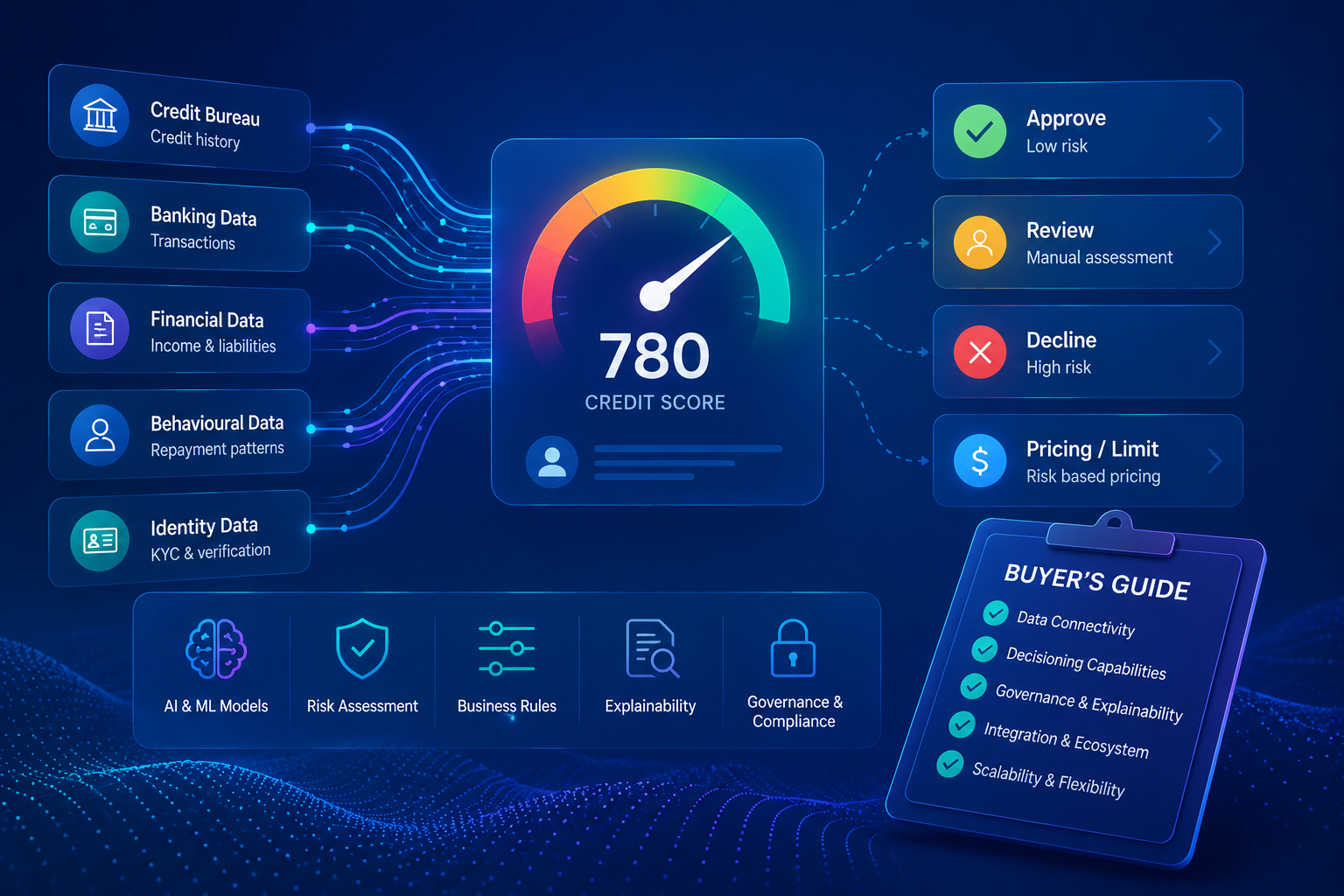
Lending has entered a phase where a credit score alone cannot carry the weight of a lending decision. Borrower behaviour is more dynamic, data sources are multiplying, and lenders are expected to respond faster without loosening risk controls. Credit scoring software is therefore evolving from a scoring mechanism into a decision infrastructure that connects data, risk intelligence, policy and action.
The shift matters because better models do not automatically create better lending outcomes. The real advantage comes from how quickly and consistently a lender can turn risk signals into a controlled decision.
This guide examines the capabilities, benefits, architecture and buying criteria lenders should consider when evaluating modern credit scoring software.
1. From Credit Scores to Credit Intelligence
A conventional score answers a narrow question: how likely is this borrower to repay?
Modern lending needs a broader answer.
Should the application be approved? At what limit? At what price? Should additional verification be triggered? Should the case go straight through or to manual review? And what happens when the borrower’s risk changes after disbursement?
This is where credit scoring software starts to intersect with decisioning.
Instead of treating a score as the endpoint, lenders can use bureau data, banking information, financial statements, behavioural signals, identity information and alternative data to build a broader risk view. That intelligence can then feed eligibility, pricing, approval paths and downstream workflows.
The distinction is important: scoring measures risk; decisioning operationalises it.
2. Why the Credit Scoring Architecture Matters
The technology surrounding the score increasingly determines its value.
A modern credit scoring platform should connect four layers: data, intelligence, policy and execution. Data supplies the signals. Models interpret them. Policy determines how those signals should affect a decision. Execution moves the outcome into the systems that act on it.
This architecture also addresses a common modernisation problem: lenders do not necessarily need to replace their entire technology stack to improve decisioning.
A decision layer can connect with existing LOS, LMS, CRM and core systems through APIs, allowing institutions to introduce new scoring strategies without creating another isolated workflow.
Decision.ezee follows this architecture by connecting lending data and AI generated inputs to governed rules and returning eligibility, risk bands, pricing and approval paths, supported by execution logs and audit trails.
The strategic question is therefore not simply “How accurate is the score?” It is “How effectively can the organisation use it?”

3. The 7 Capabilities That Matter Most
The strongest credit scoring software is defined less by the number of features it lists and more by what those capabilities enable.
1. Multi model scoring
Different products, borrower segments and risk appetites may require different credit scoring models. A modern credit scoring platform should support multiple models and strategies, allowing lenders to apply the right approach to different lending contexts rather than forcing every application through the same scorecard.
2. Alternative data intelligence
Banking, cash flow, tax and other permitted signals can strengthen credit risk assessment where traditional bureau information is incomplete. Modern credit scoring software should be able to incorporate relevant alternative data alongside conventional credit information without creating disconnected assessment processes.
3. Real time risk assessment
Current information can provide a more relevant view than a static snapshot. Real time credit risk assessment can help lenders evaluate applications using the latest available borrower and financial signals, supporting faster and more responsive credit decisioning.
4. Configurable decision logic
Credit policies need to be translated into rules, thresholds, routing and exception paths. A configurable credit decisioning platform should allow business teams to adapt decision logic without rebuilding the application or depending on a software release for every policy change.
5. Explainable decisions
Risk teams need to understand the factors behind automated credit decisions and reproduce outcomes when required. Explainability should extend beyond the score to the data, rules and policy logic that influenced the final lending decision.
6. Testing and challenger capabilities
New credit scoring models and decision strategies should be tested against existing approaches before production deployment. Champion challenger testing can help lenders evaluate whether a new model or policy performs better before making it the production standard.
7. Continuous risk monitoring
Credit risk intelligence should remain useful after origination rather than stopping once a loan is booked. Changes in borrower behaviour, financial information or external risk signals can create new inputs for credit risk monitoring, portfolio management and subsequent lending actions.
4. AI Credit Scoring: Beyond Better Prediction
The next stage of AI credit scoring is not simply replacing a traditional scorecard with a machine learning model. It is about expanding the range of signals that can inform a decision while keeping those decisions governed.
AI can analyse patterns across financial behaviour, documents, transactions and other permitted signals that may be difficult to evaluate manually at scale. That can support more granular risk segmentation and potentially improve access for borrowers with limited traditional credit histories.
The momentum is substantial. Experian’s 2026 global research, covering more than 800 senior decision makers across 12 countries, found that 73% of financial institutions are prioritising real time decisioning. The same research found 86% consider transparency critical to improving decisions.
But intelligence without governance creates another problem.
PwC’s 2026 Consumer Lending Radar found that 85% of borrowers trust lenders more when AI use is disclosed upfront, while 74% are concerned about AI making lending decisions.
The implication is clear: AI needs to operate within a framework of explainability, policy controls, human oversight and auditability.
5. From Faster Approvals to Better Lending Economics

The case for automated credit scoring should not begin and end with faster approvals.
Speed matters because delays can create abandonment and increase the cost of acquisition. But the larger opportunity is improving the economics of every decision.
Grow: Better risk differentiation can help lenders identify viable borrowers who might otherwise be declined through broad or inflexible credit policies.
Protect: More granular credit risk assessment can help distinguish different levels of borrower risk rather than applying the same treatment to every applicant.
Accelerate: Automated credit assessment can reduce repetitive manual intervention and shorten decision cycles, allowing teams to focus on cases that require deeper review.
Optimise: Reusable scoring models, rules and decision logic can reduce operational effort across products and lending channels while making policy changes easier to implement consistently.
Control: Consistent execution of credit policies can strengthen governance by reducing fragmented manual interpretation and creating a more traceable decision process.
This is the difference between automation for efficiency and automation that changes the economics of lending.
6. Why Continuous Risk Intelligence Is the Next Step
The traditional lending journey ends its scoring story at origination:
Application → Score → Decision → Booking
But risk does not stop when the loan is booked.
Modern credit risk scoring can extend into behavioural assessment, portfolio monitoring and early warning. Repayment behaviour, updated financial information, bureau changes and portfolio trends can create new signals that influence limits, renewals, pricing, customer engagement or collections.
This makes the value of credit scoring software increasingly lifecycle oriented.
The same principle appears in ezee.ai‘s wider architecture. Lend.ezee supports connected origination stages, while Collect.ezee uses behavioural signals, delinquency tracking, right time and right channel intelligence and AI voice capabilities for recovery.
The opportunity is to move from asking “What was this borrower’s risk at application?” to “What does the latest intelligence tell us about this borrower now?”
7. How to Choose the Right Credit Scoring Software
Buying decisions should start with the lending strategy, not a vendor feature sheet.
Data
Can the credit scoring platform connect bureau, banking, financial, identity and alternative data sources?
Decisioning
Can scores influence eligibility, pricing, limits, approval routes and exceptions?
Governance
Can teams test, version, explain and audit models and policies?
Integration
Can the platform work with the existing LOS, LMS, core and surrounding data ecosystem?
Scalability
Can the same architecture support new products, higher volumes and new markets?
Before committing, test the platform against real scenarios: introduce a new policy, run a challenger model, simulate a portfolio, handle an unavailable data source and reproduce a historical decision.
That is where credit risk scoring technology moves from a promising capability to a dependable lending foundation.
Conclusion: The Advantage Is No Longer the Score Alone
The next competitive edge in lending will not come from producing one more sophisticated credit score. It will come from how quickly an institution can turn every relevant signal into the right decision, under the right policy, without losing control.
That changes what lenders should expect from credit scoring software. A score sitting inside an application cannot respond to changing risk, evolving policies or new data on its own. What is needed is an intelligence layer that connects bureau and financial data, AI generated insights, risk models and business rules, then turns them into decisions that are explainable, testable and auditable.
This is where decision.ezee becomes more than a scoring component. It provides a governed decision layer between connected data sources and lending systems, translating credit policies into rules, decision tables and workflows and returning eligibility, risk bands, pricing and approval paths to downstream systems. Testing, challenger management, versioning and audit trails provide the controls needed as decision logic evolves.
The strategic shift is bigger than automation. It is about moving from knowing a borrower’s risk to operationalising that intelligence across the lending lifecycle.
The lenders that build this capability will be better positioned to respond to new data, new products and new risk signals without rebuilding their decision infrastructure every time. The score may still be the signal. The real competitive advantage is what happens after it.
Frequently Asked Questions
Credit scoring software evaluates borrower risk using credit bureau, financial, behavioural and other permitted data to generate risk assessments. Modern platforms can use these assessments across eligibility, pricing and approval decisions, making scoring part of the broader lending workflow rather than the final decision.
Traditional credit scoring models primarily produce a risk score, while modern credit scoring software can combine multiple models, alternative data and real time signals. For example, a lender can use different scoring strategies for different borrower segments instead of applying one scorecard across every application.
Credit scoring software improves decision speed and consistency by automating risk assessment and applying scoring strategies and lending rules uniformly. Automation reduces repetitive manual intervention and supports faster processing, while configurable decision logic helps lenders apply policy changes consistently across applications.
Credit scoring software strengthens risk management by combining multiple risk signals and supporting continuous monitoring beyond origination. Experian’s 2026 research found 73% of financial institutions prioritise real time decisioning, reflecting the growing focus on using current data for credit decisions.
Lenders should evaluate data connectivity, model flexibility, decisioning, governance, integration and scalability. Before selecting a platform, test practical scenarios such as introducing a new policy, running a challenger model, handling unavailable data and reproducing a historical lending decision.
Credit scoring software connects data sources with AI and scoring models, then applies governed rules to turn risk signals into lending decisions. Decision.ezee, for example, acts as a decision layer between connected data sources and lending systems, supporting rules, decision tables, workflows, versioning and audit trails.
References
- https://www.experian.com/blogs/global-insights/scaling-ai-with-trusted-data-and-decisioning/
- https://www.pwc.com/us/en/industries/financial-services/banking-capital-markets/consumer-finance/consumer-lending-radar.html
- https://www.experian.in/2026/01/13/machine-learning-improving-lending-decisions-india-experian/
- https://research.finbox.in/blog/credit-underwriting-platform-india-what-to-know/
- https://www.findevgateway.org/paper/2026/05/cracking-credit-code-alternative-data-and-ai-for-financial-inclusion
