
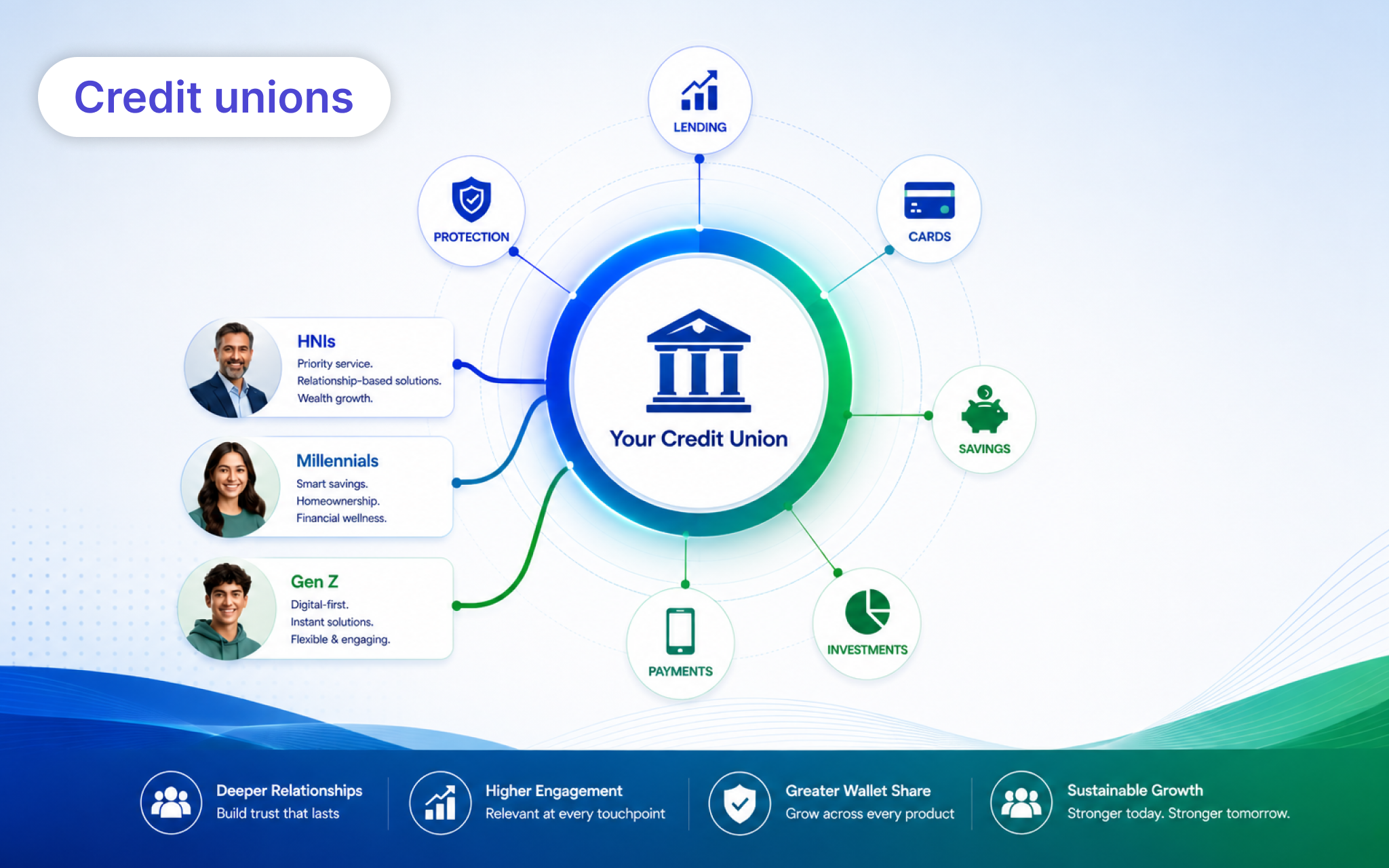
Most credit unions spend significant time discussing how to attract younger members, increase deposits, and compete with fintechs.
The bigger opportunity may already exist inside their membership base. Improving the credit union member experience for existing members often delivers greater long term value than focusing solely on acquisition.
Many institutions already serve affluent households, financially disciplined millennials, and digitally native Gen Z members. Yet these segments often receive the same onboarding journeys, product offers, and communications as everyone else. The result is a growing gap between member potential and actual credit union wallet share.
This challenge is becoming more urgent.
According to McKinsey, more than 70% of consumers now expect personalised interactions from their financial providers, while organisations that excel at personalization can generate significantly higher revenue growth than peers. For credit unions competing against fintechs and national banks, member expectations are increasingly being shaped by digital experiences outside traditional banking.
Boomers still contribute a significant share of deposits today, but millennials and Gen Z are expected to represent the majority of future financial relationships. As these groups accumulate wealth, institutions that fail to recognize and serve them differently risk becoming secondary providers while fintechs and large banks capture a greater share of their financial lives.
The solution is not simply acquiring more members.
It is understanding the value that already exists and delivering a stronger credit union member experience through data driven engagement, personalization, and intelligent journey design.
Why Traditional Segmentation Is Limiting Wallet Share

Most credit unions still segment members using age, income, location, or product ownership. While useful, these categories rarely explain behaviour.
The result is a uniform credit union member experience where affluent members, millennials, and Gen Z users often receive similar onboarding journeys, offers, and communications despite having very different needs. High value members move investments elsewhere, younger members adopt fintech tools, and relationships become increasingly fragmented.
For example, demographics might tag a group as “young family,” but behaviors reveal subgroups one saving aggressively for down payments, another leaking to peer apps. Intelligence clusters these dynamically, enabling 25-35% higher personalization accuracy. Credit unions adopting this see engagement lifts as offers align: HELOC prequals for home-improvers, not mass CD pushes, and the overall credit union member experience begins to feel far more tailored.
This is where credit union wallet share begins to erode. Members may keep a checking account with the credit union while directing lending, savings, investments, or payments to competitors. The challenge is not a lack of members. It is the inability to recognise and engage high potential members differently.
From Demographics to Behavioral Intelligence

Traditional segmentation tells institutions who a member is.
Behavioral intelligence helps explain what a member is likely to do next.
Instead of focusing solely on age or income, leading institutions increasingly evaluate:
- Spending behaviour
- Deposit growth
- Transaction patterns
- Product usage
- Digital engagement
- Financial life stage indicators
This shift creates a far richer understanding of member needs.
For example, two members in their thirties may appear identical demographically.
Behaviourally, they may be completely different.
One may be saving aggressively for a home purchase.
Another may be building a business and seeking working capital solutions.
Treating both members identically limits relevance.
Research highlighted in the original analysis suggests that behaviour based segmentation can improve personalization accuracy significantly compared with static demographic models.
This is where credit union data analytics becomes particularly valuable.
Rather than generating reports, analytics becomes a decision engine that identifies opportunities, predicts needs, and supports more relevant engagement.
The result is stronger digital banking personalization and a more responsive member experience.
Identifying Hidden High Value Members Through Data

One of the biggest opportunities for growth lies in identifying members whose value is not immediately visible.
Many high value relationships remain hidden because institutions focus primarily on declared income or existing product holdings.
Modern credit union data analytics can uncover signals that indicate greater potential.
Examples include:
- Consistently growing deposit balances
- Large recurring inflows
- Frequent transfers to external investment providers
- Premium spending patterns
- Multiple product relationships
- Strong cash flow stability
These signals often reveal members with higher future value than traditional segmentation models suggest.
Relationship value scoring can further strengthen visibility.
Instead of evaluating members through a single product lens, institutions can assess:
- Deposits
- Loans
- Cards
- Digital engagement
- Tenure
- Growth potential
This creates a more complete picture of member value.
It also supports more precise behavioral segmentation in banking, helping teams prioritize outreach, product recommendations, and service levels more effectively.
Another powerful indicator involves external deposit leakage.
Regular transfers to fintechs, brokerages, or competing banks often signal declining engagement before balances actually leave.
Recognizing these patterns early allows institutions to intervene before wallet share erosion becomes permanent.
Designing Personalized Journeys Without Re-platforming

Many credit unions assume meaningful personalization requires a complete technology overhaul.
In reality, the biggest gains often come from improving journeys rather than replacing systems.
Modern orchestration layers can sit above existing cores and connect data, workflows, and channels into a more intelligent operating environment.
This allows institutions to create differentiated experiences for specific member groups.
Examples include:
High Value Member Journeys
- Streamlined onboarding
- Priority servicing
- Relationship based offers
- Faster approvals
Millennial Growth Journeys
- Automated savings programs
- Home ownership pathways
- Investment readiness tools
- Financial wellness engagement
Gen Z Digital Journeys
- Instant onboarding
- Mobile first experiences
- Flexible liquidity solutions
- Gamified savings features
These experiences become possible through stronger digital banking personalization rather than broad based marketing.
The advantage is speed.
Business teams can configure journeys, adjust rules, and test experiences without waiting for large scale transformation projects.
This creates a more agile operating model while preserving existing infrastructure investments.
Competing for Wallet Share in the Age of Personalization

The future of credit union growth will not be defined by account acquisition alone.
It will be defined by relationship depth.
Opening an account is the beginning of a member relationship, not the finish line. Sustainable growth comes from increasing engagement, expanding product usage, and strengthening credit union wallet share across every stage of the member lifecycle.
Institutions that continue relying on broad segmentation will struggle to keep pace with fintechs that personalize every interaction.
Those that embrace behavioral segmentation in banking, advanced credit union data analytics, and meaningful digital banking personalization will be positioned differently. They will identify opportunities sooner, serve members more effectively, and create experiences that evolve alongside changing financial needs.
This is where ezee.ai fits naturally into the transformation journey. By combining intelligent decisioning, workflow orchestration, no code configuration, and real time analytics, Lend.ezee helps credit unions convert data signals into actionable journeys across lending, onboarding, servicing, and engagement. Instead of waiting for a large scale re-platforming effort, institutions can begin improving the credit union member experience using the systems and data they already have.
The credit unions that win the next decade will not necessarily have the largest membership base.
They will be the ones that understand their members best, personalize intelligently, and continuously grow wallet share through experiences that feel relevant, timely, and valuable.
Frequently Asked Questions
HNIs expect personalized wealth advisory and legacy planning, while Millennials and Gen Z prioritize seamless digital tools and values-aligned experiences. HNIs value dedicated relationship managers for investment strategies during underwriting or estate loans; younger members demand instant mobile onboarding with AI-driven budgeting nudges. 95% of Gen Z see poor mobile as a deal breaker per Digital Banking Index.
Static segments overlook dynamic behaviors like shifting spending patterns, missing 3.2% average balance growth from engaged members. They ignore transaction signals during life events, such as rent payments signaling homebuying potential. Behavioral clustering reveals high-CLV groups across ages, unlike age-based boxes.
Deposit leakage shows in trial transfers to competitors or buy-now-pay-later spikes signaling unmet needs. Declining wallet share appears via external payment outflows or stagnant loan uptake despite deposits. Real-time transaction views spot these before quarterly reports.
Behavioral intelligence improves experience by using real time transaction and engagement data to trigger relevant offers and servicing journeys. Instead of broad campaigns, it responds to life events and financial patterns. Repeated rent payments can trigger a pre approved home loan check using bureau APIs and rule engine scoring. Gartner notes data driven personalization can increase engagement rates by over 15%.
Relationship value scoring ranks members by predicted lifetime value and NPS potential (+65 threshold), prioritizing outreach for deeper loyalty. It flags promoters for cross-sell during auto loan journeys or deposit growth signals. Scores above 70 correlate to 2.5x repurchase rates versus satisfaction alone, per CUSG data.
Cluster transaction data for patterns like high deposits without loans or peer-similar spenders, revealing 20-30% untapped high-CLV members. Look for investment app logins paired with steady payrolls during KYC reviews. Machine learning surfaces these beyond balances, per Culytics analysis.
Affluents need advisor handoffs with wealth assessment tools post-KYC; digital-natives get AI-driven budgeting flows from spend signals. Trigger family loan paths from kid-related transactions or homebuying nudges from rent outflows. Tailored paths lift completion rates 35%, per Accutive benchmarks.
Prioritize no-code multi-channel builders, real-time data unification from cores/CRMs, and A/B testing for 33% faster journey launches. Essential: abandonment recovery via push notifications and compliance audit trails. Platforms automating 55% of tasks via AI cut manual effort, per Ovation CXM insights.
Shift to behavior-triggered cross-sells like credit line upsells after spend surges reducing acquisition costs by 50% while growing fees. Analyze primaries for loan opportunities during peak cycles, yielding higher ROI than new accounts. BlastPoint reports 271% engagement lifts from such campaigns.
It federates core data into a single view for real-time journeys like loan prompts from deposit patterns without rip-and-replace migrations. Integrates silos via APIs for targeted underwriting or collections workflows. Delivers 25% wallet share growth through activated segments, per industry benchmarks.
