
Why Co-Lending Success Now Depends on Unified Borrower Architecture

A Unified Borrower Architecture replaces disconnected lending systems with a shared borrower view that improves collaboration, compliance, and borrower experience.
Co-lending was designed to solve one of the lending industry’s biggest challenges: expanding credit access without requiring a single institution to manage origination, underwriting, servicing, and risk independently. By combining the capital strength and regulatory discipline of banks with the market reach and agility of NBFCs, co-lending creates opportunities to scale lending while improving financial inclusion.
Yet despite its promise, many co-lending partnerships struggle to scale efficiently. The challenge is rarely insufficient demand or limited credit appetite. Instead, participating institutions often operate on technology foundations that were never designed for collaboration. Borrower information becomes fragmented, risk assessments differ across partners, servicing records fall out of sync, and compliance increasingly depends on manual reconciliation.
What appears to be a lending challenge is increasingly becoming an architecture challenge.
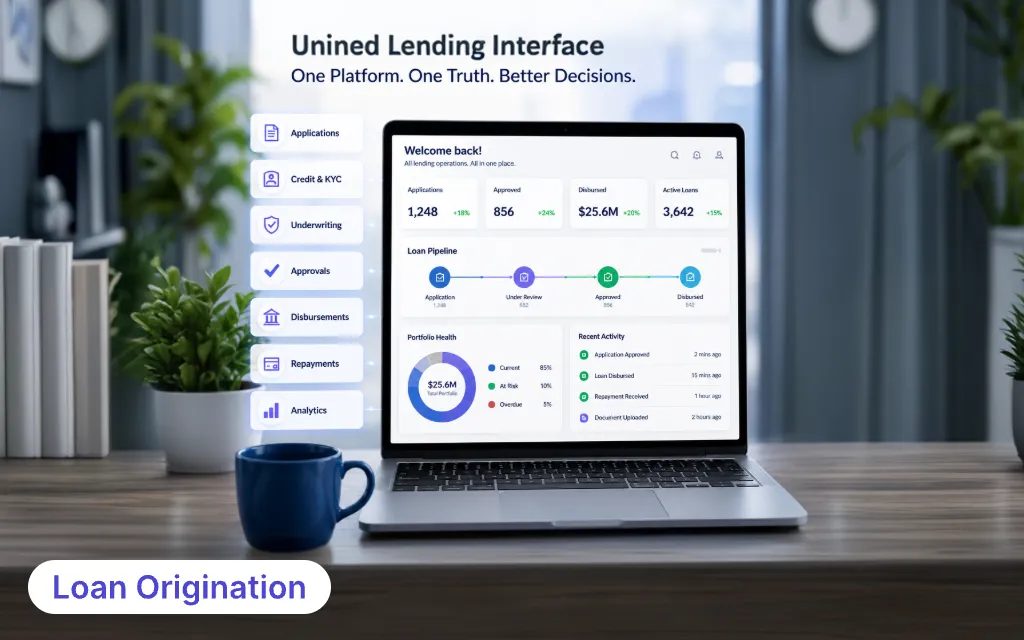
A Unified Lending Interface addresses this challenge by creating a shared operational environment where banks and NBFCs work from a common borrower view throughout the lending lifecycle. As RBI’s Co-Lending Directions place greater emphasis on transparency, governance, and coordinated operations, a unified borrower operating mode is becoming the foundation for scalable, compliant, and efficient co-lending. For a broader understanding of loan origination technology and its capabilities, explore our loan origination software guide.
The Hidden Architecture Problem Behind Co Lending

Fragmented borrower information increases operational complexity and limits efficient collaboration between lending partners.
The biggest misconception about co lending is that lenders fail to collaborate because of differing risk appetites.
In reality, many partnerships struggle because participating institutions cannot see the same borrower in the same way.
An NBFC may approve a borrower based on its underwriting framework, data sources, and risk models. When the proposal reaches a banking partner, the same borrower is evaluated through a different lens. Different bureau data, different verification standards, and different policy frameworks often lead to conflicting conclusions.
What often appears to be credit risk is actually an architecture problem created by fragmented borrower information and disconnected decision-making. Without a shared borrower view, lenders cannot build confidence in one another’s assessments, leading to repeated validation and unnecessary operational friction.
Instead of building upon each other’s assessments, lenders frequently restart the evaluation process. What should be a collaborative model becomes a cycle of validation, clarification, and reconciliation.
Where Fragmentation Shows Up
Multiple borrower records
Borrowers often exist in separate systems with varying KYC information, risk assessments, and servicing histories. Small inconsistencies create large operational delays.
Repeated credit assessment
Partner institutions frequently re-evaluate applications because they lack confidence in the data and decision logic used by other participants.
Disconnected servicing
Collections teams, servicing departments, and risk functions often operate using different borrower information, resulting in inconsistent actions and communication.
Over time, these inefficiencies create more than operational delays, they create a trust deficit between lending partners. When institutions cannot establish a single source of truth, every approval, servicing activity, and compliance process becomes slower, more expensive, and more difficult to govern. Fragmented borrower information ultimately limits collaboration, increases operational complexity, and makes it harder to scale co-lending efficiently.
The IFC’s Digital Lending Handbook similarly identifies fragmented borrower data and disconnected operational systems as major barriers to efficient and scalable lending ecosystems.
As co-lending continues to evolve, these operational challenges are no longer just efficiency concerns, they are becoming governance requirements. This shift is reflected in RBI’s Co-Lending Directions, which increasingly emphasise transparency, coordination, and consistent borrower management across participating institutions.
What RBI’s Co Lending Directions Really Mean for Lenders

RBI’s Co-Lending Directions encourage financial institutions to adopt synchronized lending operations supported by a Unified Borrower Architecture.
Much of the industry discussion around RBI’s Co Lending Directions focuses on compliance obligations.
However, the framework represents something much larger. RBI’s Co Lending framework requires participating institutions to establish clearly defined mechanisms for customer interface, loan monitoring, servicing, recovery, and grievance management, reinforcing the need for coordinated operational models rather than isolated lender workflows.
It is a governance model designed to ensure that co lending operates as a coordinated ecosystem rather than a collection of disconnected participants.
These requirements are more than individual compliance obligations. Together, they establish the operational foundation needed for multiple lenders to function as a coordinated ecosystem. Meeting these expectations consistently requires shared data, synchronized processes, and a common borrower view across every stage of the lending lifecycle.
Four Requirements Reshaping Co Lending
Unified customer agreements
Borrowers must clearly understand the responsibilities, obligations, and roles of every lending participant involved in the relationship.
A consistent customer interface reduces confusion and strengthens accountability throughout the lending relationship.
Escrow-based fund flows
Funds must move through transparent structures that provide clear auditability and accountability.
Transparent fund orchestration also reduces reconciliation effort and strengthens trust between lending partners.
Shared Asset Classification
All participating lenders must maintain a consistent understanding of borrower risk status. Effective Shared Asset Classification ensures that borrower classifications remain synchronized across institutions.
Without synchronized asset classification, participating institutions can reach different conclusions about the same borrower, increasing operational risk and regulatory complexity.
Standardized disclosures
Borrowers should receive clear, consistent information throughout the lending lifecycle, regardless of how many lenders participate in the arrangement.
Consistent disclosures ensure every lending participant communicates the same information, improving transparency and reducing servicing disputes.
These requirements may appear procedural.
In reality, they assume lenders are operating from shared information.
Without synchronized borrower information, maintaining Shared Asset Classification, ensuring timely updates, and supporting coordinated decision-making becomes significantly more difficult. The same coordinated approach can support automated underwriting software, helping institutions connect credit assessment and decisioning processes with the broader lending architecture.
Closing this gap requires more than procedural improvements. It requires an operating architecture that keeps borrower information, servicing activities, and risk decisions synchronized across participating institutions.
Why Legacy Lending Platforms Are Struggling

Legacy lending platforms were designed for single-institution operations and are not equipped to support modern collaborative lending ecosystems.
Most lending platforms were built to support a single institution’s operations.
Their underlying architecture assumes one lender, one underwriting process, one servicing model, and one governance framework.
Co-lending fundamentally changes these assumptions. Multiple institutions must now share borrower information, coordinate decisions, maintain synchronized records, and operate within a common governance framework throughout the lending lifecycle.
The Three Structural Limitations
Built for single lender operations
Traditional systems were never designed to orchestrate multiple lenders simultaneously. As partnerships grow, complexity increases exponentially.
As new lending partners are added, operational complexity increases faster than system capability, making collaboration progressively more difficult.
Synchronization remains difficult
Many institutions continue to rely on periodic updates, manual reviews, spreadsheets, and reconciliation cycles to maintain consistency across systems.
The absence of real-time synchronization delays decision-making and increases the effort required to maintain consistent borrower information across institutions.
Compliance becomes reactive
Instead of enforcing governance through system design, teams spend valuable time identifying discrepancies and correcting issues after they occur.
Instead of preventing discrepancies through system design, institutions spend valuable time identifying and correcting issues after they occur, increasing operational risk and audit effort.
The challenge is not missing functionality, it is architectural misalignment. Legacy platforms were designed for independent lending operations, whereas modern co-lending requires synchronized borrower information, shared workflows, and continuous coordination across multiple institutions. Solving this challenge requires a new operating foundation rather than incremental system enhancements. Successful loan origination process implementation can help translate this architectural foundation into coordinated workflows, integrations, and operational processes across the lending lifecycle.
The Five Pillars of Unified Borrower Architecture

The five pillars establish the architectural foundation for scalable, compliant, and collaborative co-lending operations.
A successful Unified Borrower Architecture creates an operating model where all participants work from a synchronized borrower record while maintaining appropriate governance controls.
Each pillar addresses a different source of fragmentation within co-lending operations. Together, they create a synchronized operating model where borrower information, lending decisions, servicing activities, and compliance obligations remain consistently aligned across every participating institution.
Rather than solving isolated operational issues, the five pillars work together to establish a scalable foundation for modern co-lending.
1. Single Borrower Identity
Every borrower should exist once within the ecosystem.
Identity records, bureau information, consent history, servicing activity, and risk assessments should be maintained through a single authoritative profile.
This eliminates duplication, reduces onboarding friction, and creates consistency across participating lenders.
A single borrower identity becomes the foundation upon which every subsequent lending, servicing, and compliance activity depends.
2. Shared Asset Classification
One of the most critical requirements of modern co lending is maintaining synchronized risk visibility.
Effective Shared Asset Classification ensures that delinquency events, restructuring actions, and NPA designations are reflected consistently across all participating institutions.
This reduces confusion, strengthens governance, and supports regulatory alignment.
Consistent asset classification ensures every participating institution evaluates borrower risk from the same operational context.
3. Automated Reconciliation
Manual reconciliation remains one of the largest operational burdens in co lending environments.
Loan balances, borrower updates, transaction records, and reporting activities often require significant human intervention.
Automated Reconciliation enables continuous synchronization across participating systems while reducing errors and operational effort.
As co lending volumes grow, Automated Reconciliation becomes a prerequisite for scalability rather than an efficiency enhancement.
Continuous reconciliation enables the unified borrower record to remain accurate as lending activity evolves.
4. Escrow and Transaction Orchestration
Every transaction should be transparent, traceable, and auditable.
A unified architecture enables controlled fund movement, complete transaction visibility, and stronger governance across lending participants.
This improves accountability while simplifying audit readiness.
Transparent transaction orchestration strengthens trust while supporting auditability across the lending ecosystem.
5. Consent-Driven Data Governance
Borrower trust depends on responsible data usage.
Modern lending ecosystems must ensure that information is shared only through authorized, auditable channels supported by explicit consent controls.
Strong governance protects borrowers while supporting regulatory requirements and institutional accountability.
Consent-driven governance ensures collaboration remains secure, compliant, and centred on borrower trust.
Together, these five pillars transform fragmented co-lending operations into a unified borrower architecture where every participant works from the same borrower context, follows synchronized processes, and shares consistent operational visibility. This operating foundation enables lenders to scale partnerships while maintaining governance, transparency, and operational efficiency.
Why a Unified Lending Interface Creates Competitive Advantage

A Unified Lending Interface transforms lending architecture into measurable business outcomes across the entire co-lending lifecycle.
Many lenders initially pursue transformation to satisfy regulatory expectations. The larger opportunity lies in business performance. A modern unified lending interface creates operational advantages that extend far beyond compliance. This broader digital transformation in lending perspective helps institutions connect regulatory requirements with improvements in operational efficiency, borrower experience, and scalable lending infrastructure.
Business Outcomes Enabled by a Unified Lending Interface
Faster approvals: Shared borrower information eliminates repeated verification, reduces duplicate assessments, and enables participating institutions to make faster, more consistent lending decisions.
Lower operating costs: Automation replaces manual reconciliation, duplicate processing, and fragmented workflows, reducing operational effort while improving process consistency.
Stronger compliance readiness: Consistent records, audit trails, and synchronized processes simplify governance obligations. Governance becomes part of the operating model rather than a separate manual activity.
Better borrower experience: A cohesive unified lending interface eliminates confusion and provides borrowers with a more seamless journey across participating lenders.
Borrowers experience a single, consistent lending journey even when multiple institutions participate in the loan lifecycle.
Greater scalability: New lending partnerships can be added without introducing proportional increases in operational complexity, allowing institutions to scale efficiently.
Together, these outcomes demonstrate that a Unified Lending Interface is more than an operational improvement. It becomes a strategic capability that enables financial institutions to scale partnerships, strengthen governance, improve borrower experiences, and create sustainable competitive advantage in an increasingly collaborative lending ecosystem. For institutions assessing technology options against these requirements, a structured loan origination platform evaluation can help determine whether the underlying platform supports the required architecture, workflows, integrations, and governance model.
The Future of Co-Lending Will Be Defined by Architecture
The next phase of co lending growth will not be determined by who originates the most loans. It will be determined by who coordinates information most effectively.
As the Co Lending Directions push the industry toward synchronized governance, lenders will need more than incremental system upgrades. They will need connected ecosystems that unify origination, decisioning, servicing, and compliance around a single source of truth.
This is where architecture becomes a competitive advantage. A robust unified borrower framework enables shared asset classification, supports automated reconciliation, and allows lending partners to operate from the same borrower context throughout the lifecycle. Compliance becomes easier because it is embedded into the operating model rather than managed as a separate activity.
This shift is driving lenders toward integrated platforms that can orchestrate the entire lending journey rather than relying on disconnected systems.
Delivering this level of coordination requires more than connecting individual systems. Financial institutions need a loan origination platform that can unify borrower information, orchestrate workflows, automate reconciliation, and maintain consistent governance across every stage of the lending lifecycle.
ezee.ai is built for this reality. lend.ezee helps streamline co lending origination, borrower onboarding, workflow orchestration, and partner collaboration from a single environment. decision.ezee enables consistent credit decisioning and policy execution across participating institutions, reducing friction caused by fragmented underwriting processes. collect.ezee extends this visibility into delinquency management and recovery operations, ensuring lenders continue to operate with the same borrower intelligence after disbursement.
The future of co-lending belongs to institutions that can establish a single source of truth across the lending lifecycle. A Unified Borrower Architecture is no longer simply a technology upgrade, it is becoming the foundation for scalable partnerships, stronger governance, operational resilience, and better borrower experiences. Financial institutions that invest in this operating foundation today will be better positioned to lead the next generation of collaborative lending.
Frequently Asked Questions
A Unified Lending Interface is a centralized operating environment that enables multiple lending institutions to collaborate using a shared borrower view throughout the lending lifecycle. It connects origination, underwriting, servicing, compliance, and partner coordination within a single architecture, reducing data fragmentation and improving operational efficiency across co-lending ecosystems.
A Unified Borrower Architecture ensures that all participating lenders access consistent borrower information, risk assessments, servicing records, and compliance data from a single source of truth. This reduces duplicate verification, minimizes operational friction, strengthens governance, and enables banks and NBFCs to collaborate more effectively while delivering a seamless borrower experience.
A Unified Lending Interface improves co-lending by synchronizing borrower information, automating workflow coordination, reducing manual reconciliation, and maintaining consistent records across participating institutions. This enables faster loan approvals, better operational visibility, stronger compliance, and more efficient collaboration throughout the lending lifecycle.
Fragmented co-lending systems often result in duplicate borrower records, repeated credit assessments, disconnected servicing activities, and inconsistent compliance processes. These inefficiencies increase operational costs, delay lending decisions, and make it more difficult for institutions to maintain a shared borrower view and scale co-lending partnerships effectively.
Shared Asset Classification helps participating lenders maintain a consistent understanding of borrower risk and loan performance throughout the lending lifecycle. By synchronizing asset classification across institutions, lenders improve regulatory reporting, strengthen governance, reduce operational discrepancies, and support coordinated portfolio management.
Automated Co-Lending Reconciliation continuously synchronizes borrower records, transactions, balances, and servicing activities across participating institutions. By replacing manual reconciliation processes with automated workflows, financial institutions improve data accuracy, reduce operational effort, strengthen audit readiness, and support scalable co-lending operations.
RBI’s Co-Lending Directions encourage financial institutions to operate with greater transparency, coordinated servicing, consistent governance, and synchronized borrower information. Meeting these expectations requires more than procedural compliance, it increasingly depends on a Unified Borrower Architecture that supports shared operational visibility and standardized lending processes across participating institutions.
Financial institutions should look for capabilities such as a single borrower identity, shared asset classification, automated reconciliation, escrow and transaction orchestration, consent-driven data governance, and real-time workflow coordination. Together, these capabilities create a scalable, compliant, and collaborative lending environment that supports sustainable co-lending growth.
References
- Reserve Bank of India (RBI). Co-Lending by Banks and NBFCs to Priority Sector
- International Finance Corporation (IFC). Digital Lending Handbook
- World Economic Forum. The Future of Financial Services
- McKinsey & Company. Financial Services Insights
- Deloitte Insights. Banking & Capital Markets
- Accenture. Banking Industry Insights & Digital Transformation
