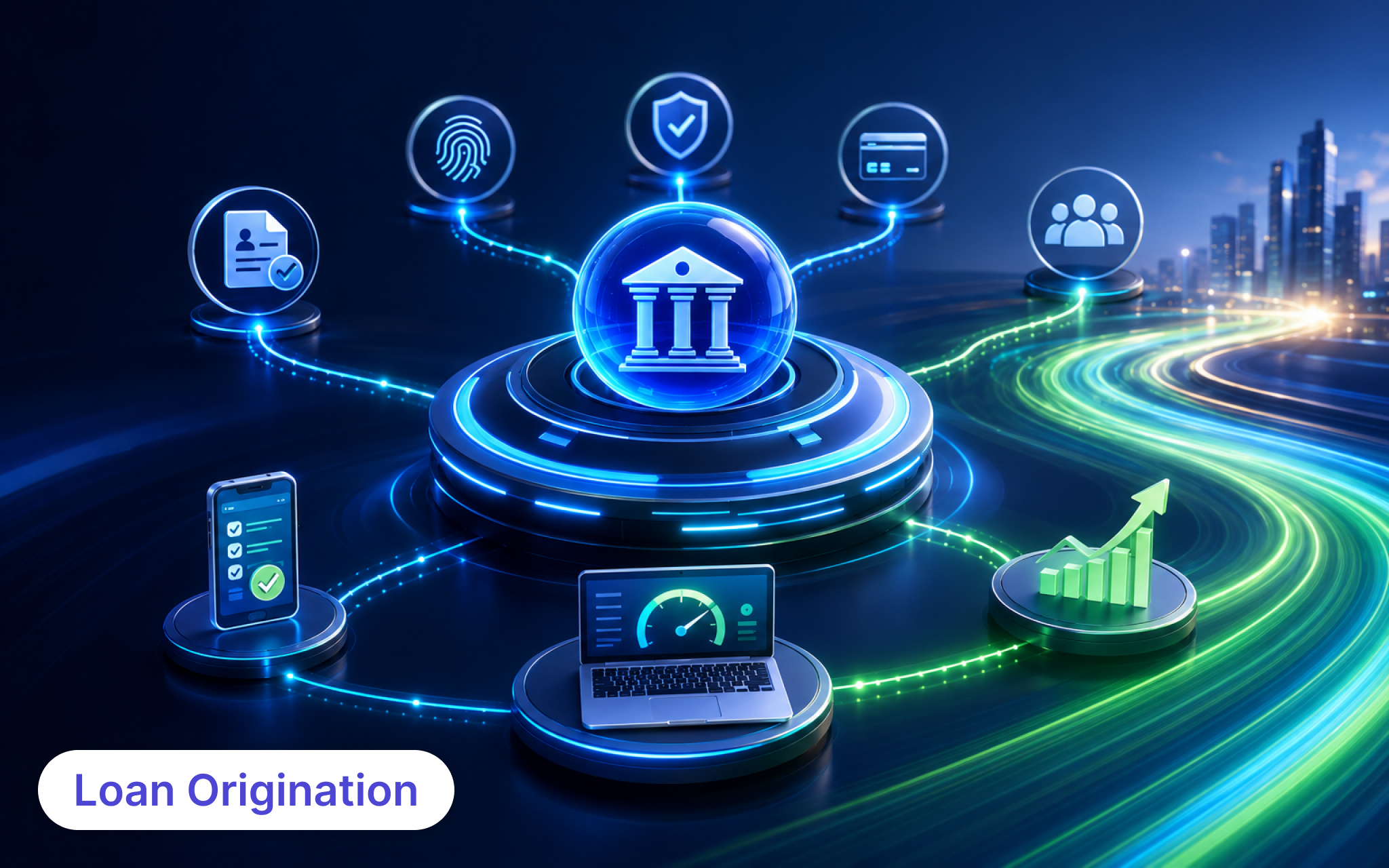
A Loan Origination Platform enables banks, NBFCs, and financial institutions to automate and manage the entire loan application process, from digital loan onboarding and borrower verification to underwriting, loan approval, and disbursement. By connecting workflows, business rules, integrations, and decisioning on a single platform, it helps lenders reduce manual effort, improve borrower experiences, and launch lending products faster.
As lending becomes increasingly digital, financial institutions need platforms that can scale with changing customer expectations, regulatory requirements, and business growth. A modern Loan Origination Platform provides the flexibility to streamline the loan origination system workflow while maintaining speed, compliance, and operational efficiency.
In this evaluation guide, you’ll learn the key features of a modern Loan Origination Platform, the factors to consider when evaluating solutions, and how to choose a platform that supports long-term lending growth. For a broader overview of loan origination technology, capabilities, and benefits, explore our loan origination software guide.
Why Loan Origination Has Become a Competitive Advantage

A modern Loan Origination Platform transforms lending operations by improving approvals, efficiency, and business outcomes.
For most banks and financial institutions, growth discussions revolve around customer acquisition, risk management, pricing, and portfolio expansion. Yet one of the biggest drivers of lending performance often receives far less attention, the loan origination platform.
Every lending KPI ultimately connects back to the loan origination platform that powers the lending process.
Faster loan approvals improve conversions. Better loan origination workflows reduce operating costs. Smarter decisioning improves portfolio quality. Seamless experiences reduce abandonment. When origination slows down, every downstream metric suffers.
This challenge has become more visible as borrower expectations continue to evolve.
Today’s customers compare lending experiences not only against banks and NBFCs but also against the digital experiences they encounter every day. Waiting several days for updates, repeatedly submitting documents, or navigating fragmented journeys feels increasingly outdated.
At the same time, lenders face pressure to launch products faster, adapt policies quickly, and maintain compliance across rapidly changing regulatory environments.
The institutions winning market share are not necessarily those with the largest balance sheets.
They are often the ones with the most agile lending infrastructure.
A modern Loan Origination Platform has evolved from a back-office system into a strategic growth platform that improves lending efficiency, accelerates product launches, strengthens compliance, and enhances borrower experiences.
The Evolution of Lending: From Processing Loans to Designing Experiences

The evolution of lending has shifted from manual processing to intelligent, experience-driven loan origination platforms.
A decade ago, applying for a loan often involved branch visits, paperwork, manual verification, and lengthy approval timelines.
Today, borrowers expect a Loan Origination Platform that delivers seamless digital journeys, instant updates, paperless onboarding, and near real-time lending decisions. What was once considered exceptional service has become a baseline expectation.
Several market shifts have accelerated this transformation:
- Digital first consumer behaviour
- Growth of fintech lending
- Embedded finance ecosystems
- Real time data availability
- Increased competition across lending channels
Borrowers no longer compare one lender against another. They compare the speed and experience of the entire loan application process.
If a competing lender offers a smoother loan application process, faster decisions, or fewer steps, switching becomes effortless.
This creates a new reality for banks, NBFCs, and financial institutions.
The borrower experience is only as efficient as the Loan Origination Platform supporting every stage of the lending journey.
A McKinsey study found that digital lending leaders are 1.5 to 2 times more likely to use configurable platforms that reduce product launch timelines by more than 70 percent. Meanwhile, many traditional institutions still require several months to introduce a new lending product because underlying systems lack flexibility.
This is where the Loan Origination Platform becomes critical. It orchestrates the entire loan origination system workflow, enabling lenders to launch products faster, automate approvals, and deliver consistent borrower experiences across every channel.
The Hidden Cost of Legacy Loan Origination Platforms

Legacy loan origination platforms create operational bottlenecks, increase costs, and slow digital transformation.
Many lenders invest heavily in improving customer-facing experiences while continuing to rely on legacy loan origination platforms behind the scenes. Initially, these systems appear to support day-to-day lending operations. However, as lending volumes increase, products diversify, and regulatory expectations evolve, their limitations become increasingly difficult to ignore.
Most legacy platforms were designed to automate individual tasks rather than orchestrate the entire lending lifecycle. As a result, they create operational bottlenecks, increase technology dependency, and slow the ability to respond to changing market demands.
Slow Loan Processing
Many legacy platforms still depend on spreadsheets, email approvals, and manual interventions to move applications through the loan application process.
These disconnected workflows increase turnaround times, introduce avoidable errors, and create inconsistent borrower experiences.
Limited Business Agility
Launching new lending products, updating credit policies, or modifying workflows should be a business decision, not a lengthy technology project.
On legacy platforms, even small changes often require extensive development cycles, delaying innovation and slowing time-to-market.
Disconnected Lending Ecosystems
Modern lending depends on seamless connectivity with credit bureaus, KYC providers, fraud detection tools, payment gateways, and core banking systems.
Legacy platforms often struggle to support these integrations efficiently, resulting in fragmented data, duplicate processes, and slower loan approval workflows.
Growing Operational Costs
When business teams depend on IT for every workflow update or policy change, operational costs increase and innovation slows.
Modern Loan Origination Platforms empower business users to configure journeys, rules, and decision workflows without extensive development, allowing institutions to respond faster to changing business and regulatory requirements.
These challenges extend far beyond operational efficiency. They directly affect customer experience, product innovation, regulatory agility, and long-term profitability.
According to McKinsey, many financial institutions continue to operate on legacy origination environments that lack true automation capabilities. Institutions using configurable platforms report faster product rollouts, lower operational dependency, and greater business agility. IBS Intelligence also identifies inflexible Loan Origination Platforms as a major barrier to digital lending transformation.
The issue is rarely the people.
More often, it is the platform.
What a Modern Loan Origination Platform Should Enable

Modern Loan Origination Platforms combine automation, integrations, operational visibility, and configurability to support digital lending.
A modern Loan Origination Platform should do far more than digitize the loan application process. It should enable lenders to launch products faster, automate lending workflows, improve decision quality, integrate seamlessly with external systems, and give business teams the flexibility to adapt without lengthy development cycles.
It should create an operating environment where business teams can move quickly without compromising control, compliance, or customer experience.
Empower Business Teams
Product teams should be able to configure rules, workflows, and journeys without waiting for development cycles. This dramatically improves speed to market while reducing operational bottlenecks.
Workflow Automation That Scales
A strong loan origination system workflow automates document collection, borrower verification, eligibility screening, routing decisions, and status updates, allowing teams to focus on complex lending decisions rather than repetitive administrative tasks.
Connected Lending Ecosystem
Modern lending depends on seamless connectivity with credit bureaus, digital identity providers, fraud detection solutions, banking APIs, and partner ecosystems. A connected lending platform simplifies integrations today while remaining flexible as the ecosystem evolves.
Real-Time Operational Visibility
Every stakeholder should operate from a single source of truth. Real-time dashboards give credit teams, operations leaders, product managers, and risk teams complete visibility into application status, performance, bottlenecks, and turnaround times, enabling faster and better-informed decisions.
Compliance by Design
Modern Loan Origination Platforms should embed audit trails, consent management, role-based access controls, configurable approval rules, and regulatory checkpoints directly into lending workflows. Compliance should be built into every stage of the lending lifecycle, helping institutions maintain governance, reduce risk, and remain audit-ready as regulations evolve.
Together, these capabilities transform a Loan Origination Platform from a workflow automation tool into a strategic business platform. Institutions evaluating modern platforms should prioritize long-term flexibility, scalability, and business agility over feature checklists alone.
Choosing a Platform That Can Scale With Your Business

Evaluate scalability, configurability, implementation expertise, and long-term support when selecting a loan origination platform.
Selecting a Loan Origination Platform is a long-term strategic decision. Beyond features, lenders should evaluate how well a platform supports business growth, operational agility, regulatory compliance, and evolving customer expectations.
The right platform should solve today’s lending challenges while providing the flexibility to adapt as products, regulations, and customer needs evolve.
Scalability
A Loan Origination Platform should scale with your institution, not limit it. Evaluate whether the platform can support multiple lending products, business units, distribution channels, and increasing application volumes without requiring major redevelopment.
A scalable platform enables lenders to expand operations while maintaining performance, governance, and consistent borrower experiences.
Industry Expertise & Implementation Experience
Technology alone does not guarantee implementation success. Evaluate vendors based on their experience with banks, NBFCs, and financial institutions, as well as their understanding of lending regulations, migration strategies, and implementation methodologies. A partner with proven industry expertise and experience in loan origination process implementation reduces implementation risk and accelerates time-to-value.
Business-Led Configuration
Modern lending requires continuous adaptation. Business users should be able to configure workflows, approval rules, forms, and lending products without depending on development teams.
A configurable Loan Origination Platform enables institutions to respond faster to regulatory changes, launch new products quickly, and continuously optimize lending operations.
Integration & Ecosystem Readiness
A modern Loan Origination Platform should integrate seamlessly with core banking systems, credit bureaus, CKYC, Account Aggregators, payment gateways, CRM platforms, and other third-party services. API-first connectivity reduces implementation complexity, improves data accuracy, and enables faster digital lending innovation.
Security, Compliance & Long-Term Partnership
Evaluate more than ongoing technical support. Consider the vendor’s security standards, regulatory compliance capabilities, product roadmap, release management, and customer success approach.
A long-term technology partner should help your institution remain secure, compliant, and prepared for future lending requirements.
The best Loan Origination Platform is not necessarily the one with the longest feature list. It is the platform that aligns with your lending strategy, integrates with your technology ecosystem, empowers business teams, and continues to scale as your institution grows. Evaluating platforms through this lens helps lenders make technology investments that deliver long-term operational and business value.
Essential Features to Look for in a Loan Origination Platform

A modern Loan Origination Platform should do more than automate lending workflows. It should provide the flexibility, intelligence, and scalability required to support changing borrower expectations, regulatory requirements, and business growth. When evaluating platforms, lenders should prioritize the following capabilities.
No-Code Configuration
Business users should be able to configure workflows, lending products, forms, and approval rules without relying on development teams. No-code configuration accelerates product launches, simplifies updates, and helps lenders respond quickly to changing business and regulatory requirements.
Workflow Automation & Intelligent Decisioning
A modern Loan Origination Platform should automate the loan application process through configurable workflows and built-in decision engines. This reduces manual effort, speeds up loan approvals, and ensures consistent policy execution across lending operations. Institutions evaluating advanced credit automation can also explore automated underwriting software to understand how automated assessment and decisioning capabilities support modern lending workflows.
API-First Integrations
Seamless integrations with core banking systems, credit bureaus, CKYC, Account Aggregators, payment gateways, and CRM platforms create a connected lending ecosystem. API-first architecture simplifies implementation and enables faster, data-driven lending decisions.
AI-Powered Decisioning & Document Intelligence
AI and document intelligence help automate credit assessments, detect fraud, verify borrower documents, and extract critical data. These capabilities improve decision quality, accelerate digital loan onboarding, and reduce manual processing.
Analytics & Operational Visibility
Real-time dashboards provide visibility into application volumes, turnaround times, approval rates, and operational bottlenecks. These insights help lenders optimize workflows, improve productivity, and make informed business decisions.
Compliance by Design
Built-in audit trails, consent management, role-based access controls, and configurable policy rules help lenders meet regulatory requirements while maintaining speed, consistency, and audit readiness throughout the lending lifecycle.
The Future Belongs to Agile Lenders
The lending market is no longer competing on interest rates alone.
Institutions compete on speed, adaptability, customer experience, and operational efficiency.
Increasingly, the difference comes down to the quality, flexibility, and scalability of the underlying Loan Origination Platform.
Lenders that continue operating on rigid systems will find it harder to launch products, respond to regulatory changes, optimise the loan application process, and meet rising borrower expectations. Those that embrace configurable, API driven platforms gain a different advantage: the ability to evolve continuously. This ability to adapt is central to digital transformation in lending, where technology, processes, and operating models evolve together to create more agile lending operations.
This is where platforms such as lend.ezee fit naturally into the modern lending ecosystem. By combining no code configuration, intelligent decisioning, workflow orchestration, and seamless integrations, Lend.ezee enables institutions to streamline the loan qualification process, accelerate the loan approval workflow, and optimise every stage of the loan origination system workflow without increasing operational complexity.
The institutions that lead the next decade of lending will not necessarily be the largest.
They will be the institutions that can adapt fastest, launch new lending products quickly, and continuously improve borrower experiences without increasing operational complexity.
Frequently Asked Questions
AI-driven credit risk assessment combines configurable business rules with machine learning models to evaluate borrower data, automate credit decisions, and improve underwriting consistency. This enables faster approvals while reducing manual effort and supporting better risk management.
Look for no-code configuration, configurable workflows, API-first integrations, built-in compliance, and scalable architecture. These capabilities help lenders launch products faster and adapt to changing business and regulatory requirements.
Evaluate ease of implementation, scalability, integration capabilities, configurable workflows, and vendor support. The platform should meet current lending needs while providing flexibility for future growth.
Successful migration starts with data cleansing, mapping, validation, and phased testing. Working with an experienced implementation partner helps minimize disruption while maintaining data integrity and business continuity.
Automated underwriting applies predefined lending rules to assess borrower eligibility, validate documents, and support faster loan approvals. This reduces manual reviews while improving consistency and operational efficiency.
Modern Loan Origination Platforms provide a unified workflow across digital channels, branches, and partner networks, allowing borrowers to move seamlessly between channels while maintaining a consistent lending experience.
By automating document collection, verification, workflow routing, and approval processes, Loan Origination Platforms reduce manual intervention, accelerate lending decisions, and improve borrower experiences.
Modern platforms can automate KYC, consent management, audit trails, approval controls, and policy enforcement, helping lenders strengthen compliance while reducing operational risk.
Next-generation platforms use no-code configuration and reusable workflows, enabling lenders to introduce new products, update lending policies, and respond to market changes much faster than legacy systems.
Commercial and SME lending platforms should support configurable workflows, complex approval processes, collateral management, document-intensive lending, and seamless integrations to handle specialized business lending requirements efficiently.
