In 2025, lending isn’t evolving, it’s already transformed. Borrowers expect instant decisions, seamless digital experiences, and faster access to credit, while financial institutions must balance speed with compliance, risk, and operational efficiency.
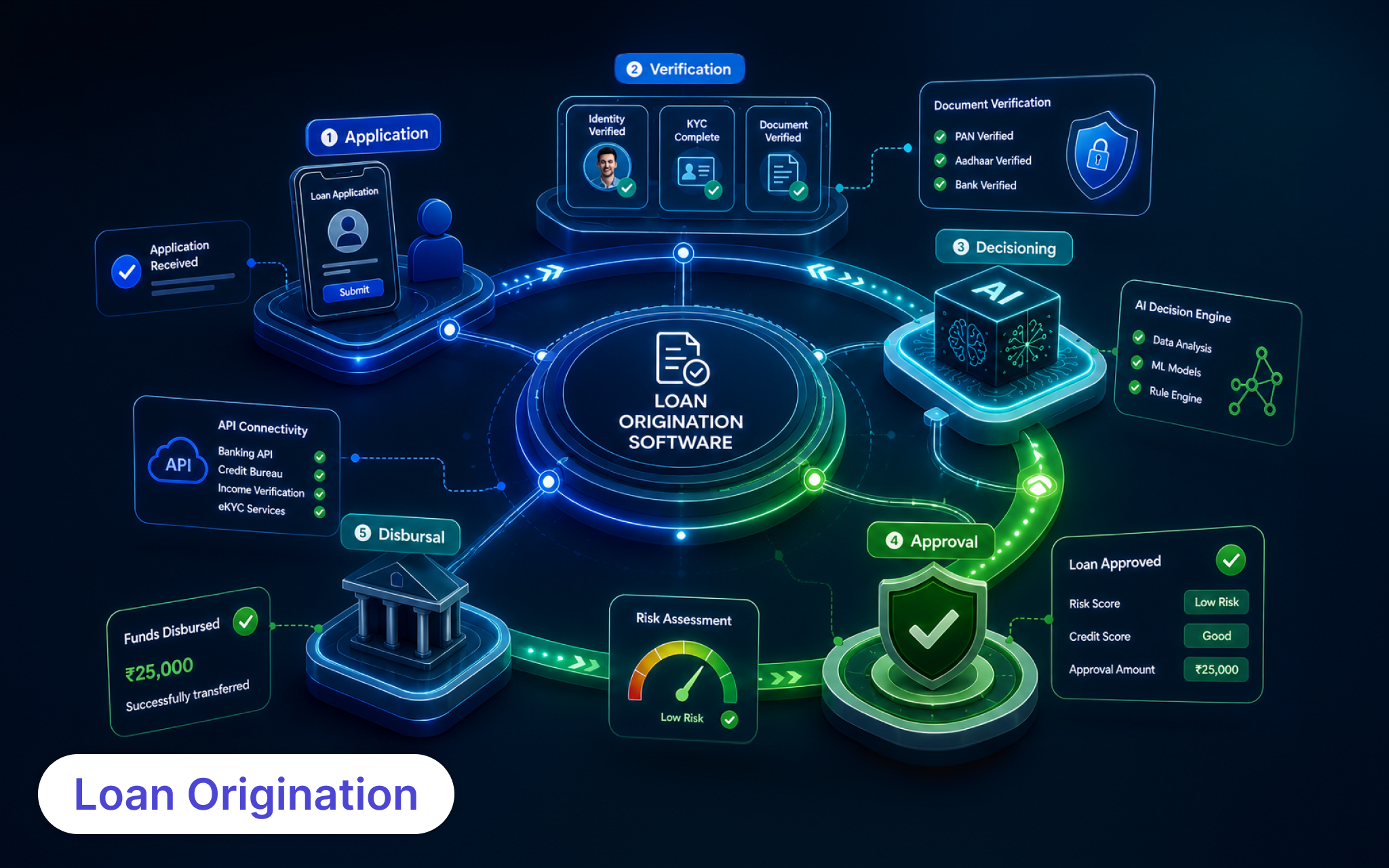
Loan Origination Software (LOS) is the digital platform that powers this transformation. It automates the entire loan origination process, from borrower onboarding and document verification to credit assessment, approval, and disbursement, helping banks and financial institutions streamline the entire loan origination workflow through automated lending processes, digital loan onboarding, and intelligent credit decisioning. By replacing fragmented manual processes, LOS reduces turnaround times, improves borrower experience, and strengthens governance across the lending lifecycle.
The need for modern Loan Origination Software is reflected in current market trends. Leading FinTechs are now disbursing loans in under 10 minutes, while many traditional lenders still take between 24 and 48 hours, resulting in higher borrower drop-offs.
According to Research and Markets, the global Loan Origination Software market is projected to reach USD 10.3 billion by 2029, growing at an 11.9% CAGR, while India’s embedded credit market is expected to surpass ₹90,000 crore, driving demand for scalable digital lending platforms.
In this guide, you’ll learn how Loan Origination Software works, its key features and benefits, how AI is transforming loan origination, and the factors financial institutions should consider when choosing the right loan origination platform.
Why Loan Origination Software is Essential Today?

Modern Loan Origination Software enables financial institutions to streamline lending operations, improve compliance, and deliver faster digital lending experiences.
External demands are rising, internal pressures are mounting, and the margin for delay or error keeps shrinking.
What used to work slow, step-by-step processes, stitched together across teams no longer holds up under the weight of modern scale.
There’s a growing need for Loan Origination Software that not only keeps pace with evolving lending demands but also creates stability in motion. Modern loan origination platforms adapt in real time, enforce consistent lending policies, automate the loan origination workflow, and provide end-to-end visibility across decisions, customer data, compliance, and outcomes.
That’s where Loan Origination Software comes in. It automates repetitive tasks, digitizes manual processes, streamlines digital loan onboarding, and enables automated underwriting and intelligent credit decisioning, giving lenders complete visibility and control across every loan application.
In today’s market, Loan Origination Software is no longer optional, it’s a strategic technology investment for financial institutions seeking faster approvals, improved compliance, and scalable digital lending operations.
While adopting Loan Origination Software may feel like a technology upgrade, its real value lies in transforming lending operations. The greatest risk for financial institutions is no longer just loan rejection, it’s the operational delays, inconsistent decisions, and fragmented workflows that prevent scalable growth.
Core Challenges in Traditional Loan Origination

Traditional loan origination processes often rely on disconnected systems and manual workflows, resulting in delays, compliance challenges, and poor borrower experiences.
Fragmented onboarding, inconsistent rule enforcement, and undocumented overrides weaken portfolio integrity long before the first EMI is missed. Traditional origination systems fail to embed risk governance by design, making early control and real-time visibility nearly impossible. Modern lenders overcome these challenges through Loan Origination Software, which automates governance, standardizes decision-making, and provides end-to-end visibility across the loan origination system workflow.
Here’s where traditional origination systems fall short :
- Fragmented Workflows
Multiple teams, tools, and touchpoints create inefficiencies and handoff delays. - Manual Processing
High reliance on paper forms, emails, and spreadsheets increases errors and slows down approvals. - Inconsistent Decisioning
Credit rules are applied unevenly across branches, geographies, or teams—leading to governance gaps. - High Drop-off Rates
Disjointed customer journeys cause friction, leading to borrower abandonment before approval. - Slow Time-to-Yes / Time-to-Disburse
Turnaround times stretch across days due to verification bottlenecks and back-and-forth. - Limited Visibility & Tracking
Lack of real-time dashboards or audit trails makes it hard to monitor performance or enforce SLAs. - Compliance and Risk Exposure
Difficulty in enforcing policy or logging digital consent opens gaps in regulatory readiness. - Rigid Product Launch Cycles
Introducing new loan products or partnerships requires heavy IT involvement and long lead times.
These operational flaws don’t exist in isolation they stack. And when they do, time becomes the casualty. But in credit, time isn’t neutral. Every delay in origination triggers a ripple effect. Here’s what cost really looks like.
Business Impact of Manual Loan Origination

Every delay in the loan origination workflow affects operational efficiency, customer satisfaction, revenue realization, and lending performance.
In loan origination, time isn’t just a metric it’s margin. It’s not just about longer turnaround times. It’s about what gets lost in the lag. Every delay compounds silently across the business: in customer experience, in operational efficiency, and in missed growth opportunities.
The impact:
- Lower approval-to-disbursal conversion
- Higher cost per acquisition and fulfilment
- Slower time-to-revenue on booked loans
- Reduced productivity across credit and operations teams
- Increased risk exposure from inconsistent workflows
What feels like a processing lag is often a performance leak.
Let’s go through these and understand with a real life case.
Modern Borrower Expectations in Digital Lending

Today’s borrowers expect fast, digital-first lending experiences with seamless onboarding, instant decisions, and personalized loan journeys.
Borrowers may not say it outright, but the shift is clear.
They move faster, compare quicker, and drop off sooner. Their standards aren’t set by banks they’re shaped by the platforms they use every day.
What they really want is :
- Instant application experiences, anytime, anywhere
- Real-time updates without repeated follow-ups
- Paperless, presence-less onboarding
- Personalised offers that feel relevant
- Fast approvals without compromising clarity
- One-touch disbursals with minimal effort
Some lenders still rely on email threads, spreadsheets, and physical files to process loans. It works until volumes grow, teams stretch thin, or compliance standards rise.
Modern Loan Origination Software enables lenders to replace these fragmented processes with digital loan onboarding, automated workflows, and real-time credit decisioning, delivering the speed and convenience that today’s borrowers expect.
Others have reimagined the journey where applications are captured online, checks happen in real time, and approvals flow through logic-based rules instead of inboxes.
Others have reimagined the journey, where applications are captured online, checks happen in real time, and approvals flow through logic-based rules instead of inboxes, creating a seamless loan origination workflow from application to disbursal.
Because in lending, how you start often defines how fast and how far you go.
How Modern Loan Origination Software Transforms the Loan Origination Workflow

Modern Loan Origination Software transforms lending operations by combining intelligent automation, digital compliance, API connectivity, and scalable workflow management.
Modern Loan Origination Software transforms the entire loan origination workflow by replacing fragmented, reactive processes with a centralized, rule-based loan origination platform. The result is faster decision-making, improved compliance, automated underwriting, and a seamless digital lending experience.
The comparison below highlights how modern Loan Origination Software differs from traditional lending processes.
| Challenge | What a Modern LOS Solves |
|---|---|
| Fragmented workflows | Unifies processes across teams, channels, and stages |
| Manual processing | Automates KYC, credit checks, document handling, and approvals |
| Inconsistent decisioning | Applies centralised, rule-based credit policies across all applications |
| High drop-off rates | Creates seamless, real-time borrower journeys |
| Slow turnaround times | Accelerates time-to-yes and disbursement through digitised workflows |
| Limited visibility & tracking | Offers real-time dashboards, status tracking, and SLA monitoring |
| Compliance risk | Embeds audit trails, consent capture, and policy enforcement |
| Rigid product launch cycles | Enables configurable workflows, rapid prototyping, and faster rollout |
The Push Toward Smarter LOS Is Accelerating
The lending landscape is changing rapidly, and modern Loan Origination Software is evolving to keep pace with new borrower expectations, regulatory requirements, and digital lending innovations.
More than 52% of borrowers abandon applications that take longer than five minutes to complete (Experian APAC, 2024). At the same time, regulators are demanding digital first compliance, while embedded finance and AI driven lending are raising expectations around speed and intelligence.
Five forces are driving the shift toward smarter Loan Origination Software platforms.
Borrower expectations: Customers expect instant decisions, mobile first journeys, and minimal documentation. Slow, fragmented onboarding directly impacts conversion.
Digital first regulation: Frameworks such as RBI Digital Lending Guidelines, DPDP, and GDPR are making real time consent management, digital KYC, and audit ready workflows mandatory.
Embedded lending growth: Lending is increasingly happening through marketplaces, fintech platforms, ERP systems, and partner ecosystems, creating demand for API-driven loan origination platforms, rapid integrations, and scalable digital lending ecosystems.
AI powered decisioning: Lenders are using AI to assess thin-file borrowers, automate approvals through automated underwriting systems, strengthen fraud detection, and improve risk assessment. These capabilities depend on real time, consent driven data flows.
Public digital infrastructure: Platforms such as CKYC, DigiLocker, Account Aggregator, eSign, eNACH, and OCEN are transforming onboarding and verification. According to World Bank research, more than 70% of lending decisions are expected to rely on real time API based data exchanges by 2026.
The message is clear. Modern Loan Origination Software is becoming faster, more connected, and increasingly intelligent. Institutions operating on manual processes and rigid systems will find it harder to compete, comply, and scale. The question is no longer whether financial institutions need smarter Loan Origination Software—it is how quickly they can adopt it.
AI and Machine Learning: Revolutionizing Loan Origination Software

Artificial Intelligence enables Loan Origination Software to automate risk assessment, improve decision accuracy, detect fraud, and accelerate lending operations.
Artificial Intelligence (AI) and Machine Learning (ML) are reshaping the landscape of lending including financial services. Wondering how?
Because these aren’t merely technological add-ons – they’re strategic imperatives
Let’s be honest, Loan Origination Software platforms today aren’t broken, but they’re far from ready for what’s coming next.
Sure, they process applications, automate some tasks, and integrate with a few third-party tools. But if you’re leading lending operations or credit transformation, you already know: traditional LOS setups were built for a world that no longer exists. They’re rule-based, inflexible, and reactive – hardly what you’d call intelligent.
That’s exactly where AI and ML step in – not as fancy upgrades, but as foundational shifts. Because at this point, it’s not about moving faster.
It’s about making smarter, more contextual decisions, that adapt in real time, that self-learn, that optimise outcomes while staying compliant. That’s the promise of AI in loan origination.
Today’s credit landscape is complex. Borrowers are more diverse, data is more scattered, and fraud is more sophisticated than ever. You can’t rely on one-dimensional scorecards and static rules. Lenders need systems that can absorb large volumes of data, learn from patterns, and improve over time.
That’s what modern machine learning models offer and it’s already happening in live production environments, not just innovation labs.
Think of it this way: instead of a one-size-fits-all approval flow, ML allows you to personalise decisions at the application level. It can tell you, with far more accuracy, whether a thin-file gig worker is likely to repay, or which SME segment poses emerging credit risk. You get faster approvals, but more importantly—better ones.
And it’s not just about approvals. Functions are being rebuilt from the ground up with AI. Real-time algorithms can now detect anomalies before a human team even sees the file, driven by systems that deliver clear, explainable credit decisions.
Policy engines can simulate outcomes before you hit deploy.
You’re not just reducing turnaround times, you’re building adaptive systems that get better with every case.
Still, this isn’t a magic switch. Deploying AI responsibly means thinking about explainability, governance, and regulatory alignment from day one.
The best lenders aren’t asking “Can we use AI in lending?” anymore. They’re asking “Where does it create clear lift, and how fast can we embed it in our LOS stack without losing control?”
Because here’s the truth: the winners in the next wave of lending won’t be the ones who digitised first. They’ll be the ones who learned faster – about their customers, their risks, and their margins. And they’ll do it with AI and ML at the core.
In the next section, we’ll go deeper into real examples, business value, and how the smartest lenders are turning LOS into a living, learning system. Not just a process engine, but a competitive advantage.
Because if your LOS still treats AI as a nice-to-have, you’re already behind.
Next-Generation Credit Intelligence
Modern Loan Origination Software powered by AI is transforming credit intelligence across every stage of the lending lifecycle. The following capabilities demonstrate how intelligent Loan Origination Software delivers faster, more accurate, and scalable lending decisions.
Alternative Data Ecosystems:
Advanced Loan Origination Software platforms powered by AI, now integrate over 8,000+ alternative data points, from digital footprints and transaction patterns to utility payments and supply chain relationships enabling credit assessments for previously underserved segments with 40% greater accuracy than traditional models.
Real-Time Portfolio Intelligence:
Modern Loan Origination Software uses self-optimizing ML algorithms continuously recalibrate risk models based on emerging performance patterns, detecting early warning signals 60-90 days before traditional approaches and reducing default rates by up to 25% through pre-emptive intervention strategies.
Decision Automation Architecture:
Modern Loan Origination Software platforms implement tiered decisioning frameworks auto-approving up to 70% of straightforward applications within seconds while escalating complex cases with intelligent routing and pre-analysis, reducing underwriter review time by 65% even for manual decisions.
Affordability Intelligence Through Income & Expense Analysis
AI-Powered Income Parsing:
Within modern Loan Origination Software, machine learning algorithms extract and interpret income data from bank statements, salary slips, GST returns, and other structured or unstructured documents. This enables accurate income classification and cash flow mapping for both salaried and self-employed applicants, improving income assessment precision by over 35% compared to manual underwriting.
Real-Time Expense Pattern Recognition:
AI models analyse recurring debit patterns, bounced EMI markers, or unusual spend spikes from Account Aggregator and transaction data to detect repayment stress early. This allows for proactive affordability scoring, reducing high-risk approvals by up to 28% in volatile borrower segments.
Thin-File Credit Expansion:
By combining transaction intelligence and inferred income flows, often through intelligent automation frameworks across enterprise operations, modern LOS platforms can underwrite customers with limited bureau history.
Fraud Prevention Intelligence
Neural Network Detection:
Deep learning models process millions of data points across application networks, identifying sophisticated fraud rings and synthetic patterns with 3x greater accuracy than rule-based systems, preventing an estimated ₹120 crore in fraud losses annually for mid-sized lenders.
Multimodal Authentication:
State-of-the-art platforms leverage computer vision, voice recognition, and behavioral biometrics simultaneously – creating layered identity verification that achieves 99.7% accuracy while reducing genuine customer friction by 40% compared to traditional KYC processes.
Forensic Data Analysis:
Advanced entity resolution algorithms can detect manufactured identities by triangulating subtle inconsistencies across 15+ data dimensions, including temporal anomalies invisible to human review – catching 82% of synthetic fraud attempts at application stage.
Precision Customer Intelligence
Micro-Segmentation Engines:
Sophisticated clustering algorithms create dynamic customer microsegments based on 50+ behavioural and financial attributes, enabling hyper-personalized product structuring that improves conversion rates by 45% and reduces early defaults by 30%.
Behavioral Prediction Frameworks:
Multi-dimensional predictive models calculate probabilities across the entire customer lifecycle – from application completion likelihood to prepayment risk, allowing for real-time journey optimization that increases pull-through rates by 28% while optimizing portfolio yields.
Contextual Intelligence Systems:
Advanced recommendation engines analyse customer situations, product usage patterns, and market conditions to deliver perfectly-timed interventions, increasing cross-sell success by 3.2x while improving customer satisfaction metrics by 40%.
Operational Excellence Amplifiers
Cognitive Document Processing:
Next-generation platforms combine OCR, NLP, and machine vision to achieve 99.5% extraction accuracy across 100+ document types – even with poor image quality, handwritten text, and non-standard formats, reducing manual intervention by 85% and cutting processing costs by ₹120-150 per application.
Dynamic Resource Optimization:
Intelligent orchestration engines balance workload distribution across underwriting teams based on application complexity, staff expertise, current capacity, and projected inflow – reducing average processing time by 42% while maintaining consistent quality standards.
Predictive Operations Analytics:
ML-powered forecasting models anticipate processing bottlenecks 48-72 hours before they materialize by analyzing historical patterns, seasonal variations, and external events, enabling proactive resource allocation that maintains SLA compliance even during 3x volume spikes.
Strategic Implementation Framework
Model Governance Architecture:
Implement comprehensive explainability frameworks that provide transaction-level decision rationales and factor importance rankings, satisfying RBI’s transparency requirements while enabling rapid remediation of potential bias vectors.
Algorithmic Fairness Controls:
Deploy advanced fairness testing protocols that analyze model outputs across 20+ demographic dimensions to identify potential disparate impacts, preventing regulatory issues while expanding addressable markets through more inclusive lending practices.
Adaptive Learning Infrastructure:
Establish automated model surveillance systems that continuously monitor prediction accuracy, population drift, and concept shift, triggering recalibration workflows before performance degradation impacts business outcomes.
Integrating AI and ML into Loan Origination Software goes far beyond a technology upgrade, it creates a sustainable competitive advantage. Leading institutions using intelligent Loan Origination Software achieve 42% faster time-to-revenue for new products, 65% reduction in credit decision time, and up to 300 basis points of additional portfolio yield through better targeting and risk assessment, all while maintaining regulatory compliance and improving customer experience.
Implementation Strategies and Change Management
Most Loan Origination Software implementations do not fail because of technology. They fail because of poor adoption, fragmented processes, and excessive dependence on IT teams.
The most successful lenders approach Loan Origination Software implementation as a business transformation initiative rather than a software deployment. For a detailed implementation framework covering process assessment, phased deployment, change management, testing, and post-go-live optimisation, see our loan origination process implementation guide.
Deploy in Phases
Replacing everything at once creates unnecessary risk.
A phased rollout by product, geography, or channel allows teams to learn, adapt, and build confidence before scaling. One NBFC reduced origination time by 37% after initially deploying its LOS for MSME and gold loans before expanding to retail lending.
Research also shows that structured implementation approaches can reduce operational bottlenecks by up to 44% during the first 90 days after deployment.
Rebuild Processes, Not Just Screens
Digitising inefficient workflows rarely delivers meaningful results.
Every implementation should challenge existing processes:
- Is this document necessary?
- Can this verification be automated?
- Can this approval step be simplified?
Modern no-code Loan Origination Software platforms allow business teams to redesign workflows, digital loan onboarding journeys, and credit decision rules without lengthy development cycles, accelerating both implementation and adoption.
Put Business Teams in Control
Technology adoption improves when business users own the process.
According to McKinsey, 62% of unsuccessful LOS implementations were linked to insufficient business team engagement. When credit, operations, and risk teams can modify rules and loan origination workflows without IT intervention, continuous improvement becomes part of daily operations.
Test for Reality, Not Demonstrations
Successful implementations are tested under real operating conditions.
This includes:
- Live bureau, KYC, and API integrations
- Actual distribution channels
- Production level transaction volumes
The objective is not simply finding defects. It is validating operational readiness.
Build Change Champions
Implementation success depends on cross functional alignment.
Credit, risk, operations, legal, and compliance teams should participate early to identify policy conflicts, support training, and drive adoption across the organisation.
Optimise Beyond Go Live
Implementation is the starting point, not the finish line.
Leading lenders continuously monitor abandonment rates, processing times, support issues, and workflow performance, using real user behaviour to refine journeys and improve outcomes.
With a modular, API-driven, and configurable Loan Origination Platform, transformation becomes an ongoing capability rather than a one-time project.
Regulatory Compliance in Loan Origination Software
Compliance is no longer a back office function. It directly influences lending speed, risk exposure, customer trust, and market expansion.
As lenders navigate frameworks such as RBI Digital Lending Guidelines, the DPDP Act, GDPR, and FATF recommendations, compliance requirements are becoming more complex, more frequent, and more demanding. The challenge is not simply staying compliant. It is maintaining compliance without slowing growth.
Three factors are driving this shift:
- Regulatory fragmentation as requirements vary across products, regions, and lending models.
- Continuous policy changes that require lenders to adapt quickly.
- Greater demand for transparency, with regulators expecting complete visibility into decisions, approvals, data usage, and borrower consent.
Traditional compliance models built around manual reviews, spreadsheets, and disconnected systems struggle to support modern Loan Origination Software environments.
A modern Loan Origination Software embeds compliance directly into the lending workflow through:
- Automated audit trails
- Consent driven customer journeys
- Configurable compliance rules
- Role based access controls
- Secure and traceable API integrations
The biggest misconception is that compliance slows lending.
In reality, compliance by design removes manual checks, reduces rework, improves consistency, and accelerates approvals. When policies are built into workflows, lenders can respond faster to regulatory changes while maintaining control and audit readiness.
The strongest institutions no longer treat compliance as a checkpoint.
They treat it as a core capability that enables faster growth, lower operational risk, and scalable digital lending operations powered by modern Loan Origination Software.
Benefits and ROI of Loan Origination Software
For most lenders, the value of a Loan Origination Software extends far beyond automation. The real return comes from faster disbursals, higher conversions, lower operating costs, and the ability to scale lending without proportional increases in headcount.
Key ROI Drivers
Faster disbursals, faster revenue
Modern Loan Origination Software platforms platforms can reduce processing times from days to minutes, enabling:
- 3 to 5x higher lending capacity without additional staff
- Up to 40% lower application abandonment
- Faster loan booking and revenue realization
Higher conversion rates
Digital borrower journeys improve completion rates through:
- 30 to 45% higher application completion
- 70% lower document submission friction
- Up to 60% shorter application times through automation and prefilled data
Lower operating costs
Straight through processing reduces costs across the lending lifecycle:
- 35 to 50% productivity gains for credit and operations teams
- 80 to 90% lower document processing costs
- Error rates reduced from 5 to 7% to below 0.5%
- Reduced dependency on branch based operations
Understanding the Cost Structure
Implementation costs
- Platform setup and configuration
- Core banking, bureau, KYC, and CRM integrations
- Data migration and onboarding
- Training and change management
Ongoing costs
- Platform support and maintenance
- API and third party service fees
- System upgrades and enhancements
- Internal administration and optimization
Measuring Success
A well implemented LOS typically delivers:
- 60 to 80% reduction in turnaround times
- 30 to 50% improvement in staff productivity
- 15 to 30 point improvement in customer satisfaction scores
- 40 to 60% reduction in cost per loan
- 200 to 300% growth in lending volumes without equivalent cost increases
Looking Beyond Initial Costs
When evaluating Loan Origination Software solutions, lenders should assess total cost of ownership rather than implementation costs alone. Factors such as scalability, integration flexibility, vendor support, upgrade requirements, and the ability for business users to configure workflows without developer involvement often have a greater long term impact on ROI than licensing fees alone. For a dedicated discussion of pricing models and cost considerations, see our loan origination software pricing guide.
The most successful LOS investments are not the cheapest. They are the ones that continue delivering efficiency, agility, and growth as lending volumes, products, and customer expectations evolve.
How to Choose the Right Loan Origination Platform
Selecting the right Loan Origination Software platform is a long-term strategic decision. Beyond features, lenders must evaluate how well the platform supports growth, operational agility, evolving regulatory requirements, and future digital lending initiatives. A structured loan origination platform evaluation can help lenders assess these requirements systematically before selecting a technology partner.
Strategic Fit
The platform should align with your lending products, distribution channels, and growth plans. Equally important is its ability to scale with increasing volumes and support future business models without requiring major rework.
A scalable loan origination platform should support multiple lending products, changing business models, and increasing transaction volumes without extensive redevelopment.
Technology and Architecture
Prioritize solutions built on modern, API first architecture that integrate seamlessly with bureaus, KYC providers, core banking systems, CRM platforms, and third-party services through secure API integrations.
Assess:
- Configurability versus custom development requirements
- Business user control over workflows and rules
- Cloud, on premise, or hybrid deployment flexibility
Functional Capabilities
Evaluate both current and future requirements, including:
- Application and document management
- Loan origination workflow automation, automated underwriting, and intelligent credit decisioning
- Compliance and audit capabilities
- AI driven risk assessment and fraud detection
- Reporting, analytics, and self service configuration tools
Institutions assessing automated underwriting capabilities can also review our automated underwriting software resource for a deeper look at technology supporting automated credit assessment and decisioning.
Implementation and Support
A strong platform requires a strong delivery model.
Review the vendor’s implementation methodology, migration experience, training approach, support structure, and expertise within your lending segments and regulatory environment.
Total Cost of Ownership
Look beyond licensing fees.
Assess implementation costs, integrations, upgrades, support services, scaling economics, and the level of ongoing developer dependency required to maintain and evolve the platform.
Evaluate the long-term cost of maintaining and enhancing the Loan Origination Software without excessive dependence on custom development.
Risk and Validation
Evaluate vendor stability, security standards, compliance certifications, data portability, and business continuity capabilities.
Finally, validate claims through customer references, peer reviews, and independent analyst assessments. The right Loan Origination Software provider should not only solve today’s challenges but also support your lending strategy for years to come. Institutions comparing multiple vendors can also use a structured loan origination software comparison to assess capabilities, architecture, implementation considerations, and overall fit.
Key Features to Look for in a Loan Origination Software

Modern Loan Origination Software combines intelligent automation, document management, compliance, API integrations, and configurable workflows to support scalable digital lending.
A modern Loan Origination Software platform should do more than digitize applications. It should help lenders launch products faster, improve decision quality, strengthen compliance, automate the loan origination workflow, and scale operations efficiently.
No Code Configuration
Business teams should be able to modify workflows, forms, and lending rules and credit decisioning policies without relying on development teams. This enables faster product launches and quicker adaptation to regulatory changes.
Integrated Decisioning & Automated Underwriting
Built-in rules, automated underwriting, and intelligent credit decisioning frameworks ensure lending policies are applied consistently across products, geographies, and channels while reducing manual intervention.
Document Intelligence
OCR and document management capabilities should automatically classify, extract, validate, and store borrower documents, reducing processing time and operational effort.
API First Connectivity
Seamless integrations with credit bureaus, CKYC, Account Aggregators, GSTN, payment systems, and other ecosystem partners enabling digital loan onboarding, real-time decisioning, and faster onboarding.
Digital Agreement Execution
Integrated eSign, eStamp, and digital consent workflows help lenders complete post approval processes faster while maintaining compliance and auditability.
Real Time Visibility
Live dashboards should provide complete visibility across the loan origination workflow, turnaround times, bottlenecks, team performance, and SLA adherence without relying on manual reporting.
Multi Product Scalability
The Loan Origination Platform should support multiple lending products, business units, and partner driven models on a common infrastructure, allowing institutions to expand without system limitations.
Mobility and Assisted Journeys
Field teams, DSAs, and branch staff should be able to capture and process applications from any location through mobile friendly interfaces and offline capabilities.
Compliance by Design
Automated audit trails, consent tracking, rule monitoring, and activity logs should be embedded into every workflow, making compliance a built in capability rather than a separate process.
Individually, these capabilities improve efficiency. Together, they transform Loan Origination Software into a strategic platform that enables faster growth, better risk management, stronger customer experiences, and more agile digital lending operations.
The Future of Loan Origination Software
The lending industry is moving toward a model that is faster, more intelligent, and increasingly configurable. Institutions that continue operating on fragmented workflows, manual decisioning, and rigid systems will find it harder to compete in a market defined by speed, personalization, and regulatory agility.
This is why Loan Origination Software has evolved from an operational tool into a strategic growth platform. Its evolution is closely connected to broader digital transformation in lending, where financial institutions are redesigning technology, processes, and operating models around faster, more connected lending experiences.
A modern Loan Origination Software platform does more than digitize applications. It connects every stage of the loan origination workflow, from lead qualification and digital loan onboarding to underwriting, approval, compliance, and disbursement, creating a unified operating model for scalable growth.
This is where platforms such as lend.ezee fit naturally into the transformation journey. With a 100% no code architecture, AI-powered automation, automated underwriting, configurable business rules, and an ecosystem that spans origination, credit decisioning, loan management, and collections, lenders can launch products faster, adapt policies with confidence, and scale operations without creating technology bottlenecks.
More importantly, the platform gives business teams greater control over change. New lending products, workflow modifications, compliance updates, and partner integrations can be introduced in weeks rather than months, allowing institutions to respond to market opportunities while maintaining governance and consistency. ezee.ai supports more than 25 lending products and 135+ integrations across the lending ecosystem, providing the flexibility required for long term growth.
The institutions that lead the next decade of lending will not necessarily be the largest. They will be the ones that can adapt the fastest, make better decisions, and continuously evolve their customer journeys without increasing operational complexity.
In that environment, the question is no longer whether lending should be digital.
It is whether your lending platform is ready for what comes next.
Ready to Modernize Your Loan Origination Process?
If you’re evaluating Loan Origination Software to modernize your lending operations, discover how lend.ezee enables banks, NBFCs, and financial institutions to automate loan origination, accelerate credit decisioning, and scale digital lending through a 100% no-code platform. Request a personalized demo to see how it can support your digital lending strategy.
Frequently Asked Questions
Loan origination software (LOS) runs everything from application to disbursal, automating KYC, bureau checks, underwriting, and sanctions in one workflow. For example, it pulls CKYC, PAN, GST, and bank-statement data via APIs, applies policy rules, then triggers eSign and disbursal – often cutting TAT by 40–60% versus manual processing.
LOS handles pre-disbursal activities – intake, KYC, credit bureau pulls, underwriting, and documentation while LMS manages post-disbursal servicing like EMIs, interest, charges, and collections. In practice, LOS “structures the deal,” and LMS “runs the deal” through its life, updating schedules, handling part-payments, and supporting delinquency workflows.
[table “LOS_VS_LMS” not found /]
LOS is the lender’s decision engine; POS is the front-end where the customer chooses finance at checkout or a merchant’s app.
| Layer | LOS (Backend) | POS (Frontend) |
|---|---|---|
| Role | KYC/bureau checks, rule engine, approval | EMI/BNPL selection, consent capture |
| Trigger | Called by POS/app/branch with borrower data | Merchant site or app at purchase moment |
| Example Flow | Validates CIBIL score, applies limits | Pay ₹5k later?" → data to LOS → instant yes/no |
Loan origination follows these five core stages in sequence.
- Application captures from branches, apps, or DSAs.
- KYC/KYB via CKYC/PAN plus data ingestion from bureaus/GST.
- Underwriting and decisioning through rule engines or analysts.
- Documentation, acceptance of digital agreements, and eSign.
- Disbursal and handover to LMS for servicing.
Loan origination software delivers faster approvals, fewer errors, and better compliance through automated workflows.
- Pulls CKYC, CIBIL data, and bank statements via APIs, runs rule engines for underwriting, generates sanction letters.
- Reduces manual handoffs that cause delays or mistakes.
- Lenders see 50–70% TAT cuts per industry benchmarks.
LOS slashes TAT by automating data ingestion, KYC validation, and decisioning in minutes instead of days. When a borrower applies online, it instantly fetches CKYC/PAN, bureau scores, and GST returns, applies policy rules, and routes straight to disbursal if approved. Studies show 60–80% faster approvals versus manual processes.
Lenders need LOS with configurable rule engines, CKYC/CIBIL APIs, and no-code workflows that scale from 100 to 10,000+ loans monthly without recoding. Prioritize vendors offering real-time decisioning and STP rates above 70%, as 80% of growing NBFCs report this as their top selection criterion per recent benchmarks.
Lenders should ask these core questions to validate LOS fit.
- API integrations for CKYC, CIBIL/Experian bureaus, and core banking handshakes?
- No code configurability to launch new products without developer cycles?
- Is implementation timeline under 90 days with phased go-live?
- Is scalability proven for 5x volume growth and RBI digital lending compliance?
- Does live pilot demos show 60–80% TAT reduction?
Lenders should prioritize these features for scalable, compliant lending workflows.
- Real-time CKYC/CIBIL APIs for instant data pulls.
- Configurable rule engines handling underwriting decisions.
- Multi-channel intake from apps, branches, and DSAs.
- eSign disbursal workflows with STP >70% for low-risk cases.
- No-code product launches without dev dependency.
- 85% of adopters prioritize API-first architecture.
LOS connects via secure APIs to pull CIBIL/Experian scores and CKYC records in seconds, then feeds them into rule engines for instant underwriting. When a borrower applies, it queries CKYC for KYC status, CIBIL for 24-month history and scores, and GST portals for business verification – all automated. 90% of digital lenders report under-30-second data retrieval with pre-built connectors.
References
- Gartner – Automation Use Cases to Improve Loan Origination and Lending Processes
- Gartner – 4 Can’t-Miss Capabilities for Your Next Loan Origination Solution
- McKinsey & Company – The Lending Revolution: How Digital Credit Is Changing Banks from the Inside
- McKinsey & Company – Modernizing Corporate Loan Operations
