
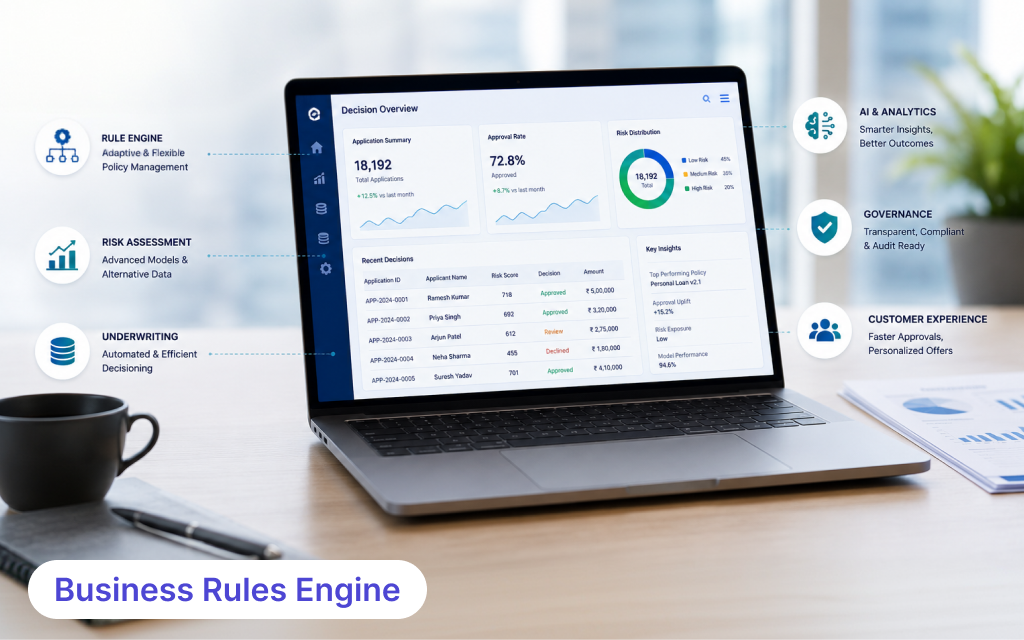
Every lending institution competes on three things: speed, risk, and customer experience.
The challenge is that all three depend on decisions.
Who gets approved. What offer is presented. Which risk policy applies. When an application moves forward. These decisions influence growth, profitability, compliance, and portfolio quality more than almost any other operational function.
This is why Credit Decision Software has become an important capability for banks, credit unions, and NBFCs. By centralizing decision rules, data, risk policies, and decision logic, it helps lenders automate and manage credit decisions more consistently across the lending lifecycle.
Yet many institutions still struggle to adapt quickly.
Product teams want to launch new lending programs. Risk teams need to refine policies. Compliance teams must respond to evolving regulations. But decision logic often remains buried inside code, creating bottlenecks that slow execution and increase operational dependency.
The issue is not automation.
The issue is control.
Modern lenders need decisioning systems that allow business teams to adapt policies, test outcomes, and respond to market changes without waiting for lengthy development cycles.
That shift is redefining the role of Credit Decisioning Software from a back-office tool into a strategic business capability.
Why Traditional Rule Engines Are Holding Lenders Back

Traditional rule-based approaches can create decision friction, while modern decision intelligence enables more configurable and transparent decision processes.
A decade ago, lending environments were relatively stable.
Products changed infrequently. Regulatory requirements evolved slowly. Risk models remained consistent for extended periods.
Today’s environment looks very different.
Embedded finance, co lending, digital onboarding, alternative data, and evolving compliance requirements have dramatically increased complexity. Decision logic must evolve continuously.
Unfortunately, many traditional rule engines were not designed for this pace.
Their limitations typically include:
- Hard coded business rules
- Heavy IT dependency
- Limited visibility into rule logic
- Slow testing and deployment cycles
- Difficult auditability
The business impact can be significant.
A fast growing lender in Southeast Asia attempted to launch a time sensitive promotional lending campaign. Although product and risk teams finalised eligibility criteria quickly, the required rule changes remained dependent on development resources.
The campaign launch was delayed by several weeks, reducing expected business impact and creating internal friction between business and technology teams.
These situations occur because static decision logic creates organisational bottlenecks.
When every rule change requires technical intervention, agility disappears.
This is why institutions increasingly adopt Credit Decisioning Platforms that place control closer to business users while maintaining governance and compliance.
Five Capabilities Defining Modern Credit Decision Software

Five capabilities that support modern credit decisioning: visual rule design, simulation, intelligent data handling, adaptive decisioning, and reusable rule architecture.
The strongest lending organisations no longer evaluate decision engines based solely on automation. They evaluate modern Credit Decisioning Software based on how well it enables adaptability, control, and continuous improvement. These capabilities are closely connected to how automated underwriting software manages decision policies, risk assessment, and underwriting workflows.
They evaluate them based on adaptability.
Visual Rule Design
One of the biggest challenges in lending is visibility.
Product teams define policies. Risk teams approve them. Technology teams implement them.
When issues emerge, tracing the source becomes difficult.
Modern Credit Decisioning Software solves this through visual rule design.
A credit decision engine can provide the underlying framework for configuring and executing this decision logic.
Instead of hiding logic in code, rules are displayed as transparent workflows that business teams can understand, review, and modify.This improves collaboration while reducing implementation errors.
Simulation and Testing
Every policy change creates potential risk.
A small modification to eligibility criteria can impact approval rates, portfolio quality, and customer acquisition performance.
Modern Credit Decisioning Platforms allow lenders to test rules against historical data before deployment.
This enables teams to answer critical questions:
- How many applications will be affected?
- What is the expected impact on risk?
- Which borrower segments are influenced?
Testing before deployment reduces uncertainty and improves confidence.
Intelligent Data Handling
Modern lending decisions increasingly rely on data beyond traditional credit reports. This broader data environment can strengthen credit risk assessment by giving lenders more inputs for evaluating borrower risk.
Institutions now evaluate:
- Open banking information
- API based data sources
- Alternative credit scoring signals
- Partner ecosystem data
- Behavioural information
The challenge is not obtaining data.
The challenge is using it efficiently.
Modern credit scoring software can help lenders turn relevant borrower and risk data into structured inputs for decision strategies. Modern Credit Decisioning Software can support dynamic data structures, API integrations, and real-time decisioning while reducing the need for extensive custom development.
Adaptive Decisioning
Traditional rule engines execute predefined logic. Modern decisioning systems can incorporate outcome data and feedback loops to help lenders refine decision strategies over time. This is an important shift in lending technology.
McKinsey research suggests that institutions implementing adaptive credit decisioning frameworks can improve approval performance while reducing portfolio risk through continuous optimisation and feedback loops.
This allows lenders to refine decision strategies based on actual performance rather than assumptions.
Reusable Rule Architecture
As institutions expand products, channels, and partnerships, complexity grows rapidly.
Reusable rule components allow lenders to:
- Launch products faster
- Reduce duplication
- Maintain consistency
- Simplify governance
Rather than rebuilding logic repeatedly, teams can adapt proven decision components across multiple lending journeys.
From Decision Automation to Decision Intelligence

Decision automation executes defined policies, while decision intelligence adds data-driven analysis, outcome feedback, and more adaptive decision management.
The next competitive advantage comes from intelligence.
Many lenders have automated portions of underwriting, onboarding, and approval workflows.
The next competitive advantage comes from intelligence.
This is where modern credit decisioning platforms begin to move beyond automated decision execution toward decision intelligence.
Instead of simply executing predefined rules, it helps institutions understand how decisions perform over time.
Consider a lender noticing lower than expected offer acceptance rates.
A traditional decisioning system may show where a decision outcome is changing. A more intelligence-driven approach can help analyse the factors contributing to that change.
They reveal:
- Which eligibility criteria are causing friction
- Which borrower segments are declining offers
- Which risk thresholds may be overly restrictive
- Which rules require refinement
A fintech lender offering short term credit identified an unexpected drop off point during offer acceptance.
Decision analysis revealed that a specific employment based filter was unnecessarily excluding qualified applicants.
After refining the rule, offer acceptance improved significantly within weeks.
This demonstrates an important shift.
The goal is no longer simply automating decisions.
The goal is continuously improving them.
Institutions move from:
- Decision automation
- To decision optimisation
- Static policies
- To adaptive policies
- Periodic review
- To continuous improvement
That is the foundation of modern lending intelligence.
Building Trust, Transparency, and Governance into Every Decision

Explainable decisioning connects applied rules, data inputs, rule versions, user actions, and decision records to support transparency and governance.
As lending becomes more automated, explainability becomes more important.
Every risk leader, auditor, regulator, and compliance officer eventually asks the same questions:
- Why was this applicant approved?
- Why was another declined?
- Which rule was active at the time?
- Who modified the decision logic?
Without clear answers, automation creates risk rather than reducing it.
Modern Credit Decisioning Software addresses this challenge through explainability, governance, and version control.
Every decision should include:
- Applied rules
- Data inputs
- Decision outcomes
- Rule versions
- User actions
Explainable decision frameworks can strengthen regulatory readiness, operational trust, and governance.
Version control is particularly valuable.
Rules change frequently.
Months later, institutions may need to recreate the exact logic that was active during a specific decision.
Strong governance capabilities make this possible.
A large NBFC facing regulatory review was able to demonstrate precisely how its lending decisions were generated, including rule history and supporting data. The ability to provide complete transparency helped accelerate audit reviews and reduce operational disruption.
Trust is not created by automation alone. It is strengthened when credit decisions are transparent, explainable, traceable, and defensible.
The Future of Lending Belongs to Adaptive Decisioning

A credit decision engine can combine data sources, validation, decision rules, risk assessment, and analytics to produce configured lending decisions.
Lending is becoming more dynamic every year.
New products emerge faster. Risk conditions evolve more frequently. Customer expectations continue to rise. Regulatory oversight becomes increasingly complex.
In this environment, static rule engines can become operational constraints because they make it harder to adjust decision policies as products, risk conditions, and regulatory requirements change.
Modern lenders require Credit Decisioning Software that combines adaptability, transparency, automation, and intelligence within a single framework, allowing decision policies to evolve as products, borrower segments, risk conditions, and regulatory requirements change.
How Decision.ezee Applies Modern Credit Decisioning
decision.ezee applies these principles through a no-code approach to credit decisioning, combining decision logic, governance, workflow orchestration, and automation within the lending process.
By combining no-code decisioning, intelligent decision logic, governance, workflow orchestration, and AI-powered automation, ezee.ai helps institutions translate policy into executable decision workflows while maintaining greater visibility and control over how decisions are configured and managed.
It can complement loan origination, underwriting, and collections processes by giving institutions a configurable layer for applying decision policies as lending products and requirements change.
Credit decisioning is evolving from static rule execution toward more adaptive, transparent, and intelligence-driven decision management.
Conclusion
For financial institutions, the objective is not simply to automate more decisions. It is to create a decisioning environment where policies can evolve, outcomes can be evaluated, and every decision remains governed and explainable.
The institutions that will lead the next decade of lending will not necessarily be those with the most data. They will be the ones that make the best decisions with it.
Frequently Asked Questions
A credit decision engine automates or orchestrates credit decisions using configurable rules, data, and models. Traditional underwriting typically relies more heavily on analyst review, manual assessment, and sequential checks, although modern underwriting processes can combine both automated and human decisioning.
Cloud-based credit decisioning software can support faster deployment, elastic scaling, and centralized updates, while on-premises deployments can provide greater control over infrastructure and data-management requirements. The appropriate model depends on an institution’s security, regulatory, integration, and operational requirements.
An AI-enabled decision engine can analyze multiple borrower and risk signals more efficiently than manual assessment. Depending on the implementation, these models can complement rule-based decisioning by identifying patterns across income, behavior, bureau data, and other relevant signals. Explainability mechanisms such as rule traces and model factors can provide additional context for decision outcomes.
Credit decisioning software accelerates approvals by running KYC, bureau pulls, and policy rules in parallel instead of sequential reviews. When an application is submitted, eligibility, limits, and pricing can be evaluated automatically as part of the decision workflow, depending on the configured rules, data sources, and integrations Industry benchmarks show automated decisioning reduces approval cycles from days to minutes .
Credit decisioning software reduces defaults by enforcing consistent policy checks and early risk signals across every application. It flags high risk patterns missed in manual reviews, especially in unsecured lending. McKinsey notes disciplined automated underwriting can lower delinquency rates by 15 percent over time .
Lenders should look for configurable rule engines, real-time data integrations, and version-controlled policy management. These capabilities can help teams adapt decision policies and launch or modify lending products without relying on code changes for every policy adjustment, depending on the platform’s architecture and implementation.
Modern credit decisioning platforms can expose APIs for services such as bureau checks, identity validation, and eligibility assessment. These APIs allow developers to embed decisioning capabilities into loan origination systems, mobile applications, and other digital lending journeys.
AI in credit decisioning can analyze borrower and portfolio data to identify patterns relevant to repayment risk, fraud, affordability, or other decision factors. Depending on the implementation, these model outputs can complement rules, scorecards, or other decision strategies. Human oversight, validation, and governance remain important when AI is used in regulated lending decisions.
Financial institutions can integrate credit decisioning software through APIs connecting systems such as a loan origination system, KYC services, credit bureaus, and loan-management systems. Decision responses can then trigger workflows such as approval, manual review, or rejection. Integration should also preserve appropriate audit trails, access controls, and governance requirements for regulated lending environments.
Lenders can customize credit decisioning software by defining product-specific rule sets, eligibility criteria, and segment thresholds within the decision engine. For example, an MSME lending policy may incorporate business cash-flow or financial-statement criteria, while a salaried lending policy may place greater emphasis on employment and income characteristics. Policy-based segmentation can help apply the appropriate decision logic consistently across borrower and product segments.
