
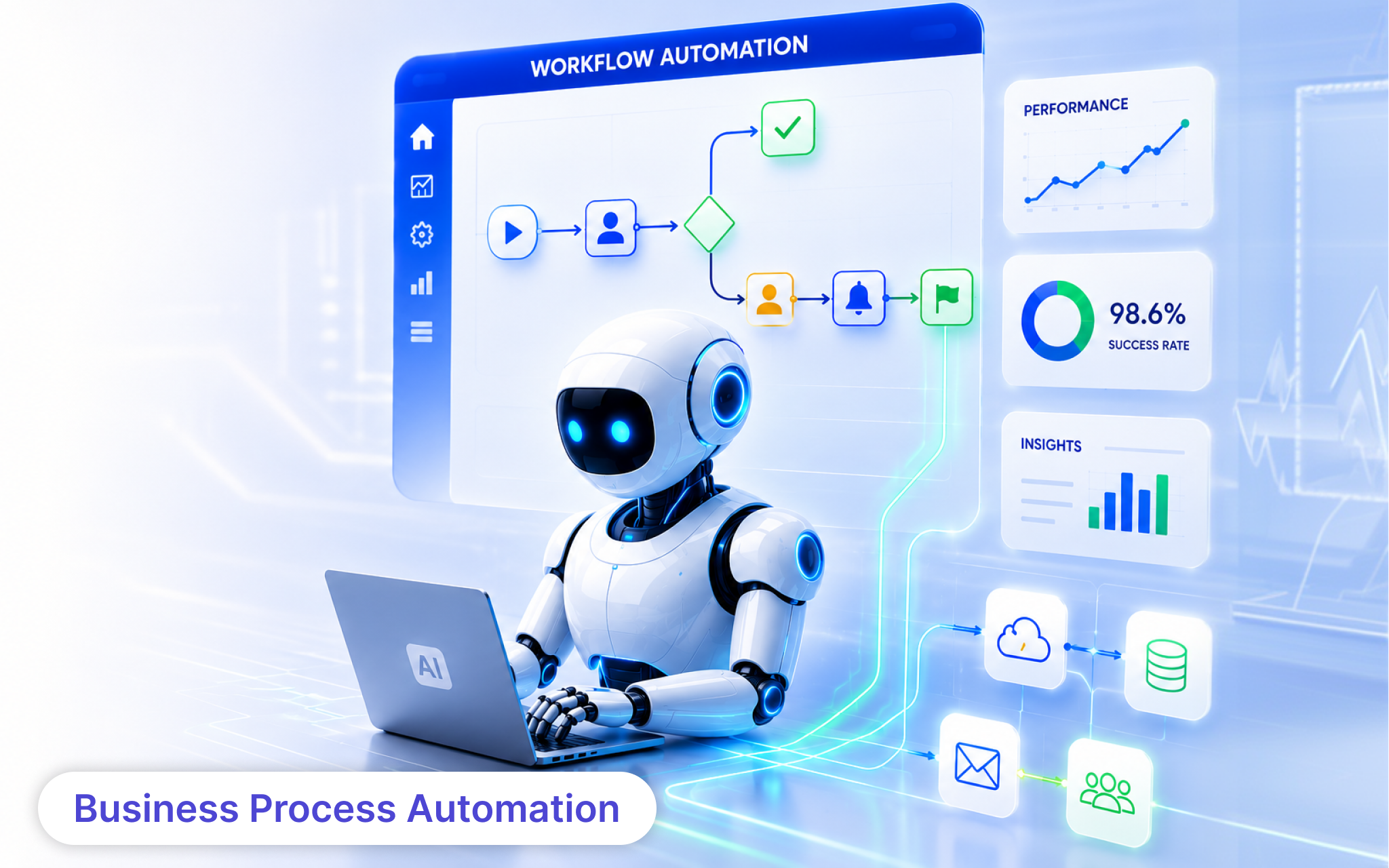
Why Enterprise Workflow Automation Is the Next Competitive Battleground

For years, enterprise workflow automation was viewed as a back office efficiency tool, designed to reduce costs, eliminate manual effort, and improve operational productivity. That view no longer reflects reality.
In 2025, workflows have become the operating system of the modern enterprise. They determine how quickly organisations adapt, launch new products, respond to change, and convert strategy into execution. Gartner projects that by 2026, more than 80 percent of enterprises will have formal workflow automation strategies, up from just 30 percent in 2020. Meanwhile, Forrester expects the automation software market to surpass 65 billion dollars by 2027. The message is clear: automation is no longer a technology initiative. It is a business growth strategy.
The shift is driven by a simple reality. Enterprises no longer compete through isolated processes. They compete through the speed and quality of their workflows. Whether it is a loan approval, claims settlement, patient journey, supply chain decision, or product launch, every outcome depends on how effectively work moves across people, systems, and decisions.
The first wave of automation focused on efficiency. Organisations reduced manual tasks, lowered processing costs, and improved cycle times. Those gains remain valuable, but they are no longer enough. According to Deloitte research, organisations that scale automation as part of broader transformation initiatives achieve significantly stronger business outcomes than those focused solely on efficiency.
The leaders are now using workflow automation to create entirely new capabilities:
- Faster time to market through automated product and service launches
- Better customer experiences through frictionless, personalised journeys
- Higher workforce productivity by freeing teams from repetitive work
- Greater resilience through embedded controls, compliance, and adaptive workflows
- Stronger decision making through real time data and process intelligence
This shift also changes how ROI is measured. Traditional metrics such as hours saved and cost reduction remain important, but leading organisations increasingly focus on:
- Revenue acceleration
- Working capital improvements
- Risk reduction
- Customer retention
- Innovation velocity
The most successful enterprises no longer view automation as process improvement. They view it as enterprise architecture. Workflows have become the connective layer between strategy, execution, customer experience, and growth.
The competitive advantage of the next decade will not come from having more resources. It will come from how effectively organisations design, orchestrate, and continuously optimise the workflows that move value across the business.
Breaking the Legacy Trap: Why Incremental Fixes Fail
Enterprise automation is full of pilots that delivered quick wins but never scaled. While incremental fixes feel safe, they often create long term inefficiencies that limit transformation.
Why Incrementalism Persists
Departmental automation is often the preferred starting point because it appears lower risk and easier to fund. Gartner’s 2024 CIO survey found that 62 percent of enterprises begin with departmental automation initiatives rather than enterprise wide programs.
The challenge is scale. Research shows that nearly 70 percent of automation pilots fail to progress to enterprise adoption, not because the technology fails, but because isolated tools cannot support end to end business workflows.
The Cost of Fragmentation
What starts as a collection of tactical solutions often becomes difficult and expensive to maintain. Deloitte’s Automation with Intelligence 2023 study found that organisations with fragmented automation environments spend up to 40 percent of their automation budgets on maintenance rather than innovation.
This creates what McKinsey describes as automation debt where disconnected tools, scripts, and workflows become increasingly difficult to adapt as business requirements evolve.
When Growth Gets Stuck
Fragmentation creates visible gaps in customer journeys and operational execution. A bank may automate credit assessment while leaving disbursement workflows manual. A hospital may digitise scheduling but retain disconnected claims processes.
The result is inconsistency, delays, and poor customer experiences. According to PwC, 32 percent of customers will stop doing business with a brand after a single bad experience.
Beyond customer impact, fragmented workflows limit enterprise visibility, making it harder to identify bottlenecks, manage risk, and optimise performance across the organisation.
Moving Beyond Patchwork Automation
Breaking the legacy trap does not require replacing every existing system. It requires a shift from task automation to workflow orchestration.
Leading organisations are:
- Designing around end to end value streams rather than departments
- Adopting unified no code workflow platforms
- Embedding governance, compliance, and auditability into workflows
According to Accenture’s 2024 research on enterprise operations, organisations with fully modernised, AI led processes achieve 2.4 times greater productivity and 2.5 times higher revenue growth than their peers, highlighting the value of transforming end to end workflows rather than automating isolated tasks.
The real opportunity is not operational efficiency alone. Unified workflow automation gives organisations the agility to launch faster, adapt quicker, and scale innovation without accumulating complexity.
Enterprise Workflow Automation and the AI Shift

Workflow automation is entering a new phase. What began as rule based task execution is evolving into intelligent orchestration powered by AI. The question is no longer whether to automate, but how deeply AI is embedded into enterprise workflows.
AI Moves to the Core
Traditional automation delivered efficiency through predefined rules and triggers. But modern enterprises operate in environments shaped by changing customer expectations, regulatory shifts, and market volatility. Static workflows struggle to keep pace.
AI changes this dynamic. It enables workflows that can analyse signals, adapt in real time, and continuously improve. Instead of following fixed paths, workflows become intelligent systems that learn, optimise, and evolve with the business.
How AI Reshapes Workflows
Three capabilities are driving this shift:
- Predictive routing identifies bottlenecks before they occur and dynamically redirects work to maintain flow.
- Anomaly detection flags unusual patterns across transactions, operations, or customer interactions before they become business risks.
- Self healing processes automatically resolve issues by reallocating resources, adjusting workflows, or triggering corrective actions.
Together, these capabilities move automation beyond execution toward continuous optimisation and resilience.
The Business Impact
AI driven workflows deliver measurable value across operations.
- Faster resolution times and improved process efficiency
- Reduced operational disruptions through early risk detection
- Lower support and maintenance costs through automated remediation
- Stronger customer experiences through faster and more consistent outcomes
The impact extends beyond efficiency. Organisations that mature in AI enabled automation consistently outperform peers in growth, agility, and operational performance.
What It Means for Leaders
For executives, AI driven enterprise workflow automation delivers three strategic advantages:
- Decision velocity through faster movement from insight to action
- Operational resilience through real time adaptation to disruption
- Scalable innovation through workflows that continuously learn and improve
The real shift is conceptual. Automation once meant doing the same work faster. AI enables workflows to anticipate what happens next, identify issues before they escalate, and respond proactively.
As workflow platforms evolve into intelligent operating systems, competitive advantage will increasingly depend not on automation alone, but on how effectively AI is embedded into the flow of work. Enterprises that make this shift will gain faster execution, stronger resilience, and a lasting capacity to adapt and grow.
Cloud Native Workflow Orchestration: Beyond Deployment to Ecosystem Play

Cloud native is no longer just a deployment model. Its real value lies in orchestrating workflows across customers, partners, regulators, and data ecosystems in real time.
A cloud based workflow alone is still a silo. The advantage comes when orchestration connects customer journeys, compliance checks, third party services, and operational systems into a single flow. This shifts enterprises from digitising tasks to orchestrating entire operating models.
From Cloud Migration to Connected Operations
Early cloud adoption focused on infrastructure. Today, orchestration enables institutions to connect multiple systems in real time, dramatically reducing cycle times and creating seamless experiences.
Whether in banking, healthcare, or manufacturing, orchestration synchronises processes across functions, partners, and channels. Instead of disconnected handoffs, organisations operate through coordinated, end to end workflows.
The Network Effect Advantage
Every new integration strengthens the ecosystem. When workflows connect data sources, partners, and services through a common orchestration layer, organisations gain greater visibility, responsiveness, and adaptability.
The value no longer comes from individual systems. It comes from how effectively they work together.
The Strategic Payoff
Orchestrated workflows deliver:
- Lower operating costs
- Faster time to market
- Real time compliance adaptation
- Greater operational agility
- Faster innovation cycles
More importantly, they create a foundation where every new capability compounds the value of the ecosystem.
The Rise of No-Code Configurability and Citizen Automators

For decades, technology control sat firmly within IT departments. Business users were expected to consume what was built for them, not shape the tools themselves.
That model is now collapsing. In 2025, no-code configurability and citizen automation are emerging as strategic levers, not risks. What was once dismissed as shadow IT is being reframed as distributed agility under governance.
1. Beyond Shadow IT: Governance Built In
- Old fear: Business teams adopting their own tools would fragment processes and compromise security.
- New reality: Enterprise-grade no-code platforms now include role-based permissions, audit trails, and compliance monitoring by design.
- Result: Business users gain freedom to adapt workflows, while IT retains oversight through centralized controls.
This shows that no-code does not erode governance but rather strengthens it by embedding compliance into daily workflows instead of bolting it on later.
2. Agility as a Collective Mandate
- Traditional model: Every request routed through IT created long queues and bottlenecks.
- No-code shift: Business users become active problem-solvers, adjusting workflows in real time without needing technical expertise.
- Impact: Gartner projects that by 2026, 80 percent of enterprises will have citizen development programs through no-code platforms, delivering applications and workflows up to four times faster than conventional approaches.
This reframes agility from being the job of IT alone to being the shared responsibility of the entire enterprise.
3. Innovation at the Edges
- Frontline teams like sales, operations, customer service see inefficiencies and opportunities daily.
- With no-code, those insights can be translated directly into automation without waiting for central IT sprints.
- Examples:
- A financial institution achieved 35 percent faster onboarding through unified loan origination systems.
- In manufacturing, supervisors built no-code dashboards that improved throughput by tracking anomalies in real time.
This shows that the most valuable automation opportunities often live outside the IT core, and no-code brings them to light.
4. Guardrails that Enable, Not Restrict
- Concern: Too much freedom creates chaos.
- Reality: Modern no-code ecosystems balance autonomy with oversight. IT defines data standards, integration protocols, and security rules. Within those boundaries, business users innovate freely.
- This hybrid model transforms governance from being a blocker to being an enabler of scale.
Think of it as freedom within frameworks – creativity flows, but nothing escapes compliance.
5. From Cost Efficiency to Growth Creation
- First-generation automation was measured in cost savings.
- The new lens: Citizen automators create entirely new forms of value – faster product launches, improved customer experiences, and real-time adaptability.
- Deloitte’s 2024 survey found that companies leveraging distributed automation reported up to 20 percent uplift in top-line growth compared with peers that only focused on efficiency.
This signals a clear shift: the question is no longer “How much money do we save?” but “How much growth can we enable?”
No-code configurability is not a workaround. It is the operating philosophy of adaptive enterprises. By reframing shadow IT as distributed innovation, organizations unlock agility at scale without sacrificing governance. Citizen automators are not a threat. They are the workforce’s new growth catalysts.
Risk, Compliance, and Governance in Automated Enterprises
Automation at scale is not only about speed or efficiency. It introduces new layers of complexity that must be handled with deliberate design.
The three areas that decide whether automation becomes an advantage or a liability are risk, compliance, and governance.
Each comes with its own pitfalls and requires a distinct approach to resolution.
1. Risk in Automated Enterprises
Automation amplifies risks because decisions once handled manually are now executed at scale and in real time. These risks fall into three broad categories:
- Operational risks: System failures or downtime can instantly disrupt entire business lines because workflows are interconnected. A glitch in one rule can cascade across dependent processes.
- Data and algorithmic risks: Automated workflows rely on vast datasets and models. If inputs are biased, incomplete, or compromised, outputs will mirror those flaws. Algorithmic bias in lending or healthcare can damage reputation and invite legal scrutiny.
- Security risks: Increased reliance on APIs, third-party integrations, and cloud environments creates more attack surfaces for cybercriminals. Automation magnifies both the speed and scope of exploitation.
How it is solved:
- Embed real-time anomaly detection to flag irregularities before they escalate.
- Use circuit breakers to pause workflows automatically when thresholds are breached.
- Conduct stress-testing and simulations of workflows under different scenarios, ensuring resilience against both expected and unforeseen disruptions.
- Treat risk management as continuous rather than periodic, with monitoring baked directly into the orchestration layer.
2. Compliance in Automated Enterprises
Traditional compliance models depend on manual reviews and documentation. This breaks down in an automated environment where thousands of transactions occur simultaneously. The risks here are:
- Regulatory exposure: Automated decisions that bypass mandated checks can result in fines and sanctions.
- Reputation risks: Customers and partners lose trust when errors in compliance are exposed publicly.
- Latency of updates: Regulations change frequently, and manual updates lag behind, leaving enterprises vulnerable.
How it is solved:
- Shift from compliance as paperwork to compliance as code, where regulatory rules are expressed in decision logic that systems execute automatically.
- Embed regulatory checks directly into workflows (for example, eKYC and digital identity verification within lending journeys).
- Maintain immutable audit trails for every action and decision, ensuring traceability for regulators and internal reviews.
- Enable real-time policy updates, so new mandates can be deployed immediately instead of waiting for IT releases.
By embedding compliance directly into operational flows, enterprises gain in-flight assurance rather than relying on after-the-fact correction.
3. Governance in Automated Enterprises
Governance ensures automation operates in line with enterprise priorities and ethical standards. Without it, organisations face chaos from uncoordinated bots, workflows created outside central oversight, or opaque AI models.
The challenges of governance include:
- Lack of accountability: Without clear ownership, it becomes unclear who approves or manages a process.
- Shadow processes: Teams build automations independently, creating conflicts, redundancies, or security risks.
- Opaque decisioning: AI-driven workflows can produce outputs no one understands or can justify, creating compliance and trust issues.
How it is solved:
- Define clear role-based permissions so only authorised individuals can create, modify, or deploy workflows.
- Deploy central monitoring dashboards that provide a unified view of automated processes across the enterprise.
- Implement explainability through centralized decisioning engines enabling business control.
- Align governance with strategic objectives, ensuring that automation accelerates long-term value creation rather than creating fragmented, siloed gains.
Measuring Success in 2025: From SLAs to Business Outcomes

In the past, success in enterprise workflow automation was often judged by service-level agreements. Metrics such as processing speed, system uptime, and task completion were considered sufficient. Today, those indicators are only part of the picture. Success is now defined by how automation drives growth, resilience, and adaptability across the enterprise.
1. Scalable Value
- Enterprises are asking whether workflows can expand capacity without proportionate increases in staff or infrastructure.
- Automation must handle spikes in demand, seasonal surges, and new product launches without bottlenecks.
- Example: Financial institutions processing triple volume through debt collection software optimizing operations demonstrate scalable workflows. Scale is now measured by elasticity rather than size.
2. Sustainable Growth
- It is not enough to process more tasks; growth must be high quality, reliable, and enduring.
- Automation should reduce operational errors, optimize resources, and strengthen long-term relationships.
- Example: Insurers accelerating claims settlement are not just saving time they are enhancing policyholder trust and retention, which drives repeat revenue and profitability.
3. Trust and Compliance Advantage
- Compliance and risk management are no longer solely defensive.
- Automated workflows create transparent audit trails, embedded controls, and reliable adherence to regulations, giving enterprises a strategic edge.
- Example: A supply chain with fully automated compliance checkpoints can meet strict contractual requirements, enabling new partnerships and faster market entry.
4. Adaptable Customer Experiences
- Enterprises evaluate how quickly workflows can adjust to evolving customer expectations or regulatory changes.
- Traditional dashboards and static satisfaction scores provide incomplete insight; agility matters more.
- Example: Healthcare providers dynamically reallocating resources and patient scheduling maintain consistent service quality during demand spikes, ensuring superior patient experiences.
5. Innovation Throughput
- Workflow automation is assessed by how effectively ideas move from concept to production.
- Workflows must support rapid testing, refinement, and scaling of new offerings to create tangible business outcomes.
- Example: Manufacturers implementing automated production workflows can test and launch new processes in weeks instead of months, accelerating time to market and revenue capture.
6. Outcome-Oriented Enterprise Dashboard
Enterprises today monitor automation using outcome-based measures rather than SLA compliance alone:
- Can value scale efficiently without increasing cost?
- Does growth improve in quality and sustainability?
- Are trust and compliance embedded as competitive advantages?
- How quickly can customer experiences adapt to change?
- Can innovation move seamlessly from idea to execution?
Focusing on these metrics ensures that workflow automation is a driver of agility, resilience, and strategic growth, not merely a tool for operational efficiency. Enterprises that adopt this approach are better equipped to compete, adapt, and create lasting value in an environment defined by rapid change and high expectations.
Future Horizons: Autonomous Enterprises and Self-Optimizing Workflows

Enterprises today operate in an environment defined by speed, complexity, and unpredictability. Markets shift rapidly, customer expectations evolve continuously, and operational risks can emerge without warning. Traditional automation, which executes predefined tasks efficiently, is no longer sufficient. The next evolution is the autonomous enterprise, where workflows are not only automated but capable of sensing changes, making decisions, and optimizing themselves continuously. In this paradigm, operations move from reactive execution to proactive and adaptive orchestration, turning every process into a dynamic contributor to growth and resilience.
Autonomous workflows leverage real-time data, embedded intelligence, and integrated decision logic to respond to disruptions, adapt to evolving demands, and create new opportunities. This is not hypothetical. Early adopters across manufacturing, finance, healthcare, and logistics have demonstrated that embedding intelligence and adaptability directly into operational flows leads to measurable gains in efficiency, revenue, and customer satisfaction. The core principle is simple: workflows that can think, learn, and adjust continuously unlock value far beyond what static automation can deliver.
1. Workflows That Sense and Respond
- Autonomous workflows detect changes across systems, customer behavior, or market conditions and respond without manual intervention.
- Real-time analytics and operational monitoring allow immediate adaptation.
- Example: A manufacturing plant can reroute production automatically when a critical component is delayed, reducing downtime and preserving output.
2. Decision-Making Embedded in Operations
- Intelligence is no longer separate from execution. Workflows evaluate options and act instantly based on embedded rules and data signals.
- Example: In banking, loan approval workflows through intelligent decisioning platforms adapt dynamically to risk signals.
3. Continuous Optimization
- Self-optimizing workflows improve efficiency and outcomes with every execution.
- Machine learning identifies bottlenecks, redundancies, and emerging risks, adjusting flows automatically.
- Example: Retail enterprises optimize inventory replenishment continuously, reducing overstock and preventing stockouts, leading to higher revenue and customer satisfaction.
4. Integration Across the Enterprise
- Workflows connect departments, systems, and partner networks into a single adaptive operational ecosystem.
- Changes in one area propagate intelligently across all relevant processes.
- Example: Insurance claims automation integrates underwriting, fraud detection, and customer communication so updates in one function immediately inform the others, reducing cycle times.
5. Predictive and Proactive Operations
- Workflows anticipate disruptions before they occur using predictive insights from historical and external data.
- Example: Logistics companies can reroute deliveries proactively based on traffic and weather forecasts, maintaining reliability and customer trust.
6. Innovation Embedded in Operations
- Workflows remove friction for experimentation, allowing new ideas to move from concept to execution seamlessly
- Example: Healthcare providers integrate new patient care protocols directly into operational workflows, enabling continuous improvement without disruption.
7. The Enterprise of Tomorrow
The autonomous enterprise shifts focus from task completion to dynamic operational intelligence, adaptability, and continuous learning. Metrics of success include speed of adaptation, accuracy of decisions, seamless integration across functions, and the ability to embed innovation in everyday operations. Enterprises adopting self-optimizing workflows are not only more agile but are creating competitive advantage through intelligence, resilience, and growth.
Executive Wrap-Up
Enterprises today are navigating an environment where speed, complexity, and unpredictability define the competitive landscape. Traditional automation, built to optimise isolated tasks, is no longer sufficient. What is required now is a fundamental re-architecture of the enterprise operating model, with workflows serving as the connective fabric that aligns people, systems, and decisions.
Enterprise Workflow Automation represents this shift. It moves beyond incremental efficiency to create an operating system where processes are intelligent, connected, and adaptable. Workflows are no longer static sequences. They evolve with market dynamics, regulatory expectations, and customer demands, enabling enterprises to respond with precision and scale.
The foundation of this transformation lies in a set of interrelated capabilities that work together to make workflows truly intelligent and adaptive. No-code configurability allows business teams to adjust processes rapidly without waiting on IT. Cloud-native orchestration connects partners, data flows, and compliance frameworks into a seamless operational ecosystem, ensuring that each element interacts harmoniously. AI-driven intelligence provides predictive insights and continuous optimisation, enabling faster and more informed decisions. Embedded within these workflows, governance and compliance are no longer bolt-ons but intrinsic to operations, integrating requirements from GDPR, SOX, AML, and industry-specific mandates directly into the flow of business.
The impact is significant. Enterprises adopting workflow automation report accelerated product launches, lower operating costs, stronger customer engagement, and greater resilience in the face of disruption. Each advantage compounds as workflows self-optimise, creating a foundation for sustained growth.
This is where process.ezee becomes a natural fit. Designed as an intelligent automation-as-a-service platform, it integrates robotic and cognitive automation, AI and machine learning models, and an intuitive workflow designer that empowers both technical and non-technical teams. It goes beyond task-level automation by enabling end-to-end process orchestration, from customer onboarding and loan processing to compliance monitoring and reporting. With inbuilt connectors for web, desktop, OCR, email, and device-level integrations, enterprises can unify fragmented systems without heavy upfront investment.
process.ezee also embeds security and governance at its core, with role-based access controls, detailed audit logs, and industry-standard encryption ensuring compliance is continuous. Its modular, pay-as-you-need model provides maximum flexibility, allowing enterprises to scale automation at their own pace while ensuring faster ROI and measurable topline growth.
For executive leaders, the imperative is clear. Enterprise workflow automation is not a tactical investment in efficiency. It is a strategic re-architecture of how the enterprise operates, competes, and evolves. Platforms like Process.ezee provide the foundation to translate that vision into reality, equipping enterprises with the agility, resilience, and intelligence required to lead in a world that refuses to stand still.
Frequently Asked Questions
Enterprise workflow automation is the use of software to route tasks, data, and decisions across teams and systems without manual handoffs. It standardizes repeatable processes like loan application review, KYC checks, or exception approvals. Banks use it to reduce turnaround time and dependency on emails and spreadsheets.
Enterprise process automation automates entire business processes by combining workflows, rules, and system integrations. It triggers actions based on data events like application submission or bureau response. For example, once CKYC is verified, the process auto routes the case to underwriting or disbursal, reducing delays per Gartner.
Workflow automation orchestrates end to end processes and decisions, while RPA mimics human actions on screens.
| Aspect | Workflow Automation | RPA (Robotic Process Automation) |
|---|---|---|
| Lending Example | Decides when to pull CIBIL data or route to underwriting. | Logs into legacy systems for data entry or extraction. |
| Scalability Advantage | Scales better for compliance-driven processes. Gartner notes superior handling of rule-based, auditable flows. | Best for isolated, screen-scraping tasks; less flexible for complex orchestration. |
Yes, no code automation platforms let teams design workflows using visual builders without writing code. Credit teams can configure KYC checks, approval paths, or exception rules directly. This reduces IT dependency and speeds policy changes, with many enterprises reporting faster deployment cycles per Forrester.
Workflow automation primarily improves:
- Speed
- Consistency
- auditability
In lending, it shortens application to approval time and reduces manual errors in KYC and underwriting. Studies show automated workflows can cut processing time by over 50 percent while improving compliance traceability per McKinsey.
Automation slashes costs 10-15% by automating 30% of sales activities like order processing, per McKinsey. In lending, it eliminates data entry errors during CKYC pulls, avoiding rework. Fewer mistakes mean faster disbursals and lower default risks.
- Evaluate workflow complexity, integration depth, compliance requirements, and policy change frequency
- High volume lenders require API led integration with credit bureaus and core lending systems
- Platforms should support versioned rule control for audits and controlled rollbacks
- Scalability and audit readiness matter more than feature count for sustained ROI, per Gartner
AI + no-code platforms scale workflows for 10x loan volumes via drag-and-drop rules and auto-optimizing agents. They adapt fast to regs like co-lending by tweaking flows without code. McKinsey notes 20-25% productivity gains handle peaks seamlessly.
Designing a workflow starts with:
- Defining workflow triggers, decision rules, and routing paths upfront
- Mapping integrations such as CKYC, credit bureau, or bank statement APIs
- Configuring exception handling and escalation logic
- Enabling straight through processing for low risk loans, with edge cases routed to credit officer review to balance speed and control.
Enterprise workflow tools integrate via APIs, pre-built connectors, and plugins to ERPs/CRMs without disruption. They connect LOS, LMS, bureaus, and document services to orchestrate steps. For example, a bureau response triggers rule evaluation and next action automatically, improving flow without system disruption per Gartner.
