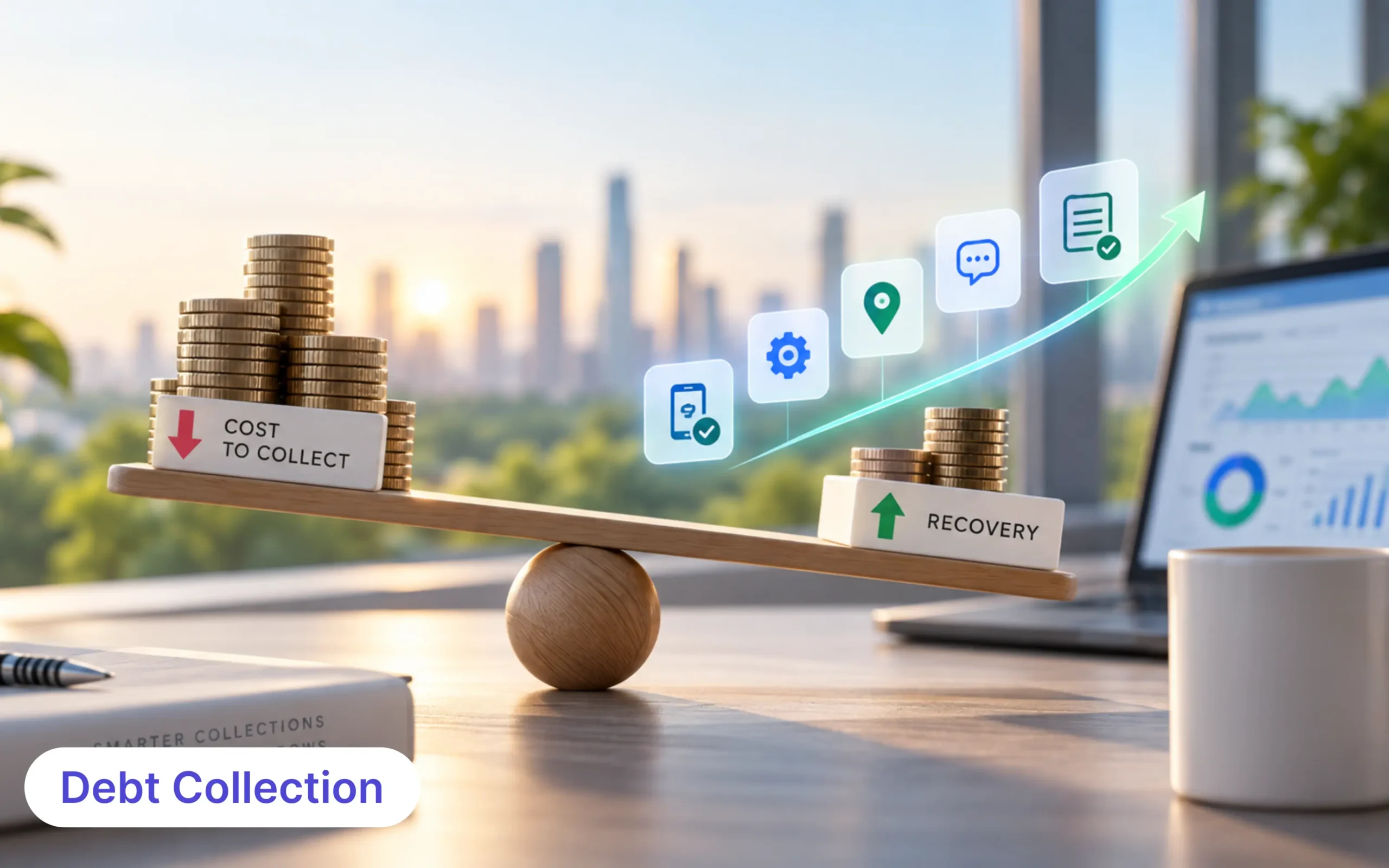
Today’s lender no longer has a choice between increasing collection costs and diminishing recovery rates: that’s a bad situation that continues to make no changes. Manual follow-ups, DPD buckets and field visits, which are rigid and traditionally done, waste money without giving any results. With intelligent automation, behavioral insights and digital self-service, the answer is modern loan collection software that reduces cost-to-collect by as much as 48% and increases recoveries.
Let’s look at 5 different ways loan collection software can revolutionize loan recovery economics without sacrificing results.

The objective is not to automate every collection activity, but to use the lowest-cost channel capable of achieving the required recovery outcome.
1) Scale Self-Service Payments on a Customer-360 Backbone
The highest cost interaction is when your agent contacts you by phone. But a significant number of early-stage delinquencies do not require human intervention – they require clarity, convenience and frictionless payment. Modern loan collection management system platforms provide a single Customer-360 view of borrower data and make them available to customers via digital self-service channels (WhatsApp, SMS, email, web portals), enabling customers to see their dues, select repayment plans and pay instantly without involving an agent.
This change in the paradigm from agent led to self-service solution impacts the cost math significantly. Once implemented, self-service portals can cut costs per recovery by as much as 80% because digital interactions are a fraction of the cost of human calls. Meanwhile, 24/7 access and one-tap payment boosts conversions and maintains the promise-to-pay.
If you are using a built-in Customer-360 solution as part of your loan collection system, you can further reap its advantages. All interactions populate the borrower profile field, helping to inform the next best action decisions with more intelligent borrowers and less duplicity in outreach. The outcome: reduced operating expenses, improved borrower satisfaction, and without losses on the part of the recoveries.
2) Automate Compliance and Audit Trails with a No-Code Rule Engine
Compliance is not a choice, it’s a necessity. However, manual compliance checks and sampled QA checks are costly and prone to errors. A no-code, compliance-driven rule engine applies contact-frequency or time-of-day restrictions, approved templates and escalation policies to each interaction and creates immutable audit logs automatically.
This shifts the quality assurance from 1–2% sampling to 100% coverage, significantly fewer manual reviews. Cost-to-collect can decrease by 30-60% by replacing manual sampling with real-time monitoring in QA. Most significantly, any compliance violations reduce any gains otherwise made, in rollouts, litigation and damage to reputation losses.
Embedded rule engines also enable faster changes in strategy when compared to loan recovery software that lacks them. With drag-and-drop builders, operations teams can tweak policies in hours, rather than weeks, waiting for IT updates to call scripts or escalation rules. When the rules change or there is a need for portfolio rapid course correction, this agility comes into play.
3) Optimize Field Force with Geo-Clustering and Visit Prioritization
Field visits are by far the most costly collection method but are still sent out by many lenders indiscriminately. New daily loan collection software incorporates predictive scoring so that accounts where recovery is likely to be higher than the cost of the visit are prioritized and routes are clustered together to reduce travelling time. This allows field teams to be a precision tool for the most challenging 20-30% of accounts, not a blunt tool for all.
The cost impact is stark. Cost per recovery can drop 60–70% by reserving expensive visits for high-value, high-intent cases. At the same time, higher visit productivity and same-day replanning improve payment outcome per visit, so recovery rates don’t suffer.
This is a game-changer for NBFCs and MFIs with a massive field team. While the agents normally make 8-10 visits a day with a mixed result, they are making 12-15 targeted visits a day and getting higher conversions. The geo-clustering feature in loan collection software also helps to minimize fuel usage, overtime pay, or last mile risks, contributing to further savings.
4) Deploy Autonomous Negotiation Within Lender-Defined Bands
Not all borrowers are able to pay back the full amount, but many can be able to pay back some amount. The difficulty comes when the exact settlement sum is not determined without a tedious process of negotiation. Multi-round settlement discussions are carried out automatically in pre-approved negotiation bands, with counteroffers automatically sent as they are received rather than static offers and “take-it-or-leave-it” offers.
This maximizes the value of willing to pay, but price sensitive borrowers in the policy band. Rapid settlement decreases follow-up periods and agent time for each account, which directly decreases cost to collect. Ability based dynamic offers also boost settlement acceptance and safeguard floor recoveries, leading to overall higher recovery rates.
This is because loan collection system platforms that have autonomous negotiation also lessen the burnout of the agents. agents work on accounts with the highest value, high-risk, and challenging cases instead of repetitive settlement cases, providing the expertise and human judgment needed. This not only increases the efficiency of employees but also increases their retention.
5) Replace Manual Document Chasing with Automated Doc Workflows
Documentation is required for restructuring, cure plans, and legal escalations; however, manual chasing of documents is an expensive and time-consuming process. Automated document collection (checklists, e-sign, reminders, tracking status) saves 2–3 hours of processor time per document and avoids delays in the pipeline due to missing documents.
Money is saved rapidly. Recovering 22–30 hours/month per team can save $770–$1,650 against a $299–$699 software spend. Especially, faster and full documentation shortens restructure approvals and cure completions, holding back more slippages and safeguarding recovery values.
When lenders are using loan recovery software that has built-in document workflows, the advantages are greater than just collections. The cleaner, the better for audit, less legal risk and faster portfolio reporting, the more often the better.

Five operational levers can reduce collection costs while preserving human effort for the cases where it has the greatest impact.
The Bottom Line: Lower Cost, Higher Recovery, Better Experience
The old notion that cutting collection costs leads to fewer recovery is wrong. Modern loan collection software proves you can do both by automating low-value work, optimizing expensive channels, and enabling self-service at scale. Lenders deploying these capabilities report cost-to-collect reductions of 40–48% alongside recovery improvements of 10–25%.
The issue is not if but when! Each month of manual processes, sampled QA and blanket field visits is a month at cost and lost recoveries. Loans collection software, equipped with daily collection and no-code rule engines is no longer a luxury. It becomes the standard for competition-based financing in 2026.
This is exactly where collect.ezee fits into the picture. Built on a no-code, cloud-agnostic architecture, collect.ezee brings together Customer-360 visibility, audit-ready compliance, digital self-service payments, and field-force optimization into a single loan collection management system. Instead of stitching together multiple point solutions, lenders get an end-to-end loan recovery software platform that enforces compliance on every interaction, routes accounts to the right channel at the right time, and lets borrowers resolve dues 24/7 without agent involvement.
For lenders ready to make the shift, the path is clear: start with self-service and compliance automation, then layer in field optimization and autonomous negotiation. With collect.ezee, these capabilities aren’t future roadmap items they’re available today through a drag-and-drop rule builder, pre-integrated digital channels, and real-time audit trails. The result: a leaner, smarter, more resilient collections operation that protects margins without compromising recovery.
Frequently Asked Questions
A legacy loan origination system is an older lending technology platform that supports processes such as application intake, credit assessment, underwriting, approval, and related workflows. These systems can continue to support established lending operations, but heavily customised or tightly coupled architectures may make it harder to introduce new products, integrate new data sources, automate processes, or adapt lending policies efficiently.
An AI lending platform can extend traditional loan origination workflows with AI-assisted analysis, configurable automation, connected integrations, and governed decision support. A legacy loan origination system may continue to manage core application workflows effectively, but its architecture and degree of customisation can make changes and integrations more difficult. The key difference is therefore not simply age, but how effectively the lending environment supports data, workflows, decisioning, integration, and governance.
Yes. Lending modernization does not necessarily require replacing the core banking system. Banks can introduce a modern lending layer that works alongside existing infrastructure through APIs and other integration mechanisms. This approach can modernize customer journeys, workflows, decisioning, and automation while allowing the existing core to continue supporting the systems and transactions for which it remains fit.
Banks should evaluate a modern loan origination platform based on more than its current feature set. Important capabilities include AI-assisted credit analysis, configurable workflows and products, API-first integration, explainable decisioning, governance and auditability, and real-time operational analytics. Institutions should also assess how well the platform fits their existing architecture and how easily it can adapt to changing lending products, policies, data sources, and regulatory requirements.
Common indicators include lengthy technical effort for product or policy changes, disconnected lending workflows, repeated data entry, difficult integration with new data sources or digital channels, heavy reliance on manual credit analysis, and significant effort required for governance or decision traceability. These indicators do not automatically mean that the existing loan origination system must be replaced; they can help the institution determine whether an incremental modernization approach would improve agility and operational efficiency.
References
- https://www.cgi.com/us/en-us/blog/banking-and-capital-markets/debt-management-trends
- https://rel8.cx/blog/agentic-ai-debt-collection-contact-centre-fca-compliant
- https://www.plivo.com/blog/8-best-ai-voice-agents-for-debt-collection-payment-recovery-in-2026/
- https://hubtalk.ai/blog/how-a-national-debt-relief-company-put-its-hardest-calls-on-ai-and-kept-human-level-conversion
- https://retrievables.com/blog/ai-agents-are-reshaping-b2b-collections-heres-whats-actually-working
- https://www.omind.ai/blog/conversational-ai/voice-ai/ai-voice-bot-for-collections/
- https://lydonia.ai/hidden-costs-manual-accounts-receivable-agentic-ai-recovers-revenue/
- https://m.rbi.org.in/Scripts/BS_ViewREwiseDraftDirections.aspx?id=303
