
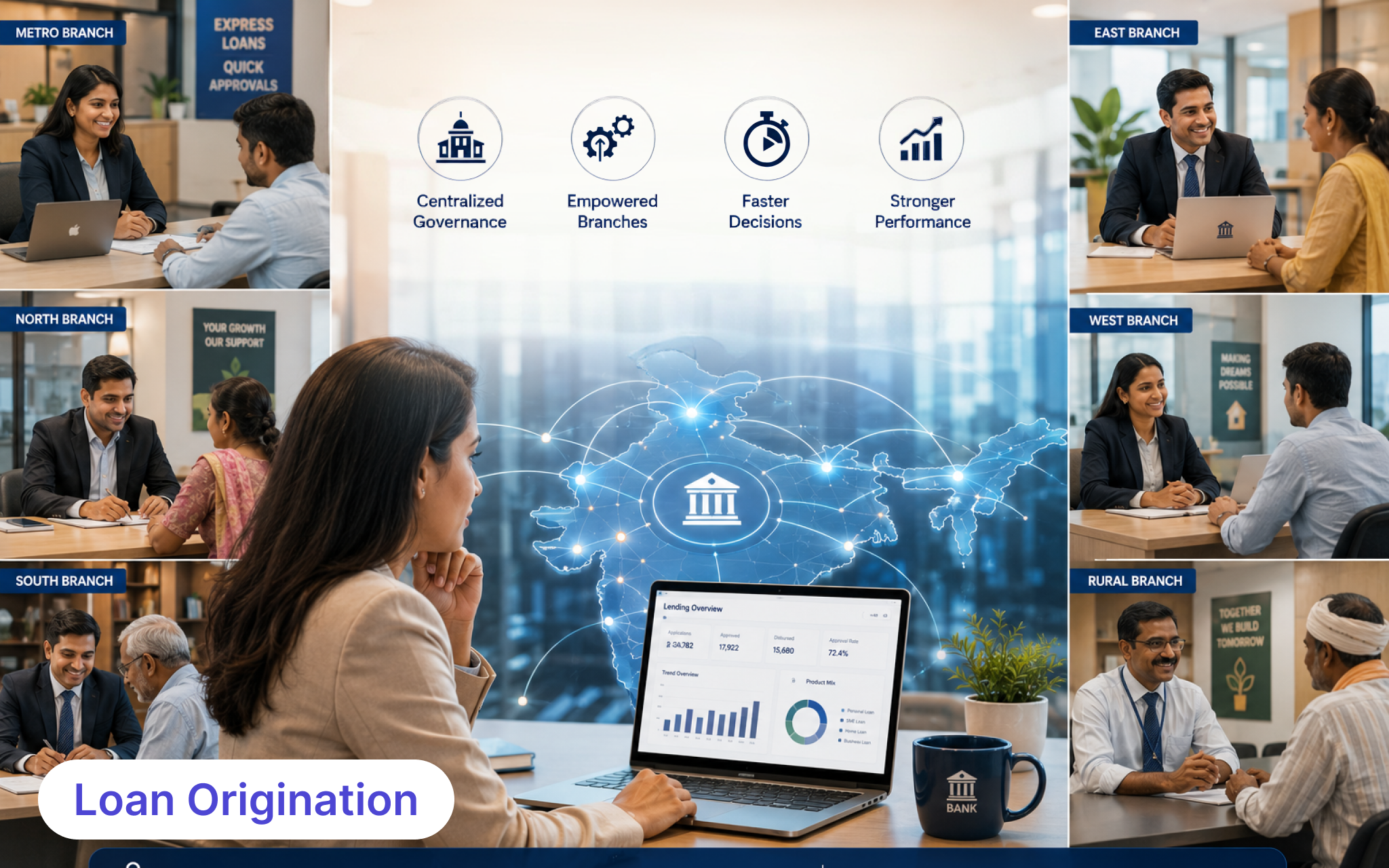
Banks today face a challenge that becomes more complex as branch networks expand.
A well-designed loan origination system workflow enables financial institutions to orchestrate lending operations consistently across every branch while balancing speed, governance, and regulatory compliance. As lending becomes increasingly digital, the workflow itself has become a strategic differentiator rather than just an operational process.
Many institutions still operate at one of two extremes. Some centralise every decision, creating bottlenecks and slowing customer service. Others give branches excessive autonomy, introducing operational inconsistency and compliance risk.
The most successful lenders are moving toward a hybrid approach that combines enterprise-wide governance with controlled local authority.
This model enables faster approvals, stronger risk management, lower operational costs, and a better borrower experience without sacrificing regulatory discipline.
What Is a Loan Origination System Workflow?
A loan origination system workflow is the structured framework that governs how a loan application progresses through every stage of the lending lifecycle. Rather than functioning as a simple sequence of tasks, it orchestrates people, processes, business rules, and technology to ensure every application follows a consistent, compliant, and efficient path from application to disbursement.
Modern workflows go beyond task automation. They intelligently route applications, trigger approvals, assign responsibilities, enforce lending policies, integrate with third-party systems, and provide complete visibility into every decision made during the loan origination process. This enables financial institutions to standardise operations while adapting to different lending products, customer segments, and regulatory requirements. For a broader understanding of the technology and capabilities supporting modern lending operations, explore our loan origination software guide.
For banks operating across multiple branches, workflow orchestration becomes even more important. A well-designed workflow enables central teams to maintain governance and risk controls while allowing branches to process applications efficiently within predefined approval limits and operational guidelines. This balance between enterprise-wide consistency and local flexibility is fundamental to scalable lending operations.
End-to-End Loan Origination System Workflow
Every loan application follows a structured workflow designed to ensure consistency, compliance, and operational efficiency. While the exact process varies across institutions and lending products, modern Loan Origination System Workflows generally follow a common sequence of interconnected stages that automate decision-making and reduce manual intervention.

Typical end-to-end workflow followed by modern loan origination systems.
Although every financial institution configures workflows differently, the core objective remains the same: move applications efficiently while maintaining governance, regulatory compliance, and customer experience across every stage of the lending journey.
| Workflow Stage | Primary Objective | Automation Opportunity |
|---|---|---|
| Application | Capture borrower information | Digital application forms |
| KYC & Identity | Verify customer identity | Identity verification |
| Document Collection | Gather required documents | OCR & document intelligence |
| Credit Assessment | Evaluate borrower risk | Credit scoring & business rules |
| Underwriting | Review policy compliance | Automated underwriting |
| Decision | Approve or decline | Decision engine |
| Documentation | Generate agreements | Digital documentation |
| Disbursement | Release funds | Automated disbursement |
Why Banks Need Loan Workflow Automation
A well-defined workflow is only effective when it can operate consistently at scale. As lending volumes grow and branch networks expand, manual coordination becomes increasingly difficult. Applications often pass through multiple teams, systems, and approval levels, creating delays, inconsistent decisions, and limited operational visibility.
Loan workflow automation addresses these challenges by replacing manual handoffs with rule-driven workflows that automatically route applications, assign tasks, enforce lending policies, and trigger approvals based on predefined business rules. This enables financial institutions to process applications more efficiently while maintaining governance and compliance across every stage of the loan origination process.
Beyond operational efficiency, workflow automation provides the agility needed to introduce new lending products, adapt approval policies, and respond to changing regulatory requirements without disrupting day-to-day operations. Instead of relying on manual intervention, banks can configure workflows that scale with business growth while delivering a faster and more consistent borrower experience.
| Manual Loan Workflow | Automated Loan Workflow |
|---|---|
| Manual task routing | Rule-based workflow routing |
| Email and spreadsheet approvals | Automated approval workflows |
| Limited process visibility | Real-time workflow tracking |
| Inconsistent policy execution | Standardized business rules |
| Higher operational effort | Reduced manual intervention |
| Slower turnaround times | Faster loan processing |
Why Traditional Loan Origination Models Break Down

Manual lending workflows often create delays, duplicate checks, and limited operational visibility.
Many multi branch lending operations still rely on fragmented processes.
Applications are collected in one branch, reviewed in another, and often revalidated by multiple teams. The result is duplicated effort, inconsistent decisions, and longer turnaround times.
Common challenges include:
- Manual document collection and verification
- Multiple teams performing the same checks
- Limited visibility across branches
- Inconsistent interpretation of lending policies
- Delayed approvals and customer dissatisfaction
Regulatory expectations add another layer of complexity. Banks must maintain audit trails, enforce standard credit policies, and demonstrate compliance across all lending activities.
Pure centralisation solves part of this problem by standardising decision making. However, it often removes the local knowledge that branch teams bring to lending decisions.
A branch manager may understand seasonal business cycles, regional economic conditions, or long standing customer relationships that cannot be fully captured by a central underwriting model.
At the same time, allowing unrestricted local discretion can expose the institution to inconsistent risk practices and governance gaps.
The challenge is not choosing between centralization and decentralization. It is designing a loan origination system workflow that combines enterprise-wide governance with controlled local decision-making. This hybrid operating model enables banks to standardize lending practices while preserving the agility needed to serve diverse markets efficiently.
Building a Hybrid Loan Origination Workflow

Hybrid workflow balancing centralized governance with branch-level flexibility.
A modern loan origination workflow should establish clear governance while preserving meaningful branch level decision making.
The foundation of a hybrid workflow begins with centralized policy management.
Credit rules, compliance requirements, eligibility criteria, and approval frameworks are configured centrally through a loan origination software with automated workflow. This ensures every branch follows the same standards regardless of geography. Effective loan origination process implementation helps translate these centralized policies and workflow requirements into configured processes, integrations, and operational practices.
Within that framework, branches receive controlled authority.
For example:
- Metro branches may approve larger personal loans
- Regional branches may handle smaller ticket applications
- Higher value or higher risk cases automatically escalate
- Fraud or compliance exceptions route directly to specialist teams
This structure enables faster lending decisions without compromising governance, regulatory compliance, or portfolio risk.
Routine applications move through the end to end loan origination workflow with minimal intervention, while complex cases receive expert review.
The model also enables the capture of valuable local intelligence.
Branch teams can contribute borrower context, relationship history, and market insights that strengthen credit assessment beyond purely quantitative scoring models.
Rather than competing with central underwriting, local expertise becomes an input into the overall decisioning process.
Business Impact of Hybrid Loan Origination Workflows

Comparing centralized and decentralized lending approaches to achieve a balanced hybrid workflow.
The business value of a modern loan origination system workflow extends far beyond operational efficiency. By combining centralized governance with intelligent workflow automation, banks improve decision speed, strengthen risk management, and deliver a more consistent borrower experience across every lending channel.
When routine decisions are automated and specialist resources are centralised, banks typically achieve significant operational improvements.
Key outcomes include:
Faster Processing
Applications that once required several days can often be processed within hours through automated routing, predefined business rules, and straight-through processing.
Higher Approval Conversion
Faster decisions improve customer engagement and reduce application abandonment.
When customers receive timely responses, completion rates and approval conversion generally increase.
Lower Operating Costs
Automation removes repetitive activities such as data entry, document validation, and workflow coordination.
This allows branch teams to focus on relationship management rather than administration.
Better Portfolio Quality
Combining central risk models with branch level context creates more balanced credit decisions.
Institutions gain the benefit of analytical consistency while incorporating valuable local market intelligence.
Improved Customer Experience
Borrowers increasingly expect digital convenience alongside personalised service.
A modern loan origination software workflow enables customers to move seamlessly between digital and branch channels without restarting their journey.
Compliance, Risk, and Audit Automation

Embedding compliance, governance, and audit controls into every stage of the loan origination workflow.
Regulatory compliance is no longer a standalone operational function, it is an integral part of every modern loan origination system workflow. Embedding compliance directly into workflow execution enables financial institutions to reduce operational risk while improving audit readiness.
Traditional audit preparation often involves manual document gathering and fragmented reporting.
Key capabilities include:
- Automated audit trails
- Mandatory workflow checkpoints
- Digital approval histories
- Real time risk monitoring
- Automated regulatory reporting
Every action is recorded with timestamps, user information, decision criteria, and supporting documentation.
This transforms compliance from a periodic exercise into a continuous operational capability.
Risk management also becomes more proactive.
Instead of identifying concentration risks or policy breaches after the fact, institutions receive alerts as conditions emerge.
This level of visibility is particularly important for multi branch operations where risk exposure can develop quickly across regions.
Technology Foundations of a Modern Loan Origination System Workflow

Core technology capabilities that power intelligent loan origination workflows.
The hybrid operating model depends on the right technology foundation.
Building an intelligent and scalable workflow requires technology that combines automation, integration, governance, and real-time visibility. The following capabilities form the foundation of a modern Loan Origination System Workflow. These capabilities can also provide a practical framework for loan origination platform evaluation when financial institutions compare technology against their workflow, governance, integration, and scalability requirements.
No Code Workflow Configuration
Business teams should be able to modify lending rules, approval hierarchies, and process flows without relying on lengthy development cycles.
This improves agility when market conditions or regulatory requirements change.
AI-Powered Underwriting
Artificial intelligence can automate document extraction, validate borrower information, and support risk assessment. Automated underwriting software can further support this stage of the workflow by applying credit policies, eligibility criteria, and risk rules consistently during borrower assessment.
This reduces manual effort while improving consistency.
API Driven Integration
A connected ecosystem allows lenders to integrate credit bureaus, identity verification services, fraud detection tools, core banking platforms, and external data providers.
The result is a more complete borrower view and faster decision making.
Omnichannel Lending
Customers increasingly begin applications on one channel and complete them on another.
A unified loan origination workflow enables seamless movement between mobile, web, branch, and assisted channels.
Real Time Visibility
Executives, operations teams, and branch managers require different levels of insight.
Role based dashboards provide transparency into application pipelines, SLA performance, risk exposure, and operational bottlenecks.
The Future of Loan Origination System Workflows
The future of lending will be defined by intelligent workflow orchestration rather than isolated process automation. As financial institutions expand digital channels, introduce new lending products, and respond to evolving regulatory requirements, loan origination system workflows must become more adaptive, data-driven, and configurable.
Leading banks are already moving beyond static approval processes toward intelligent workflows that combine AI-powered decisioning, business rules, workflow automation, and real-time operational visibility. This enables institutions to accelerate lending decisions while maintaining consistent governance, stronger risk controls, and a seamless borrower experience across every branch and digital channel. Intelligent workflow orchestration is also an important component of broader digital transformation in lending, connecting process automation with changes across lending operations and technology.
Platforms such as lend.ezee by ezee.ai enable financial institutions to translate these principles into production through configurable workflow orchestration, AI-powered decisioning, enterprise-grade integrations, and centralized governance.
Key capabilities include:
- AI-powered, no-code workflow design
- Centralized business rules and governance
- API-first integration with core banking and third-party systems
- Omnichannel loan origination across web, mobile, and branch channels
- Real-time workflow visibility and operational analytics
- Enterprise-grade security, compliance, and scalability
Modern lending is no longer measured solely by approval speed. The institutions that will lead the next generation of banking are those that build loan origination system workflows capable of combining automation, governance, and operational agility into a single, connected lending experience.
A loan origination system workflow is the structured process that manages loan applications from submission to disbursement. It automates approvals, business rules, and task routing to improve operational efficiency, governance, and compliance.
Workflow automation replaces manual handoffs with rule-based processes that route applications, assign tasks, and enforce lending policies automatically. This helps banks reduce turnaround times, improve consistency, and strengthen compliance.
Most workflows include application capture, identity verification, document collection, credit assessment, underwriting, approval, documentation, and disbursement. Modern loan origination systems automate these stages to improve speed and accuracy.
Multi-branch banks use centralized policies with controlled branch-level authority. This ensures consistent lending decisions while allowing branches to process applications efficiently within predefined approval limits.
A hybrid workflow automates routine applications while escalating complex or high-risk cases for specialist review. This improves decision speed, governance, and operational efficiency across branch networks.
Key features include configurable workflows, business rules, approval routing, integrations, audit trails, real-time dashboards, and role-based access controls. These capabilities support scalable and compliant lending operations.
Modern workflows embed compliance into every stage of the lending process through standardized approval rules, automated audit trails, and real-time monitoring. This improves governance and simplifies regulatory reporting.
Modern workflows connect digital applications, AI-powered decisioning, and omnichannel lending into a single process. This enables faster approvals, better customer experiences, and more scalable lending operations.
References
- McKinsey – The Lending Revolution: How Digital Credit Is Changing Banks from the Inside
- McKinsey – Modernizing Corporate Loan Operations
- Reserve Bank of India – Guidelines on Digital Lending
- Deloitte – Modernizing Commercial Loan Servicing
- McKinsey – Digitizing Credit Risk Trims Costs and Delights Customers
- McKinsey – Indian Banks: Navigating Through the Turbulence
