The lending landscape in India is evolving, and collections teams are under increasing pressure to improve recovery outcomes while managing operational efficiency and regulatory requirements. Traditional collection processes often rely heavily on manual prioritization, scripted outreach, and fragmented workflows, making it difficult to respond consistently to changing borrower behavior.
AI debt collection software addresses these challenges by applying artificial intelligence, predictive analytics, and workflow automation to collection processes. These platforms can help lenders prioritize accounts, identify appropriate treatment strategies, personalize borrower communication, and coordinate outreach across multiple channels. This guide compares five leading platforms serving the lending ecosystem in India, with a focus on their capabilities, use cases, compliance considerations, and suitability for banks, NBFCs, and fintech lenders.
The Collections Challenge in Modern India
India’s banks, NBFCs, and fintech lenders operate increasingly complex collections environments across secured and unsecured portfolios. Collections teams must balance recovery effectiveness with operational efficiency, consistent borrower communication, and regulatory requirements. For regulated entities, recovery processes also need appropriate controls around employee and recovery-agent conduct, due diligence, training, and oversight.

Traditional collection approaches can make these requirements difficult to manage at scale. Manual calling and rule-based workflows consume collector time, while limited visibility into borrower behavior can make it difficult to determine which accounts to prioritize, when to contact them, and which treatment strategy is most appropriate. Outcomes can also vary across teams because decisions often depend on individual collector experience rather than consistent, data-driven processes.
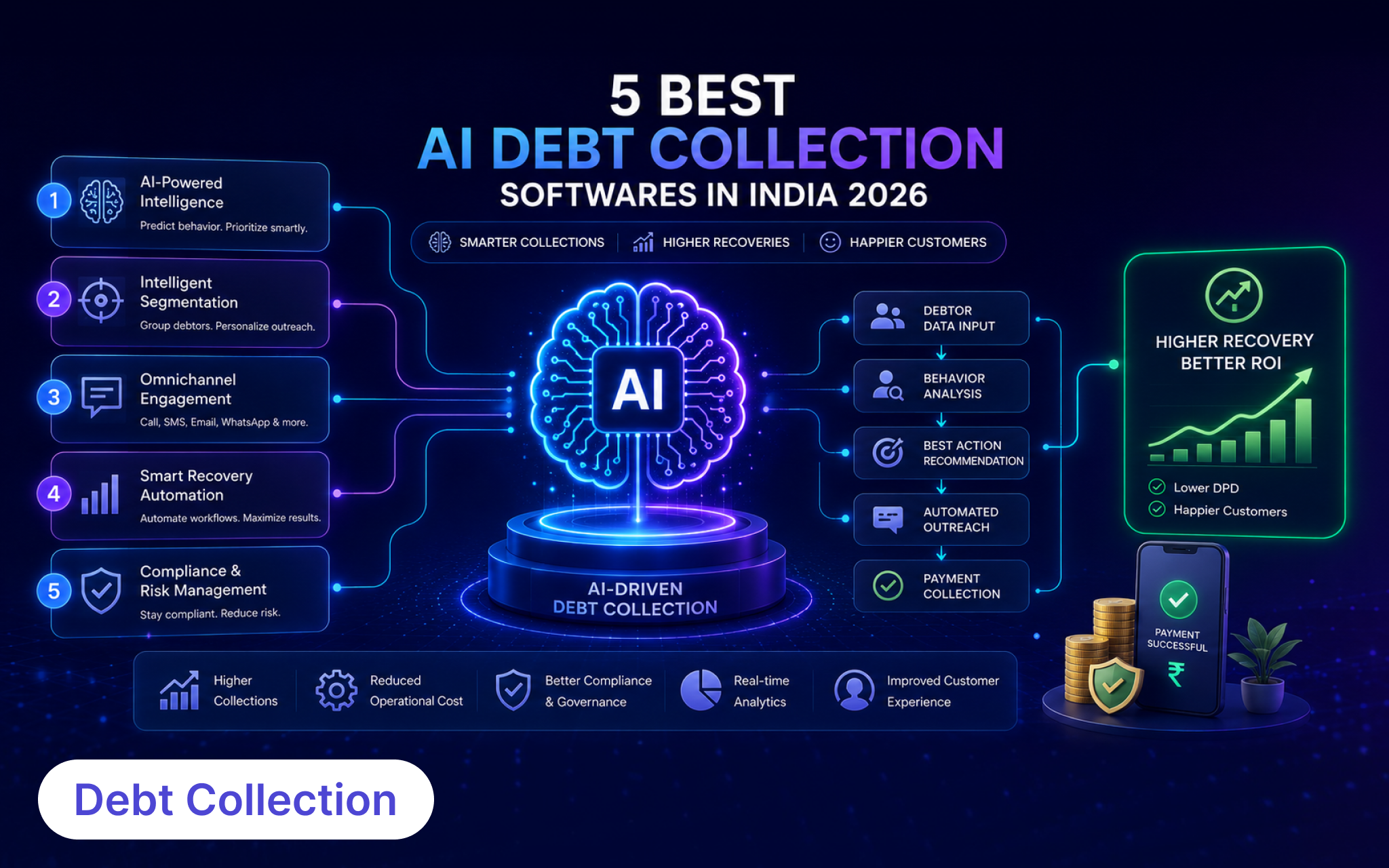
An automated debt recovery system can address these operational challenges by combining workflow automation with artificial intelligence and machine learning. Modern platforms can help lenders prioritize accounts, predict repayment behavior, personalize outreach, automate routine interactions, and coordinate communication across voice, SMS, WhatsApp, email, and self-service channels.
The result is a more measurable approach to collections. Instead of relying primarily on manual activity, lenders can use data to evaluate borrower behavior, contact effectiveness, settlement outcomes, promise-to-pay performance, and delinquency risk.
5 Best AI Debt Collection Software Platforms in India
The platforms below represent different approaches to modern collections, ranging from AI-driven portfolio prioritization and workflow automation to conversational voice AI and broader accounts receivable management. They are evaluated based on their AI capabilities, collection automation, communication channels, compliance and audit controls, integration capabilities, scalability, and suitability for different lending environments.
This comparison is intended to help banks, NBFCs, fintech lenders, and other financial institutions identify the best AI debt collection software for their specific operating model rather than treating feature volume as the primary measure of value.
1. ezee.ai

Ezee.ai’s collect.ezee platform focuses on automating collection strategies through AI-driven decision-making and workflow orchestration. Rather than relying solely on predefined collection sequences, the platform is designed to use borrower and portfolio signals to determine appropriate collection actions and adapt strategies as outcomes change.
Key Capabilities:
- Intelligent strategy orchestration across borrower segments
- Machine learning models for contact timing and channel selection
- Compliance monitoring integrated into collection decision workflows
- Omnichannel coordination across SMS, WhatsApp, voice, email, and self-service portals
- No-code configuration for collection strategy management
- Real-time audit trails and compliance dashboards
Reported Performance:
- 20% higher recovery rates, as reported for deployments using intelligent borrower understanding
- 40% reduction in collection operational costs, based on reported platform results
- 80% decrease in manual compliance work, based on reported results
- 90% faster audit completion cycles, based on reported results
- 3-4 week deployment timeline, based on the platform’s stated implementation experience
Best Suited For
ezee.ai may be a strong fit for lenders looking to combine collection workflow automation with AI-driven strategy optimization, particularly where rapid deployment, no-code configuration, omnichannel engagement, and compliance monitoring are important evaluation criteria. The platform’s approach may be relevant to collections teams that want to adjust strategies without relying extensively on technical resources.
2. Credgenics

Credgenics has established a significant presence across India’s lending ecosystem, with its SaaS platform supporting large-scale retail loan collections. Its approach emphasizes behavioral segmentation, using borrower signals to group accounts into more meaningful cohorts than traditional delinquency buckets.
Key Capabilities:
- Behavioral segmentation using customer signals for personalized treatment
- Multilingual communication across SMS, WhatsApp, IVR, and voice channels
- Field-collection integration through the CG Collect mobile application
- Legal workflow automation for notice generation and litigation tracking
- Compliance monitoring and audit dashboards
Reported Performance:
- 20% improvement in lender resolution rates
- 25% increase in collections volumes
- 40% reduction in collection costs
- 30% shorter collection cycles
- An 8M+ account case study reporting a 40% reduction in pre-due flow
Best Suited For
Credgenics may be particularly relevant for larger lenders managing geographically dispersed borrower portfolios, especially where multilingual communication, field collections, and legal recovery workflows are important. Its combination of digital engagement and on-ground collection capabilities can be useful for institutions operating across multiple collection channels.
3. HighRadius

HighRadius brings enterprise accounts receivable and collections capabilities to organizations managing complex finance and payment ecosystems. Its platform emphasizes intelligent account prioritization, predictive analytics, automated communication, and integration with existing ERP and payment systems.
Key Capabilities:
- AI-driven account prioritization based on collection scores and recovery likelihood
- Predictive analytics for payment delays and delinquency progression
- Automated communication with personalized payment-link generation
- Integration with customer AR portals for payment-status visibility
- Real-time activity tracking, promise-to-pay management, and call logging
- Analytics dashboards covering DSO trends, collector performance, and bad-debt forecasting
- ERP connectivity across SAP, Oracle NetSuite, Microsoft Dynamics, and Sage Intacct
Reported Performance:
- 20% reduction in Days Sales Outstanding
- 30% improvement in collector productivity
- 20% reduction in past-due account balances
- 3-6 month typical implementation timeline
- Integration across banks, credit agencies, ERP systems, and billing platforms, according to the platform’s reported capabilities
Best Suited For:
HighRadius may be particularly relevant to enterprise organizations where working-capital optimization, DSO reduction, analytics, and integration with complex ERP environments are important priorities. Its broader accounts receivable capabilities can be valuable for organizations that need collections management closely connected with payment, reconciliation, and finance workflows.
4. Skit.ai

Skit.ai focuses on conversational AI for high-volume debt collection, with an emphasis on automating borrower interactions through voice while supporting other digital communication channels. Its approach is particularly differentiated by the use of AI agents for collection conversations rather than limiting automation to predefined workflows.
Key Capabilities:
- Conversational AI voice agents for automated borrower interactions
- Multichannel engagement across voice, SMS, email, and chat
- Conversation handling for scenarios such as right-party verification, payment discussions, disclosures, and escalation
- Safeguards designed to support compliant and controlled collection interactions
- Sentiment-aware conversational capabilities for handling borrower responses
- Integration with collection, CRM, and payment systems
- Real-time analytics for monitoring collection interactions and outcomes
Reported Performance:
- 50–70% reported improvement in liquidation rates
- 17% reported reduction in escalations
- 24% reported improvement in right-party contact rates
- Reported deployment across a large creditor base and millions of collection interactions
These figures should be treated as vendor-reported performance indicators and evaluated against the lender’s own portfolio, contact strategy, and operating model.
Best Suited For:
Skit.ai may be particularly relevant for lenders managing high volumes of borrower interactions where voice-based automation, conversational quality, and reduction of manual calling effort are important priorities. Its approach can be especially relevant for organizations evaluating AI collection software for early-stage delinquency outreach and other high-frequency borrower conversations.
5. Growfin

Growfin approaches collections from a B2B accounts receivable perspective, combining behavioural intelligence with cash-flow and payment management capabilities. Rather than focusing exclusively on loan collections, its platform is designed to help businesses understand customer payment behaviour, prioritize receivables, and improve collection outcomes.
Key Capabilities:
- Behavioral intelligence for identifying customer payment patterns
- Customer and account health scoring to support collections prioritization
- Payment behavior analysis and settlement-likelihood assessment
- Adaptive dunning based on customer and payment signals
- Cash application and accounts receivable workflow management
- Analytics covering DSO, cash flow, and collections performance
- Integration with business systems including Salesforce, Slack, and Gmail
Reported Performance:
- 34% reported reduction in Days Sales Outstanding
- 27% reported improvement in cash-flow cycles
- 97% reported accuracy for payment prediction
- Reported improvements in DSO and collections visibility across customer accounts
These figures should be treated as reported performance indicators and evaluated against the organization’s customer base, receivables profile, and collection processes.
Best Suited For:
Growfin may be particularly relevant for B2B organizations and enterprises where accounts receivable management, customer payment behavior, DSO improvement, and cross-functional collections visibility are important priorities. It is less directly comparable with platforms focused primarily on consumer loan collections, but can be relevant for organizations evaluating broader AI-enabled receivables and collection capabilities.
AI Debt Collection Software Comparison
| Capability | Ezee.ai | Credgenics | HighRadius | Skit.ai | Growfin |
|---|---|---|---|---|---|
| Primary Strength | Intelligent Automation | Behavioral Segmentation | Enterprise Analytics | Voice Conversations | AR Forecasting |
| Deployment Speed | 3-4 weeks | 2-4 months | 3-6 months | 4-8 weeks | 1-3 months |
| Recovery Improvement | 20% higher rates | 25% collections uplift | 20% past-due reduction | 50-70% liquidation uplift | DSO optimization |
| Cost Reduction | 40% operational | 40% collection costs | DSO-focused | Volume-based | Time & effort savings |
| Best Suited For | 1-10M accounts | 5-50M accounts | Enterprise scale | High-volume portfolios | B2B & mid-market |
| Key Differentiator | 100% No-code + Learning | Multilingual Scale | Integration Breadth | Conversational Quality | Modern Tools Integration |
The Technology Evolution in Collections
Collections technology has evolved from basic workflow automation toward systems that can use data, predictive models, and AI to support collection decisions. The distinction is important when evaluating modern platforms: automation can execute a predefined process, while AI-enabled systems can use borrower and portfolio signals to inform prioritization, communication, and treatment strategies.
From Rules-Based Automation to Predictive Collections
Traditional collection systems typically operate according to predefined rules. For example, an account may enter a particular workflow after reaching a specified delinquency stage.
AI-enabled platforms can add another layer of intelligence by evaluating factors such as repayment behavior, previous contact outcomes, promise-to-pay history, and engagement patterns. These signals can help collections teams prioritize accounts and determine which intervention may be appropriate.
Dynamic Treatment Strategies
Modern collections platforms can also support differentiated treatment strategies rather than applying the same approach to every borrower. For example, a system may use repayment likelihood, previous engagement, and settlement behavior to determine whether an account should receive a reminder, payment option, settlement communication, or escalation.
The objective is not simply to automate more activity. It is to improve the quality and consistency of collection decisions while maintaining appropriate controls.
Omnichannel and Personalized Engagement
AI can also help coordinate communication across channels such as voice, SMS, WhatsApp, email, and self-service. Channel selection and message timing can be informed by borrower engagement patterns and collection outcomes, subject to the lender’s policies and applicable requirements.
This creates a more responsive collection process than relying on a single scripted sequence for every account.
Moving Toward Autonomous Decision Support
The next stage of collections technology involves systems that can continuously evaluate outcomes and adjust recommended actions or workflows within defined controls. This can reduce dependence on manual intervention for routine decisions while allowing collections teams to retain oversight of higher-risk or exceptional cases.
For lenders evaluating AI collection software, the key question is therefore not simply whether a platform uses AI. It is how that intelligence is applied to prioritization, treatment strategies, borrower engagement, compliance controls, and measurable collection outcomes.
How to Choose AI Debt Collection Software
Organizations evaluating AI debt collection software should consider more than the number of features a platform offers. The right solution depends on portfolio characteristics, collection maturity, regulatory requirements, existing technology infrastructure, and the organization’s ability to adopt new operating models.
1. Portfolio Scale and Complexity
Portfolio size is an important consideration, but account volume alone should not determine platform selection. Lenders should also assess delinquency mix, product types, geographic distribution, borrower segments, collection stages, and the number of interactions handled by internal and external collection teams.
The platform should be able to scale across the lender’s current portfolio while supporting future growth without requiring a proportional increase in manual collection activity.
2. Collections Maturity
Organizations at different stages of collections maturity will have different technology requirements. A lender beginning its automation journey may prioritize workflow digitization, standardized processes, and operational visibility. More mature teams may require predictive prioritization, treatment optimization, automated decisioning, and continuous performance analysis.
Buyers should therefore evaluate whether the platform supports their current operating model while providing a practical path toward greater automation.
3. Regulatory Environment and Controls
Compliance should be evaluated as part of the platform architecture rather than treated as an additional feature. Lenders should examine how the system supports communication controls, recovery-agent oversight, audit trails, approvals, reporting, and monitoring of collection activities.
For Indian regulated entities, the platform should also be assessed against applicable RBI requirements and the lender’s internal policies. Buyers should verify how regulatory rules are translated into configurable controls and how changes can be incorporated as requirements evolve.
4. Integration and Data Infrastructure
AI-enabled collections depend on access to reliable borrower, account, payment, and interaction data. Integration capabilities should therefore be evaluated alongside the AI functionality itself.
Key areas to assess include connectivity with loan management systems, core banking or lending platforms, CRMs, payment systems, communication providers, data platforms, and existing collection applications. Buyers should also understand how data is exchanged, monitored, secured, and used within collection workflows.
5. Change Management and Operational Adoption
Technology implementation changes how collections teams prioritize accounts, communicate with borrowers, manage exceptions, and measure performance. Successful adoption therefore depends on more than technical deployment.
Organizations should assess configuration flexibility, user experience, training requirements, reporting capabilities, governance processes, and the level of technical support required to maintain collection strategies over time.
What to Evaluate Before Selecting a Platform
A practical evaluation should consider:
- AI capability: Does the platform use AI for meaningful collection decisions, or primarily for workflow automation?
- Automation: Which collection activities can be automated, and where is human oversight retained?
- Communication: Which borrower channels are supported, and can engagement strategies be differentiated by segment?
- Compliance: Can collection policies, controls, approvals, and audit requirements be incorporated into workflows?
- Integration: Can the platform connect reliably with the lender’s existing technology stack?
- Scalability: Can it support portfolio growth, additional products, and increasing interaction volumes?
- Measurement: Can teams connect collection activity with outcomes such as recovery, promise-to-pay performance, contact rates, and operational efficiency?
Evaluating these factors together provides a more reliable basis for selecting an automated debt recovery system than comparing feature counts alone.
Market Trends Shaping Collections
Several technology and operating-model trends are influencing how banks, NBFCs, fintech lenders, and other financial institutions approach collections.
Increasing Regulatory and Governance Requirements
As digital and outsourced collection models expand, lenders need stronger visibility into how recovery activities are performed and monitored. Technology is increasingly being used to support controls, auditability, communication policies, recovery-agent oversight, and consistent execution of collection processes.
For Indian regulated entities, regulatory requirements should be considered alongside technology selection rather than after implementation.
Agentic AI Moves Toward Controlled Adoption
Agentic AI represents a shift from systems that simply recommend or automate individual tasks toward systems that can plan and execute multi-step actions within defined parameters. In collections, potential applications include borrower engagement, workflow execution, treatment decisions, and escalation.
However, agentic AI remains an emerging capability. Lenders evaluating these systems should pay particular attention to decision boundaries, human oversight, auditability, exception handling, and the ability to review how actions are generated and executed.
Generative and Conversational AI
Generative AI is expanding the role of automation beyond predefined messages and workflows. It can support conversational interactions, summarize collection conversations, assist collectors, analyze unstructured interaction data, and help personalize borrower communications.
The value of these capabilities depends on how they are integrated with collection data, business rules, compliance controls, and human oversight rather than on the use of generative AI alone.
Omnichannel Collections
Collections is increasingly moving beyond phone-centric outreach toward coordinated engagement across voice, SMS, WhatsApp, email, and digital self-service. The objective is not simply to add more communication channels, but to coordinate them according to borrower engagement, collection stage, and applicable policies.
This makes omnichannel orchestration an important capability for lenders managing large and diverse borrower portfolios.
Behavioral and Predictive Intelligence
Predictive models can help collections teams determine which accounts to prioritize, estimate repayment likelihood, identify engagement patterns, and select appropriate treatment strategies. This shifts collections from applying the same workflow to every account toward more differentiated, data-informed decision-making.
The quality of these outcomes depends heavily on the underlying data, model performance, monitoring, and the lender’s ability to translate predictions into operational action.
Data-Driven Continuous Optimization
Modern collections platforms increasingly connect collection activity with measurable outcomes. Instead of treating a strategy as a fixed workflow, lenders can evaluate contact rates, promise-to-pay outcomes, repayment behavior, settlement performance, and other portfolio signals to identify what is working and where strategies need to change.
For buyers, this means evaluating whether a platform can create a continuous feedback loop between data, decisions, collection actions, and outcomes, not simply whether it provides an AI dashboard.
Why Ezee.ai May Be a Strong Fit for Indian Lenders
Among the platforms compared in this guide, ezee.ai may be particularly relevant to Indian lenders looking for a combination of AI-driven collections, workflow automation, no-code configuration, omnichannel engagement, and enterprise controls.
AI-Driven Collection Strategy
Ezee.ai’s collect.ezee platform applies AI across areas such as borrower segmentation, channel selection, contact timing, sentiment analysis, voice interactions, and collection performance monitoring. Its current platform positioning also includes agentic AI capabilities for collections, including AI-powered voice interactions and recovery workflows.
No-Code Configuration and Faster Change
A key differentiator is the emphasis on business-user configuration. Ezee.ai positions its platform around no-code workflows and policy configuration, allowing lending and operations teams to make changes without relying entirely on development cycles. The company currently states that its lending platform can be deployed in weeks, although actual implementation timelines will depend on scope, integrations, data readiness, and institutional requirements.
Compliance and Auditability
Collections automation needs to operate within defined policies and controls. Ezee.ai describes audit trails, compliance controls, role-based access, and enterprise security capabilities as part of its platform architecture. Buyers should nevertheless validate the specific regulatory controls, reporting requirements, and governance processes relevant to their institution during evaluation.
Integration and End-to-End Lending Context
Ezee.ai’s broader platform covers origination, credit decisioning, loan management, and collections through interoperable products sharing a common data and policy layer. It also lists integrations across areas such as credit bureaus, identity providers, payments, core banking, CRM, and communication channels. This can be relevant for lenders that want collections technology connected to the wider credit lifecycle rather than operating as an isolated point solution.
Where Ezee.ai May Be the Better Fit
Ezee.ai may be worth prioritizing in a vendor evaluation when an institution places particular importance on:
- AI-driven collection strategy and borrower segmentation
- Omnichannel borrower engagement
- No-code workflow and strategy configuration
- Integration with the wider lending technology stack
- Auditability and configurable compliance controls
- Moving from rule-based collections toward more adaptive, data-driven decision-making
Ultimately, platform selection should depend on the lender’s portfolio, operating model, technology environment, regulatory requirements, and implementation objectives. Ezee.ai may be a strong fit where these requirements align with its capabilities, but lenders should validate functionality and expected outcomes through their own use cases and evaluation process.
Conclusion
AI debt collection software is changing how lenders approach collections, but the value of a platform depends on how effectively its technology fits the institution’s portfolio, operating model, regulatory requirements, and existing technology environment.
The five platforms covered in this guide represent different approaches to modern collections. Ezee.ai emphasizes AI-driven collection strategy and workflow automation; Credgenics combines digital, field, and legal recovery capabilities; HighRadius focuses on enterprise accounts receivable and finance integration; Skit.ai specializes in conversational AI for collection interactions; and Growfin approaches collections from a B2B accounts receivable perspective.
For banks, NBFCs, and fintech lenders, the selection process should therefore go beyond comparing feature lists. AI capabilities, automation depth, borrower engagement channels, compliance controls, integration, scalability, implementation requirements, and measurable collection outcomes should all form part of the evaluation.
Ezee.ai may be particularly relevant for lenders looking to combine AI-driven collection strategies with workflow automation, omnichannel engagement, no-code configuration, and integration across the broader lending technology stack. However, the right platform ultimately depends on the institution’s specific collection objectives and operating environment.
A structured evaluation using real portfolio scenarios, representative workflows, integration requirements, compliance controls, and measurable success criteria can help lenders determine which platform is best aligned with their needs.
Frequently Asked Questions
AI debt collection software combines artificial intelligence, predictive analytics, rules, and workflow automation to support collection decisions and borrower engagement. Unlike traditional systems that may primarily generate call lists or execute predefined workflows, AI-enabled platforms can help prioritize accounts, identify appropriate treatment strategies, personalize communication, and adapt actions based on borrower and portfolio signals.
Common capabilities include predictive account scoring, collection workflow automation, omnichannel borrower engagement, AI-assisted or automated conversations, integration with lending and payment systems, compliance controls, audit trails, and real-time collection analytics. The depth of these capabilities varies by platform, so buyers should evaluate how they are applied to actual collection decisions rather than comparing feature counts alone.
AI can help collections teams prioritize accounts based on repayment likelihood, delinquency characteristics, engagement history, and other available signals. Automation can also handle repetitive follow-ups and routine interactions, allowing human collectors to focus on accounts and situations requiring greater intervention. Actual recovery and cost improvements depend on portfolio characteristics, strategy quality, implementation, and execution.
Omnichannel collections allow lenders to coordinate communication across multiple borrower-preferred channels. A platform can use factors such as collection stage, previous engagement, and channel responsiveness to determine appropriate outreach sequences. The objective is not simply to use more channels, but to coordinate them in a way that improves engagement while remaining consistent with applicable policies and regulatory requirements.
Lenders should establish baseline performance before implementation and compare it with results from comparable portfolio segments after deployment. Useful measures include recovery rate, incremental recovery, cost-to-collect, promise-to-pay performance, kept-promise rate, right-party contact rate, roll rates, collector productivity, and cases handled per employee. Where possible, lenders should isolate the impact of the technology from changes in portfolio mix or collection strategy.
Lenders should evaluate the platform across several areas:
- Business fit: Portfolio size, product mix, delinquency profile, and collection model
- AI capability: Predictive prioritization, treatment strategies, and meaningful decision support
- Automation: Workflows, borrower interactions, and escalation handling
- Compliance: Configurable controls, audit trails, approvals, and monitoring
- Communication: Voice, SMS, WhatsApp, email, and self-service capabilities
- Integration: Lending, core banking, CRM, payment, bureau, and communication systems
- Scalability: Ability to support portfolio and interaction growth
- Measurement: Visibility into collection activity, outcomes, and operational efficiency
For Indian regulated entities, applicable RBI requirements and internal policies should be incorporated into the evaluation.
An AI-native platform can integrate intelligence, automation, and experimentation directly into collection workflows rather than treating AI as a separate layer. This can allow teams to test different strategies, monitor outcomes, and adjust workflows more efficiently. For regulated collections, the ability to define decision boundaries, maintain audit records, and retain appropriate human oversight is equally important.
AI models can learn from historical delinquency, payment, contact, and engagement data to identify patterns associated with repayment or continued delinquency. Depending on the platform and available data, these models may consider factors such as days past due, previous payment behavior, promise-to-pay history, contact outcomes, and channel responsiveness. Predictions should be monitored and validated because model performance depends on data quality, portfolio characteristics, and implementation.
Technology can help lenders operationalize collection policies by incorporating defined controls into workflows, communication processes, approvals, and monitoring. Audit trails can also provide visibility into collection activity and support oversight. However, software does not by itself guarantee regulatory compliance. Lenders remain responsible for determining applicable requirements, configuring appropriate controls, monitoring their effectiveness, and maintaining appropriate oversight.
Agentic AI should operate within clearly defined decision boundaries. Important safeguards include limits on what the system can communicate or offer, human escalation paths, approval controls for sensitive decisions, monitoring of AI-generated interactions, audit logs, testing, exception handling, and ongoing model evaluation. The level of autonomy should reflect the risk and sensitivity of the collection decision rather than assuming that every workflow should be fully autonomous.
