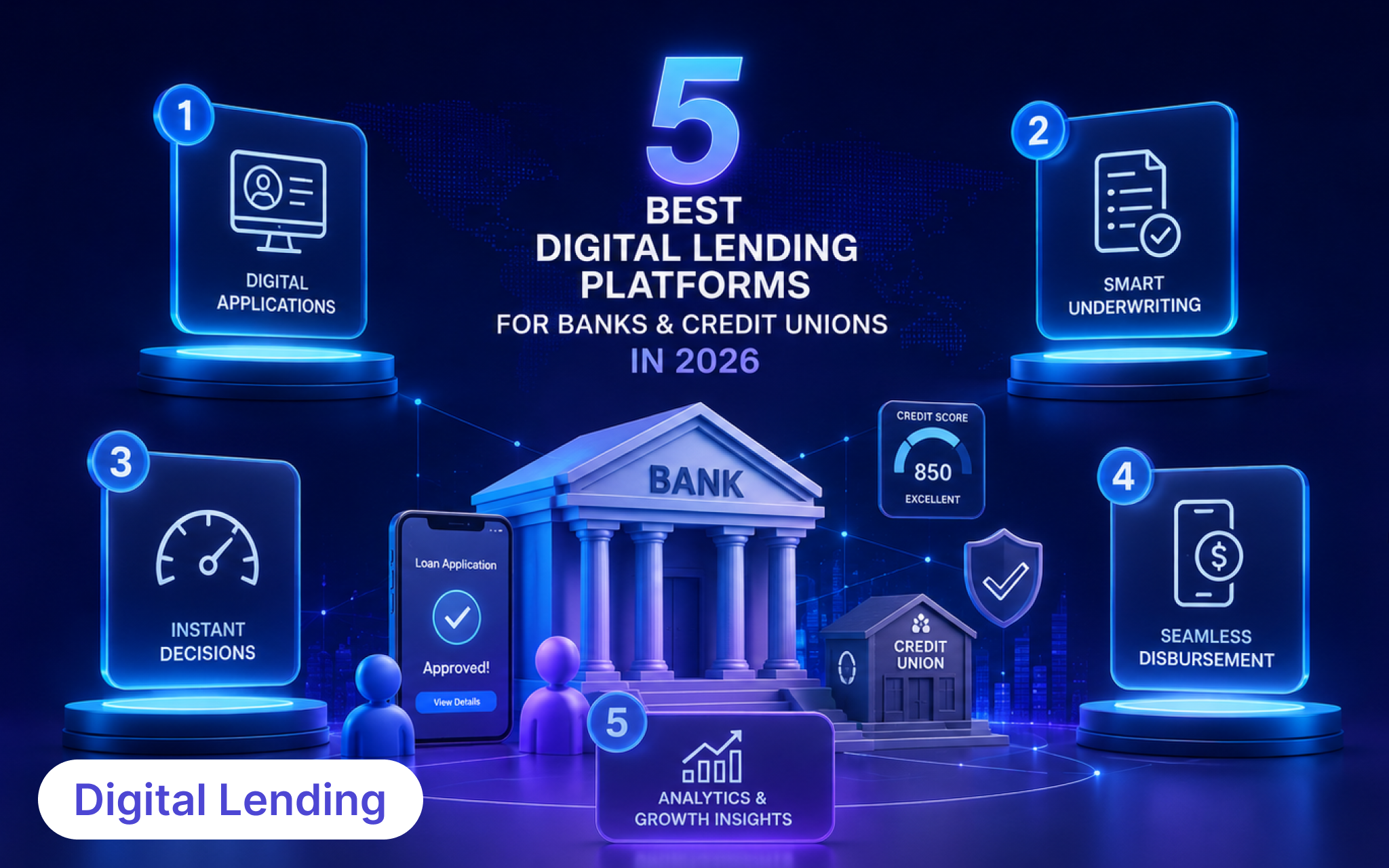
In 2026, credit unions and community banks are under more pressure than ever: compete with digital-first lenders, grow younger membership, protect margins, and still live up to a member-first mission by investing in modern digital lending platforms for banks and credit unions. The heart of that transformation is digital lending how fast you can approve, how intelligently you use data, and how consistently you deliver a frictionless experience across channels with the right digital lending platforms.
This blog looks at five of the best digital lending platforms for banks and credit unions in 2026, with a special focus on what actually matters to credit unions: member experience, configurability without crushing IT, time-to-value, and long‑term flexibility.
The analysis stays balanced across all four established players, and in the conclusion explains why ezee.ai is emerging as a compelling “next‑gen” option for institutions that want AI‑native, no‑code speed without breaking their community DNA.

What credit unions really need from digital lending in 2026
Several forces are reshaping lending economics for credit unions:
- Younger, digital‑native members expect to manage most of their financial lives online or via mobile; over three‑quarters manage finances digitally.
- Embedded finance and alternative lenders are changing how and where members access credit, from BNPL to merchant‑embedded offers.
- AI‑powered decision engines are becoming table stakes for underwriting speed, accuracy, and inclusion analysts expect that by 2026, credit unions without AI‑enhanced lending will struggle to compete on speed and risk.
- Margins are under pressure, so operational efficiency, automation, and smart cross‑sell are no longer “nice to have.”
In this context, most successful credit union strategies revolve around, and increasingly depend on, no code digital lending platforms and configurable no code lending tools that sit on top of legacy cores:
- Member‑first digital experiences (apply anywhere, pick up anywhere)
- AI‑driven, policy‑compliant decisioning
- Configurable workflows that business teams can adjust quickly using no code lending tools
- Integration with the wider digital banking stack (onboarding, servicing, collections)
- Cloud and SaaS models that scale with growth and regulatory demands, often delivered as digital lending management software
With that lens, let’s look at how each of these five platforms serves credit unions and community banks in 2026.
1. Ezee.ai: AI‑native, no‑code lending for speed, flexibility, and collections

Who it’s best for: Banks and credit unions that want to design and iterate complete lending journeys origination, decisioning, and collections, using business‑owned, no code lending tools on a no code digital lending platform, with AI baked in from day one.
ezee.ai is a newer entrant compared to the legacy platforms above but has quickly built a global footprint across banks and NBFCs. It positions itself as an AI‑powered, zero‑code digital lending platform and digital lending management software that allows financial institutions to build and launch credit journeys “like you build slides” via drag‑and‑drop screens, fields, rules, and workflows.
The platform consists of three core products:
- lend.ezee – Digital origination and loan lifecycle workflows.
- decision.ezee – AI‑enabled, no‑code business rules engine for credit decisioning.
- collect.ezee – Digital, AI‑driven collections and recovery journeys.
As a no code digital lending platform, ezee.ai is designed to plug into existing cores and channels instead of forcing a rip‑and‑replace.
Strengths for credit unions and banks
How it helps credit unions and banks
- Puts business teams in control with true no‑code
Product, credit, and collections teams can design or change lending journeys eligibility rules, policy logic, score cut‑offs, offer variants, workflows through drag‑and‑drop and visual business rules, without writing code. That dramatically cuts reliance on IT queues and vendors by giving them no code lending tools they can use themselves. - Brings AI into the heart of lending and collections
Decision.ezee allows CUs to combine policy rules, scorecards, and AI/ML models in a governed way. This can help improve risk segmentation, expand approval rates for good members, and reduce manual reviews. Collect.ezee uses AI to segment delinquent accounts and personalize outreach, improving recovery while preserving relationships. - Covers the full lending lifecycle in one layer
With lend.ezee (origination), decision.ezee (underwriting and policy), and collect.ezee (collections), CUs can run end‑to‑end loan lifecycle management on a single, AI‑native layer that sits on top of existing cores and digital banking systems. That reduces complexity and gives a single source of truth for lending logic. - Speeds up product launches and change cyclesBecause journeys and rules are no‑code, CUs can launch new products (special member segments, promotional offers, BNPL‑style credit, small‑business products) in weeks instead of long IT projects. They can also adjust policies quickly in response to risk trends or regulatory guidance. This is a core promise of modern no code digital lending platforms: shortening time‑to‑market without compromising control.
- Fits into existing architecture instead of replacing everything
ezee.ai is cloud‑agnostic and API‑first, so it can integrate with current core banking, digital banking (including Q2, Temenos, etc.), bureaus, and third‑party data sources. That makes it a strong digital lending platform for banks and credit unions that want to modernize lending without a full system rip‑and‑replace.
2. nCino Bank Operating System: Deep, unified lending for growth‑minded CUs

Who it’s best for: Larger, growth‑oriented credit unions seeking a unified lending stack across commercial, consumer, and indirect, especially those already invested in Salesforce and looking for a primary digital lending platform.
nCino has become a staple in the banking cloud space, and its presence in the credit union world has grown significantly. Institutions like Credit Union 1 in the US have selected nCino to deliver an omnichannel lending experience that unifies commercial, consumer, and indirect lending under a single cloud platform.
Strengths for credit unions
- End‑to‑end lending coverage: Commercial, consumer, indirect and mortgage lending on one platform, plus onboarding and account opening.
- Member‑centric omnichannel journeys: Credit unions like Credit Union 1 are using nCino to create “foundational omnichannel architectures” that deliver fast, personalized lending experiences across every touchpoint.
- AI‑enhanced insights: With nIQ, nCino’s AI layer, CUs can tap into data‑driven insights to improve underwriting and portfolio management.
- Scalability: Designed for institutions with ambitions to expand geographically and product‑wise, without rebuilding the tech stack each time.
Considerations
- Configuration depth vs. simplicity: nCino is highly configurable, but that power often comes with complexity; IT and external partners tend to be heavily involved. It is not positioned as a pure no‑code platform.
- Salesforce alignment: The Salesforce foundation is a strength if you’re invested in that ecosystem, but it can add architectural considerations for teams not already aligned with Salesforce.
For credit unions thinking beyond single‑product digitization and toward a unified, enterprise‑grade lending experience, nCino is a strong contender. It shines where complexity and scale are priorities and there is appetite for enterprise‑level transformation.
3. Temenos for Credit Unions: Integrated onboarding, origination, and collections

Who it’s best for: Credit unions and community banks (up to roughly USD 50B in assets) seeking integrated digital banking, origination, and collections on a cloud‑native platform.
Temenos has long served North American credit unions and community banks, and in recent years has sharpened its specialized offering for this segment. Temenos for Credit Unions and Community Banking combines onboarding, loan origination, and collections with cloud‑native digital banking capabilities, effectively acting as core digital lending management software for many institutions.
Strengths for credit unions
- Specialized CU/community focus: Temenos explicitly targets banks and credit unions up to USD 50B in assets, with solutions tuned to their scale and business models.
- End‑to‑end origination: Temenos Digital Origination delivers rapid, omnichannel product origination with instant decisioning. Reported benchmarks include “application to cash in hand” in as little as 5 minutes, and auto‑decisioning rates of 70%+ for consumer loans and 75% for new credit cards.
- Integrated collections: Temenos offers collections tools aimed at reducing delinquency and improving recovery while preserving member relationships.
- Digital experience leadership: Temenos Digital (formerly Infinity) has been recognized with awards for customer service and experience technology, underlining its strength in UX and digital engagement.
Considerations
- Configurable more than no‑code: Temenos provides configurable journeys and low‑code/no‑code app‑level innovation, but it is not positioned as a business‑user‑owned, fully no‑code rules and workflow platform.
- Ecosystem and partner reliance: Many institutions work with system integrators for implementation and ongoing enhancements, which is typical of a large, multi‑module platform but relevant for resource‑constrained CUs.
For credit unions that want an integrated stack across onboarding, digital banking, origination, and collections with a strong vendor reputation and cloud‑first roadmap, Temenos is a strong, proven option.
4. MeridianLink One: LOS workhorse with proven CU results

Who it’s best for: US‑centric credit unions that want a mature, LOS‑centric digital lending platform for consumer and mortgage lending, with strong digital workflows and a clear CU track record.
MeridianLink is widely used across US credit unions for consumer and mortgage lending. Its MeridianLink One platform unifies multiple solutions like MeridianLink Consumer, Mortgage, Portal, Opening, Engage, Insight into an end‑to‑end digital lending ecosystem.
Strengths for credit unions
- Deep CU penetration and experience: MeridianLink has long served US credit unions and understands their operational realities and compliance environment.
- End‑to‑end LOS with strong outcomes: A+ Federal Credit Union, with more than 193,000 members and USD 2.6 billion in assets, doubled instant approval rates on consumer loans after moving from six separate LOS platforms to MeridianLink One.
- Integrated data and analytics: With Insight and Engage, credit unions can leverage data to personalize offers and improve cross‑sell and member engagement.
- Marketplace and partnerships: Partnerships such as Union Credit’s point‑of‑purchase marketplace integration help CUs deliver pre‑approved, one‑click credit offers in real time, turning lending into a member acquisition and growth tool.
Considerations
- IT involvement: MeridianLink is highly configurable, but IT and vendor resources typically remain central to configuration, integrations, and change management.
- Focus on consumer/mortgage: While the platform has broadened over time, its strongest capabilities and track record are still in consumer and mortgage LOS for US institutions.
For credit unions that want to modernize and streamline existing consumer/mortgage lending (often replacing multiple LOS tools), MeridianLink One remains a proven and pragmatic choice.
5. Q2 Digital Banking + Lending: Member engagement and ecosystem power

Who it’s best for: Credit unions prioritizing digital banking experiences and ecosystem innovation, with lending as a core part of a broader engagement strategy.
Q2’s strength is its integrated digital banking platform that blends consumer, small business, and commercial banking with lending capabilities, making it a natural digital lending platform for banks and credit unions that lead with member engagement.
Strengths for credit unions
- Strong CU market presence: Q2 reports that 40% of the top 100 US credit unions trust its platform for digital banking, underlining its credibility and CU‑specific expertise.
- Member engagement and personalization: Q2 Engage and the Composable Dashboard allow CUs to craft tailored digital experiences. United Federal Credit Union, for example, tripled member engagement within a year of implementing Q2’s Composable Dashboard and saw a 379% increase in usage of embedded features like “Skip‑a‑Payment.”
- Innovation Studio and ecosystem: Q2 Innovation Studio provides low‑code/no‑code tools and an SDK to integrate pre‑vetted fintech’s, enabling CUs to extend their digital and lending capabilities with minimal friction.
- End‑to‑end digital banking: Q2’s lending is closely tied into digital account opening, payments, and everyday banking journeys, helping credit unions position lending as part of an ongoing relationship rather than a standalone transaction.
Together, these digital lending platforms show how credit unions can modernise lending without losing their member‑first culture.
Best Digital Lending Platforms for Banks and Credit Unions: How No-Code Makes Them Ready in the 3-5 Years Ahead.
To most banks and credit unions, the true next level is not pursuing the current AI buzzword. It is regaining control of lending, products, policies, and member journeys, without being held back by IT queues and multi‑year initiatives. This is what contemporary no code digital lending platforms and high‑config digital lending management software open the door to.
1. IT bottlenecks to business-led change.
Even today, weeks or months are required by many credit unions to:
- Launch a new loan variant
- Strengthen/weaken a policy regulation.
- Make an additional confirmation to a risky segment.
This is turned round by a no-code platform. Product and credit teams are free to sign in and modify flows and rules themselves, test in sandboxes and push changes live with appropriate approvals without writing a single line of code or creating a development ticket.
Within the coming several years, it means:
- Quick reaction to rate change and market shocks.
- Reduced time to market of new loan products and offers.
- Small IT groups spend less time on burnout, and can spend time on architecture and security, rather than endless tweaking. Those institutions embracing this pattern are not merely going digital or changing to whom it is possible to implement strategy in its day-to-day activity.
2. Transforming AI into a silent assistant within the no-code shell.
It is understandable why credit unions should be wary of AI. The most natural course of action is to regard AI as a service holding capabilities within a well defined no-code rules and not as a black box which makes decisions by itself.
In that model:
- The most important control level is still human-readable rules, which are created using a no-code interface.
- They enrich data with the help of AI, prioritize queues, or propose actions, always with the limits established by the business.
- When their boards or regulators enquire why this member was treated in this manner, teams can refer to the open-minded rule settings and not closed-minded model code.
This is the golden mean to which the most powerful platforms are gravitating: no-code at the top, optional AI at the bottom, business logic at all times.
3. Creating a lending engine that is capable of continuing to change.
The rules will be stricter, competition packages will be modified and demand expectations of members will continue to increase. A static LOS will not be able to survive in such an environment.
No-code lending engine is a system that allows banks and credit unions to continue evolving without necessarily re-platforming:
- It is through the changing of channels and behaviours that journeys are redesigned.
- Tuning of policies can be done on a performance basis.
- New data sources and tools can be added in the background, and front line teams to work on up to date, configurable screens and rules.
This is the point at which the value proposition of ezee.ai is highlighted compared to the five platforms that you discussed in the blog. It is designed so that:
- No-code journey builders provide business users with ownership of end-to-end origination flows.
- No-code decision engine is the one that exposes credit policy and allows a non-coder to edit it.
- The approval to repayment loop can be completed with collections strategies being orchestrated through the same configuration layer.
Yes, we have got advanced technology in it. However, in the future, it will not be the complexity of the engine that will count with banks and credit unions but how simple the process is within their own teams. On that scale, no‑code digital lending platforms, with ezee.ai as a leading example, are what turn digital transformation from a one‑off project into an everyday capability for true end‑to‑end loan lifecycle management.
- True no‑code with governance
Many platforms are configurable but still require heavy IT involvement. At ezee.ai, business teams can change underwriting logic, eligibility rules, product parameters, and workflows themselves, using a graphical rules and workflow builder, while IT maintains guardrails, environments, and security.- Credit and product teams can update rules monthly or even weekly without writing code or waiting on IT backlogs addressing one of the most common pain points in credit unions’ digital lending journeys.
- Governance features ensure that every change is versioned, auditable, and aligned with risk and compliance policies.
- AI built for lending, not added later
ezee.ai’s platform is pre‑trained on 100+ BFSI processes and validations and supports both traditional and non‑traditional data sources. AI and decisioning are not bolt‑ons; they are embedded in how applications are assessed, how exceptions are routed, and how collections journeys adapt to member behavior.- Reported outcomes include reductions in decisioning time by up to 80%, loan processing time cuts of around 70%, and significant improvements in straight‑through processing (STP).
- For collections, institutions have reported handling up to 10x more accounts with up to 60% shorter collection cycles by using intelligent segmentation and automated omnichannel follow‑ups.
- End‑to‑end lending lifecycle in one platform
Unlike many point solutions, ezee.ai spans:- Digital onboarding and loan origination
- AI‑driven underwriting and decisioning
- Post‑disbursal servicing workflows
- Collections and recovery (soft to late stage)
This is particularly valuable for credit unions seeking to modernize lending holistically without stitching together multiple vendors for origination, decisioning, and collections.
- Speed to market for new products
Because journeys are no‑code and AI‑assisted, financial institutions can launch new products or variants BNPL‑style offers, embedded SME credit, special member segments in weeks instead of quarters. This agility is crucial in a 2026 landscape where West Monroe and others expect lending economics to be reshaped by embedded finance and private credit models. - Cloud‑agnostic, microservices architecture
ezee.ai is built on a modular, cloud‑agnostic, microservices‑driven architecture with plug‑and‑play integrations, bank‑grade security, and global implementations across four continents. For credit unions that must comply with strict security and data‑residency requirements while still wanting modern cloud benefits, this is a significant plus.
Frequently Asked Questions
Digital lending platforms for credit unions handle the full loan process online, from member application to instant decisioning and disbursal. They automate KYC via CKYC, pull CIBIL scores through APIs, apply rule engines for underwriting, and integrate with core banking for funding often approving personal loans in under 24 hours.
| Aspect (LOS) | Loan Origination System | Digital Lending Platform |
|---|---|---|
| Core Focus | Initial application intake, underwriting, approval | Entire lifecycle: origination to collections |
| Key Stages Covered | Application → Underwriting → Approval → Disbursal | Adds servicing, repayments, delinquency tracking |
| Stops At | Disbursal | Seamless member experience through full lifecycle |
Traditional LOS slow credit unions with manual data entry, siloed checks, and legacy integrations that delay approvals by days. They cause 24-72 hour waits for simple loans versus fintech’s minutes, frustrating members and missing 5% projected loan growth in 2025.
Long approvals stem from sequential manual steps like credit pulls, income verification, and underwriter reviews across disconnected systems. Credit unions
average 14-30 days for personal loans due to data re-entry and compliance queues, per industry data.
Banks struggle with policy updates because rigid legacy LOS require code changes or vendor patches, often taking weeks amid fragmented data. RBI’s frequent MSME lending tweaks highlight how disconnected rule engines block agile adjustments like collateral-free limits.
Fragmented systems create data silos forcing manual handoffs, delaying collections alerts and causing inconsistent communication like lost payment history mid-loan. This invisible friction erodes trust, boosts drop-offs, and hampers retention in competitive lending.
Credit unions need platforms with AI decisioning, API integrations for credit bureaus and CKYC, omnichannel apps, and full-lifecycle support including automated servicing. Prioritize real-time analytics and compliance tools to cut TAT by up to 70%, per fintech benchmarks.
Full-lifecycle platforms integrate origination through servicing, covering application, underwriting, disbursal, repayments, and collections in one system. They enable straight-through processing (STP) for home equity or personal loans, reducing handoffs and boosting efficiency.
AI speeds underwriting by analysing alternative data alongside CIBIL scores for instant decisions, boosting approvals by 20-50%. It runs parallel checks during application like fraud screening cutting TAT while personalizing offers for members.
Using explainable AI (XAI) techniques like SHAP or LIME alongside rule engines to show why decisions were made, e.g., “denied due to DTI ratio exceeding 40%.” This meets regs like GDPR by logging interpretable factors in credit workflows.
