
Why Product Market Fit Has Become a Survival Issue for Credit Unions

Most credit unions are not short on ideas.
Leadership teams regularly discuss new lending products, youth accounts, financial wellness offerings, small business services, partnerships, and mobile innovations as part of their broader credit union digital strategy. Yet despite these efforts, many institutions continue to see limited adoption beyond traditional checking accounts, savings products, and core lending offerings.
At the same time, member expectations are changing rapidly.
Fintechs open accounts in minutes. Digital lenders approve loans instantly. Big tech platforms embed payments, rewards, and financial services directly into everyday experiences. These competitors are not trying to serve everyone. They focus on solving a small number of high value problems exceptionally well.
This is where many credit unions face a challenge.
Limited budgets, lean teams, and legacy technology environments leave little room for product missteps. Every new offering requires operational effort, technology changes, staff training, compliance reviews, and member communication.
Without clear product market fit, these investments often generate complexity rather than growth.
A modern credit union digital transformation strategy is therefore not about launching more products. This aligns with broader industry priorities, where credit union leaders increasingly view digital transformation and member experience improvement as critical drivers of sustainable growth and competitiveness.
It is about identifying the right member needs, building the right journeys, and executing them effectively.
In 2026, product market fit is no longerF a growth strategy.
It is becoming a survival strategy.
The Shiny Object Trap: Why More Products Often Create Less Growth

Many credit unions assume diversification automatically creates growth.
Sometimes it does.
Expanding into adjacent products that align with member needs can increase share of wallet and deepen relationships. The problem begins when institutions start pursuing every new opportunity simultaneously.
Each additional product introduces:
- New operational processes
- Additional compliance requirements
- More configuration work
- Greater marketing complexity
- Increased staff training demands
Over time, complexity compounds.
The result is often a broader product catalogue but a weaker member experience.
This challenge becomes even more pronounced in environments dependent on legacy system modernization initiatives. Product changes frequently require updates across multiple systems, vendors, and integrations. What appears to be a small enhancement can quickly become a lengthy technology project.
Meanwhile, member expectations continue to evolve.
Rather than offering dozens of loosely connected products, the most effective credit union digital strategy focuses on a small number of highly relevant member journeys.
The goal is not to become everything for everyone.
The goal is to become indispensable for a specific member need.
A Four Step Product Market Fit Framework for Credit Unions

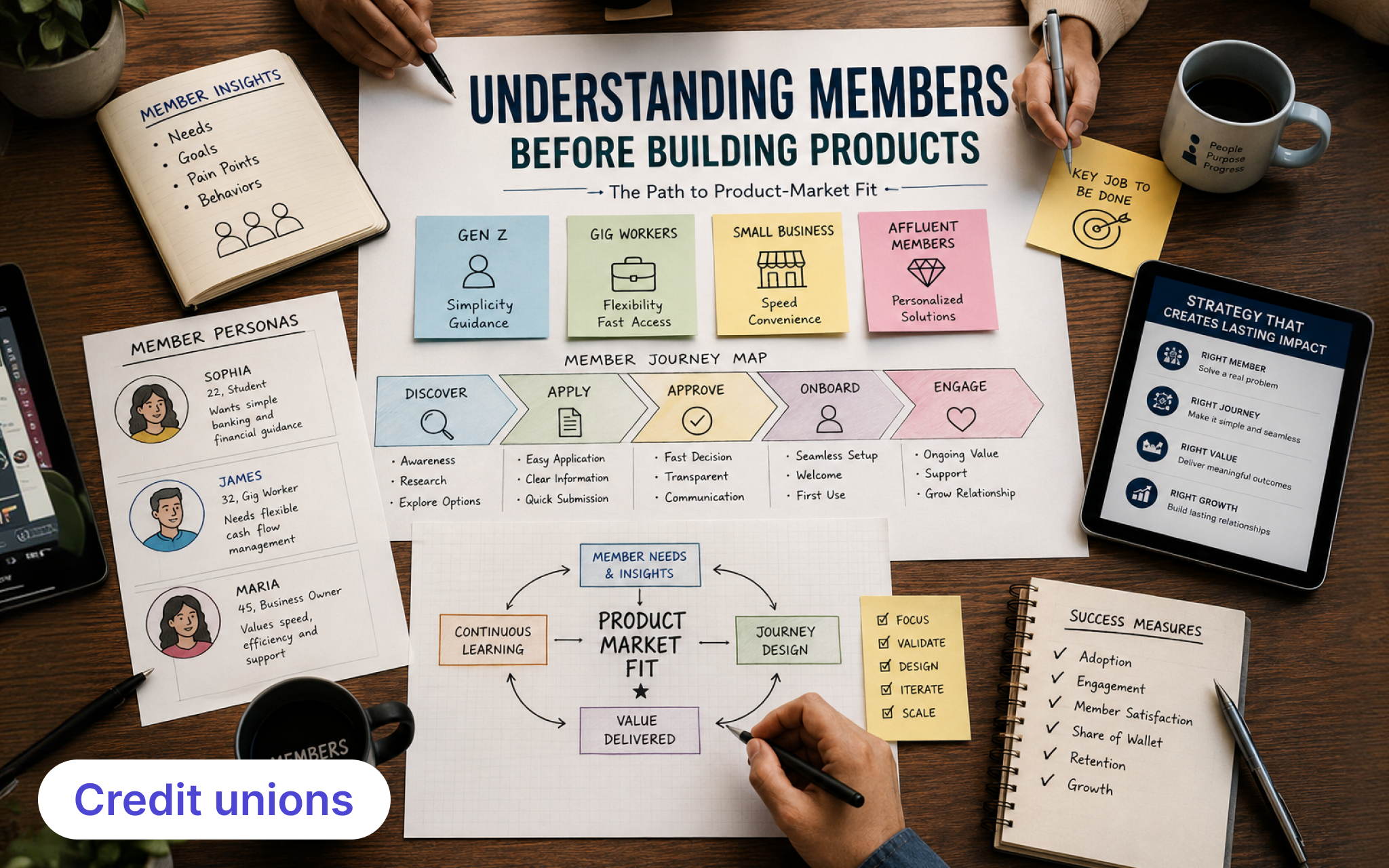
Successful product market fit begins with understanding members rather than products.
Different member groups have different financial goals. Accenture research shows that 73% of consumers expect organizations to understand their unique needs and expectations, reinforcing the importance of segment specific journey design.
- Gen Z members want simple digital experiences and financial guidance.
- Gig workers need flexible cash flow management.
- Small business owners value speed and convenience.
- Affluent members seek personalised financial solutions.
The strongest institutions use these insights to create focused experiences rather than generic offerings.
Step 1: Pick One Segment, One Job, One Flagship Journey
Start narrow.
Choose one strategically important member segment and identify one core financial problem you want to solve.
Instead of building multiple products simultaneously, focus on a single flagship journey.
This creates clarity, alignment, and measurable outcomes.
Step 2: Validate with Existing Data
Before investing resources, use existing information to confirm demand.
Useful sources include:
- Core banking data
- Transaction behaviour
- CRM insights
- Survey responses
- Service requests
Often, credit unions already possess enough information to identify member pain points without launching large research projects.
This process becomes even more effective when supported by structured member journey mapping, which helps visualise friction points across the current experience.
Step 3: Design the Entire Journey
Many institutions focus heavily on product features while overlooking the surrounding experience.
Members care about the complete journey:
- Discovery
- Application
- Approval
- Onboarding
- Ongoing engagement
Strong member journey mapping helps ensure every stage supports the intended outcome.
This is where agile product development becomes valuable. Teams can prototype journeys, gather feedback, and refine experiences before making large investments.
Step 4: Launch Narrow and Learn Fast
Rather than launching broadly, start with a controlled pilot.
Define:
- A target audience
- Success metrics
- A fixed evaluation period
Track indicators such as:
- Adoption rates
- Completion rates
- Product usage
- Member satisfaction
If the concept performs well, expand confidently.
If it does not, adjust quickly and redeploy resources.
This approach transforms product market fit from a one time project into a repeatable capability.
Why Credit Unions Need a Different Playbook Than Fintechs

Fintechs and credit unions operate under fundamentally different business models.
Fintechs optimise for rapid growth. Their investors expect experimentation and accept that many initiatives will fail.
Credit unions operate differently.
They must balance innovation with:
- Member trust
- Regulatory expectations
- Long term sustainability
- Community responsibility
This does not mean avoiding innovation.
It means approaching innovation differently.
Instead of “launch big and fail fast,” successful credit unions embrace a more disciplined principle:
Launch narrow and learn fast.
This approach allows institutions to benefit from agile product development while maintaining governance and risk controls.
It also aligns naturally with the realities of credit union operations, where every change must deliver meaningful member value.
The most successful credit union digital transformation initiatives are rarely the largest.
They are often the most focused.
Turning Strategy into Execution with a No Code Journey Layer

One of the biggest barriers to execution is technology complexity.
Many institutions believe meaningful change requires extensive legacy system modernization before any new member experience can be delivered.
In reality, that assumption often delays progress.
Modern no code orchestration platforms provide an alternative approach.
Rather than replacing core systems, they sit above existing infrastructure and coordinate journeys across channels, applications, decision engines, and operational workflows.
This allows credit unions to:
- Launch journeys faster
- Reduce dependency on large development projects
- Configure workflows through business teams
- Integrate systems through APIs
- Test and iterate more effectively
A no code layer also supports faster experimentation.
Business teams can refine eligibility rules, onboarding flows, and communication journeys without creating lengthy technology backlogs.
This creates a more practical path toward credit union digital transformation while preserving existing investments.
For institutions trying to balance innovation with operational constraints, execution flexibility often becomes just as important as strategy itself.
What Product Market Fit Looks Like in Practice

Product market fit is not a launch event.
It is an ongoing discipline.
For credit unions, the strongest indicators are not the number of products offered but the depth of member adoption and engagement.
Signals that suggest strong product market fit include:
- Rising adoption within target segments
- Increased product usage
- Higher completion rates
- Faster onboarding journeys
- Positive member feedback
- Improved retention and loyalty
These outcomes indicate that a journey is solving a meaningful problem rather than simply adding another product to the catalogue.
The institutions succeeding in 2026 are not chasing every fintech trend. They are identifying a small number of high value member needs and building experiences around them.
This is where ezee.ai fits naturally into the conversation. By combining no code journey orchestration, workflow automation, intelligent decisioning, and API driven integration, lend.ezee helps credit unions move from strategy to execution without waiting for large scale transformation programmes. It enables institutions to test, launch, refine, and scale member journeys while maintaining operational control and governance.
The future of credit union growth will not belong to institutions with the longest product list.
It will belong to those that understand their members best, execute faster, and achieve product market fit before their competitors.
Frequently Asked Questions
Product-market fit means members voluntarily use your digital channels for real tasks applying for loans, checking balances, making payments without being pushed. In practice, you see repeat usage, organic referrals, and steady loan growth from mobile and online journeys, as industry research on digital leaders shows.
Most credit unions struggle because great slideware hits legacy cores, siloed data, and thin digital teams. Strategies stall at “phase 1” while manual underwriting, paper KYC, and phone-based support persist. Industry studies repeatedly find execution not vision is the main barrier to digital transformation.
Avoid the shiny object trap by fixing critical journeys: onboarding, loan applications, collections before chasing new features. Prioritize use cases that cut TAT, reduce manual exceptions, and raise self-service adoption. Analysts frequently note that top performers win by simplifying a few high-impact journeys, not adding dozens.
In 2026, credit unions are doubling down on AI-assisted service, no-code journey design, and embedded finance partnerships. Reports show growing investment in data-driven personalization, BNPL and micro-credit journeys, and tighter core–fintech integrations to reduce time-to-market for new lending and member-experience products.
Gen Z journeys should be mobile-first, ultra-short, and transparent about fees and credit impact, unlike multi-step branch-style flows. Research shows Gen Z expects instant KYC, real-time approvals, and nudges for savings. Think one-hand flows: scan ID, fetch CKYC, pull bureau, show clear outcomes.
You’re near product-market fit when digital channels drive a growing share of new accounts and loans with high repeat usage. Common KPIs include app logins per active member, digital share of originations, NPS for mobile journeys, and lower call-centre volume for simple servicing requests.
A practical 2026 strategy might focus on three journeys: fully digital account opening, instant small-ticket credit, and self-service collections. Each has clear KPIs (TAT, approval rates, roll-rate reduction) and an execution roadmap that combines rule engines, APIs to bureaus, and workflow tools instead of big-bang re-platforming.
Credit unions can pilot new offerings by using a sandbox or middleware layer that mimics the core but keeps experiments isolated. Many cooperatives now route a small member segment through an external decisioning and workflow layer, then sync only booked loans and finalized data back to the core.
Evaluate partners on lending-specific depth (applications, underwriting, KYC, collections), proven core/bureau/CKYC integrations, and time-to-launch for similar institutions. Peer benchmarks and analyst reports stress checking real go-live timelines, change-request responsiveness, and whether business teams can self-configure journeys without constant custom development.
A no-code journey orchestration layer like ezee.ai lets product, risk, and operations teams design and change digital flows without waiting on core changes. Credit unions use such layers to quickly tweak loan forms, underwriting rules, and KYC steps, dramatically shortening time from idea to live member journeys.
