
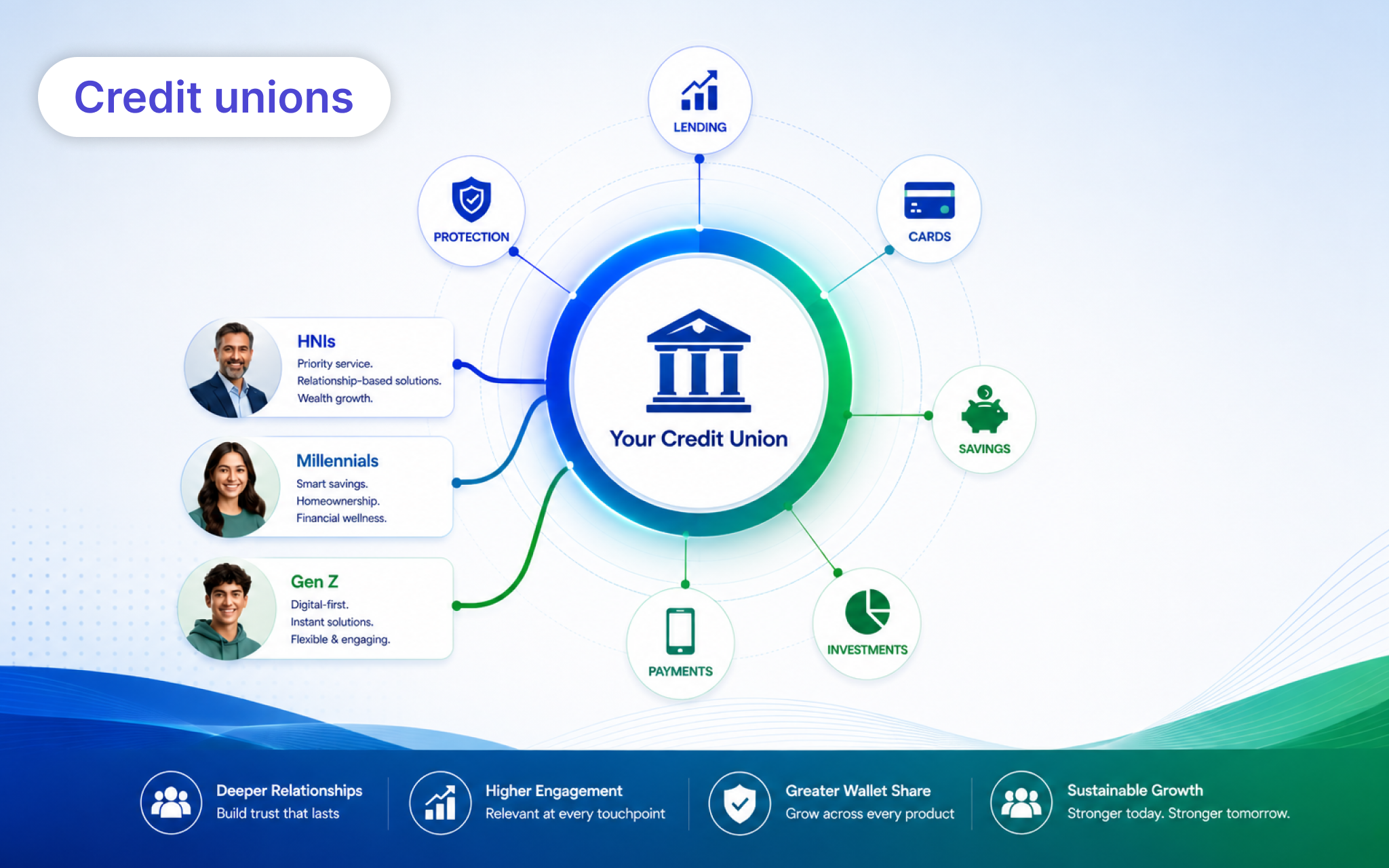
Credit unions already serve more high-value members than they realize. Hidden in plain sight are HNIs who treat the credit union as a trusted anchor, millennials who are quietly maturing into prime borrowers, and Gen Z members who will define the future deposit base. Yet most of them experience the same generic journeys as everyone else. The result is a widening gap between the value that exists inside the membership and the value that actually shows up in credit union wallet share, exposing weaknesses in the broader credit union member experience.
The opportunity is not only to attract more affluent and younger members from outside. It is to recognize and serve the ones who are already inside, with journeys that reflect their real behavior and potential, rather than broad demographic labels. That shift is now possible with modern data, behavioral intelligence and no-code orchestration layers that sit on top of existing cores, enabling far richer credit union data analytics, behavioral segmentation in banking and digital banking personalization.
The Invisible Wealth Problem Inside Credit Unions
Credit unions’ membership bases include a surprising concentration of wealth: many already serve HNIs defined by $1M+ investable assets, alongside millennials holding median savings surpassing prior generations and Gen Z entering with digital-first habits. However, these segments remain “invisible” because core systems and processes apply blanket treatment, ignoring signals like high-balance deposits parked idly or frequent premium transactions that should inform a differentiated credit union member experience.
Consider a typical mid-sized credit union: boomers contribute 50-60% of deposits today, but projections show millennials and Gen Z comprising 60% by 2030, bringing $2-3 trillion in potential U.S. household wealth. Without differentiation, these members use the credit union for basics checking or mortgages while routing investments, cards, and liquidity to fintech’s or big banks. The problem compounds as younger cohorts expect seamless integration across life stages, from student loans to family planning, yet encounter outdated interfaces causing 30-40% app abandonment rates and weakening credit union wallet share over time.
This invisibility stems from data silos: transaction histories reveal patterns of untapped value, such as consistent $10K+ monthly inflows without corresponding loan expansions. Credit unions forfeit 20-30% potential revenue per member by not surfacing these opportunities, allowing competitors to siphon share through targeted digital hooks.https://www.mckinsey.com/industries/financial-services/our-insights/the-digital-imperative-for-credit-unions. Smarter credit union data analytics and behavioral segmentation in banking can turn this same raw data into an engine for digital banking personalization and wallet growth.
The Segmentation Gap Holding Growth Back
Segmentation gaps arise when credit unions rely on outdated demographics age bands, ZIP codes, or employment types failing to reflect modern realities like hybrid work or gig economies. Every member endures identical journeys: prolonged KYC with duplicate data entry, conservative limits based solely on FICO, and uniform offers like “open a CD” regardless of profile, which erodes the perceived quality of the credit union member experience.
High-value members disengage quickly; an HNI might tolerate it once but defects after experiencing fintech’s one-click high-limit approvals. Broad strategies amplify dilution: annual campaigns promote the same auto refinance to renters and homeowners alike, yielding dismal 2-5% uptake. Meanwhile, wallet fragmentation grows members hold primary checking here but cards, investments, and BNPL elsewhere capping lifetime value at 40-50% of potential and depressing long-term credit union wallet share.
Over time, this gap erodes competitive moat: fintech’s and neobanks, armed with unified data views, consolidate spend by predicting needs across products. Credit unions must bridge this with intelligence that evolves, turning generic members into loyal, high-share advocates through better behavioral segmentation in banking and more intentional digital banking personalization.
Static Demographic Buckets Versus Behavioral Intelligence
Demographic buckets offer crude proxies a 35-year-old urbanite lumped with peers but behavioral intelligence dissects granular signals: transaction categories (e.g., luxury retail spikes), velocity (daily vs. monthly patterns), and correlations (deposits rising with stock market volatility). Static methods refresh yearly via surveys; behavioral updates hourly, flagging a Gen Z’s freelance inflows for flexible credit and giving credit union data analytics a far more dynamic role.
For example, demographics might tag a group as “young family,” but behaviors reveal subgroups one saving aggressively for down payments, another leaking to peer apps. Intelligence clusters these dynamically, enabling 25-35% higher personalization accuracy. Credit unions adopting this see engagement lifts as offers align: HELOC prequals for home-improvers, not mass CD pushes, and the overall credit union member experience begins to feel far more tailored.https://www.fintilect.com/resources/insights/credit-union-growth-behavioral-insights/
Transitioning involves no-code tools layering ML atop existing data lakes, democratizing insights for marketers without PhDs in data science. In practice, this is behavioral segmentation in banking powered by credit union data analytics, feeding a new generation of digital banking personalization rather than static “age band” campaigns.
Same Onboarding, Same Limits, Same Offers Across Segments
One of the clearest symptoms of static segmentation is uniform onboarding and product treatment. A student, a retiree, a business owner and an HNI are often put through the same steps, given the same starter limits and offered the same menu.
Typical patterns include
- Long, form heavy onboarding flows with little pre fill or reuse of existing data.
- Conservative initial credit limits that ignore the broader relationship.
- Standard product journeys that assume every member starts from zero with the credit union.
For HNIs, this feels out of sync with the rest of their financial life. They are used to priority handling, tailored limits and proactive conversations about complex needs. For younger members, especially Gen Z, it simply feels slow and clunky compared to fintech apps that can approve and activate in minutes. From a credit union member experience perspective, the lack of digital banking personalization in these moments sends a strong signal that the institution does not truly “see” the member.
When onboarding and offers are the same for everyone, the credit union is effectively telling its best members “you are average here”. The friction may be tolerated at first, often for community or trust reasons, but it quietly caps how far the relationship will go and how much credit union wallet share can realistically be captured.
Broad Campaigns That Dilute Wallet Share
Marketing campaigns are another area where blunt segmentation holds credit unions back. Email lists and app notifications are often built by very broad rules. “All members with a checking account”, “all members without a credit card”, “all members over 45”.
The problem is not that these messages are wrong in theory. It is that they are not precise enough to be relevant in practice.
- A generic “get a better rate on your auto loan” message goes to members who bought a car last month at the credit union.
- A standard “open a CD” campaign hits HNIs who already have complex investment portfolios elsewhere.
- A simple “download the app” push goes to Gen Z members who already live in the app and want something more advanced.
Broad campaigns tend to achieve broad outcomes. Modest click through, modest uptake, modest impact on wallet share. Narrow, behavior based campaigns almost always outperform them, even at much smaller audience sizes. The growth lever is not “more campaigns”. It is better targeting and journey design around real segment needs, powered by credit union data analytics and more precise behavioral segmentation in banking.
Why Fintechs Are Winning Affluent and Gen Z Members
Fintechs have grown quickly with two simple but powerful advantages. First, they design journeys around specific use cases rather than broad categories. Second, they use data aggressively to personalize those journeys once members are inside.
For Gen Z, many leading fintechs start with everyday pain points. Getting paid early, splitting bills, managing subscriptions, smoothing income volatility. They do not begin by asking members to switch their primary relationship. They begin by solving one problem beautifully, then use engagement data to cross sell in context, nailing digital banking personalization from day one.
For affluent members, digital wealth platforms make it easy to open accounts, move money, test new strategies and access advice without heavy paperwork. They can start small, evaluate the experience and then consolidate more of their portfolio if it meets expectations. In other words, fintechs have built a new benchmark for credit union member experience, even if they do not use that label.
Credit unions absolutely can compete here. They already have trust, brand equity and community presence that most fintechs would love to have. The reason fintechs win these segments today is not that credit unions lack strategy. It is that fintechs turn insights into live journeys faster, with more experimentation and more personalization, directly attacking credit union wallet share when members are at decision points.
What High Value and Digital Native Members Actually Expect
Underneath labels like “HNI” or “Gen Z” are quite specific expectations, many of which credit unions are well positioned to serve if journeys evolve.
High value members typically expect
- Recognition that reflects the total relationship, not just a single account.
- Faster decisions, fewer steps and direct access to people when needed.
- Proactive suggestions that anticipate needs, for example tax planning, liquidity events or business expansion.
Millennials often expect
- Seamless digital experiences across channels, with minimal friction.
- Integrated tools that automate good behavior, for example round up savings or auto investing from payroll.
- Transparent pricing and simple, easy to compare product structures.
Gen Z usually expects
- Instant, intuitive onboarding that feels like the rest of their app ecosystem.
- Money tools that fit around flexible, non linear income patterns.
- Clear alignment with values, including community, sustainability and fairness.
These expectations are not incompatible with the credit union model. In many ways they are a natural evolution of “people helping people” into a digital era. The key is to turn them into concrete journey designs, not just high level intent, and to embed digital banking personalization so that the credit union member experience feels as responsive as any leading fintech app.
Identifying the Hidden HNI with Smarter Data
Before a credit union can design journeys for HNIs, it has to identify who they actually are. Traditional methods rely on declared income, referrals or manual observation by branch staff. These are valuable but incomplete.
Smarter data driven identification starts by looking at signals that correlate strongly with higher net worth and higher potential. For example
- Sustained deposit balances above certain thresholds, particularly when they show consistent growth.
- Large periodic transfers to external investment platforms or private banks.
- Patterns of spending that indicate premium lifestyles or business ownership, such as frequent high value travel or vendor payments.
- Multiple properties or large one off property related transactions.
On their own, none of these makes someone an HNI. Together, they build a picture of members who may warrant closer attention. The goal is not to label people in a rigid way. It is to surface “hidden” members for better service and more relevant offers, with sensitivity and respect. This is where credit union data analytics and behavioral segmentation in banking combine to directly support targeted credit union wallet share growth.
Relationship Value Scoring Across Deposits, Loans and Cards
A more holistic way to think about value is through relationship value scoring. Instead of judging a member by a single product, the credit union scores the whole relationship across deposits, loans, cards and other services.
A basic model might consider
- Current balances and flows, showing how much of the member’s financial life sits with the credit union.
- Tenure and stability, indicating long term loyalty and predictability.
- Product diversity, revealing whether the relationship is narrow or broad.
- Profitability and risk adjusted return, tying value to sustainable performance.
A more advanced model might also consider potential value based on behavior and life stage. For example, a millennial renter with strong income and savings habits could have higher future value than an older member whose financial life is already mature.
Relationship scores do not replace traditional risk and compliance measures. They sit alongside them, helping teams decide where to focus limited human attention and where to invest in differentiated experiences. Well designed, they become a core part of credit union data analytics strategy and a practical backbone for scalable digital banking personalization.
Income and Cash Flow Proxies
For many younger and self employed members, traditional income proof is either hard to obtain or not very representative. At the same time, credit unions already have a view of cash flows through accounts and transactions.
Using income and cash flow proxies means building a view like
- Typical monthly inflows, broken down by source where possible, for example salary, freelance, business revenue.
- Typical monthly outflows, including recurring commitments, discretionary spend and transfers.
- Volatility and seasonality, especially important for gig workers and small businesses.
- Buffer capacity, showing how much headroom exists after obligations.
This does not mean abandoning documentation or underwriting standards. It means enriching them with real world behavior. For Gen Z and millennial members whose careers do not fit old templates, such proxies can unlock fairer access to credit and more suitable limits, improving the credit union member experience while still protecting the balance sheet.
External Deposit Leakage Indicators
Wallet share loss rarely happens overnight. It usually starts with small, repeated behaviors that can be observed if the credit union looks for them.
Typical leakage indicators include
- Regular transfers to the same external savings or investment institution.
- Rising card payments to a specific fintech provider that also offers accounts or credit.
- Gradual decline in inbound payroll as members shift income to another primary account.
- Dormancy in usage of key products, even when balances remain.
Treating these as early warning signals enables proactive engagement. For example
- A member moving funds to a high yield platform might receive a timely offer for a competitive savings product with the credit union.
- A member shifting card spend elsewhere might see tailored rewards or limit enhancements that match their pattern.
- A member whose payroll is slowly shrinking could be contacted to understand whether needs are changing.
The goal is not to block members from using other providers. It is to make sure the credit union stays competitive and valuable enough that members want to keep a meaningful share of their financial life there. Here again, disciplined credit union data analytics can directly protect and grow credit union wallet share when paired with thoughtful digital banking personalization.
Behavioral and Transaction Pattern Intelligence
Beyond single signals, real power comes from recognizing recurring patterns in transactional behaviour. These patterns often map directly to life events or needs that can drive product uptake.
Some examples
- A spike in home improvement spending after a property purchase may indicate a need for a line of credit.
- Growing childcare and education expenses can signal upcoming needs for savings plans or future borrowing.
- Regular large payments to suppliers suggest an opportunity for business credit or cash management solutions.
- Frequent international transactions can point to travel, family abroad or global business needs.
Machine learning models can help surface these clusters without bias, but the interpretation and journey design remain very human. Credit unions decide which patterns are important, which offers are appropriate and how to engage in a way that feels like help, not surveillance. Done well, this is behavioral segmentation in banking translated into concrete, empathetic credit union member experience improvements.
Dynamic High Value Flags Instead of Static Tags
Once smarter signals and scores exist, they need to be made usable. That is where dynamic flags replace static tags.
Instead of a member being marked “HNI” or “youth” in a system forever, rules and models update flags as behavior changes. For example
- A member is flagged as “rising HNI” when deposits and external transfer patterns meet certain thresholds.
- A member is flagged as “leakage risk” when outbound transfers cross a certain share of income.
- A member is flagged as “next best product: credit card” when spending and repayment patterns reach specific conditions.
These flags flow into channels and workflows. Contact center staff see them when a member calls. Digital channels use them to personalize offers. Branch teams use them to prioritize outreach. Because they are dynamic, journeys keep pace with real life instead of relying on a one time classification, making digital banking personalization feel timely rather than generic.
Designing Differentiated Journeys Without Re-platforming
A natural fear for many credit unions is that doing all of this requires a massive core replacement or multi year transformation. In practice, much can be achieved by adding an intelligence and orchestration layer on top of what already exists.
Differentiated journeys can be designed as modular flows that plug into current mobile apps, online banking, CRM and LOS. For example
- A “priority HNI onboarding” journey that uses pre filled data, fast track checks and early access to advisory teams.
- A “Gen Z starter” journey that offers instant account opening, digital wallet provisioning and small starter limits that grow with usage.
- A “leakage recovery” journey that triggers when external transfers cross certain thresholds and presents more competitive, personalized options.
These journeys can be owned by business teams, who define rules, content and triggers, while IT exposes the necessary integration points. No-code tools make this more practical by allowing non developers to configure and test flows without writing code.
This is where digital banking personalization becomes a living part of the day to day credit union member experience, not just a slide in a strategy deck.
The ezee.ai Approach: Turning Data Signals into Actionable Journeys
This is exactly the problem space that ezee.ai focuses on. It acts as a decision and journey layer that can sit on top of existing cores and channels, using the data credit unions already have.
At a high level, ezee.ai helps credit unions
- Ingest and unify deposit, loan and card data into a single decision fabric.
- Define relationship value scores, behavioral segments and dynamic flags through no-code interfaces.
- Orchestrate differentiated journeys for HNIs, millennials and Gen Z across digital and assisted channels.
- Execute lending and account opening decisions with AI models that respect policy and compliance requirements.
A journey like “hidden HNI activation” might look like this in ezee.ai
- Rules identify members whose behavior matches HNI proxies.
- A dynamic flag marks them as priority for a new journey.
- The next time they log into the app, they see a tailored experience with relevant limits, offers and access.
- If they call or visit a branch, staff see the same flags and guidance.
Similarly, a “Gen Z liquidity and savings” journey could provide micro limits, instant decisions and gamified savings nudges based on transaction patterns. The point is not that ezee.ai replaces existing systems. It makes them smarter and more flexible by turning raw data into real time, actionable journeys that grow credit union wallet share and elevate the credit union member experience.
Millennials and Gen Z: Playing the Long Game
Winning younger members is not only about immediate product uptake. It is about setting up a long game in which the credit union becomes the default financial partner through different life stages.
For millennials, that journey may run from first significant job to home ownership to family planning to small business ownership. For Gen Z, it may include freelance work, multiple career changes and new asset classes that are only emerging today.
Precision segmentation allows credit unions to
- Start with flexible, low friction products that fit early needs.
- Build trust through transparent, fair treatment and visible community impact.
- Introduce more complex products as behavior and capacity evolve, with journeys that feel like natural next steps rather than hard sells.
The long game is not about selling everything at once. It is about always being the most relevant and trusted option when a member is ready for the next step. Behavioral segmentation in banking, backed by strong credit union data analytics, ensures those steps feel personalized rather than transactional.
The ROI Case for Precision Segmentation
Designing and operating this kind of segmentation and journey stack requires investment. Boards and CEOs rightly ask what the tangible return will be.
Typical impact areas include
- Higher wallet share among existing members, as more products and balances consolidate at the credit union.
- Improved digital sales conversion, because journeys match context and intent more closely.
- Lower acquisition costs, since more growth comes from deepening existing relationships rather than constantly finding new ones.
- Better risk outcomes, due to richer behavioral data informing decisions.
A simple way to visualize this is to think in terms of three flagship segments.
| Segment | Differentiated Journey Focus | Illustrative Impact on Wallet Share and Revenue |
|---|---|---|
| Hidden HNIs | Priority service, tailored limits and advisory | Significant uplift in deposits, fees and lending |
| Millennials | Seamless digital, automated saving and investing | Steady multi product adoption over 3 to 7 years |
| Gen Z | Instant access, liquidity tools, gamified goals | High engagement, strong early share of daily spend |
Even modest improvements across these segments can add up to sizeable gains in net interest income and non interest revenue, particularly when scaled across tens or hundreds of thousands of members.
Over time, precision in digital banking personalization and behavioral segmentation in banking directly translates into stronger, more defensible credit union wallet share.
Competing for Wallet Share, Not Just Accounts
The mindset shift at the heart of all this is to compete for wallet share, not just accounts. Opening an account is the start of a relationship, not the victory condition. True success is when the credit union becomes the natural home for a member’s day to day money, borrowing and long term goals.
Hidden high value members, especially HNIs, millennials and Gen Z, represent the most important battleground in this shift. They already trust the credit union enough to be there. The question is whether journeys are intelligent and differentiated enough to keep them from drifting away and to continually enhance the credit union member experience.
By moving from static demographics to behavioral intelligence, from broad campaigns to precision journeys and from static tags to dynamic flags, credit unions can close the segmentation gap that has held growth back.
With platforms like ezee.ai providing the decision and orchestration layer, they can do this without waiting for a once in a decade re-platforming project, and start unlocking the hidden value inside their membership today through better credit union data analytics, digital banking personalization and a relentless focus on credit union wallet share.
By moving from static demographics to behavioral intelligence, from broad campaigns to precision journeys and from static tags to dynamic flags, credit unions can close the segmentation gap that has held growth back. With platforms like ezee.ai providing the decision and orchestration layer, they can do this without waiting for a once-in-a-decade re-platforming project and start unlocking the hidden value inside their membership today.
ezee.ai transforms credit union data analytics into live digital banking personalization at scale. No-code rules engines let business teams define HNI flags, Gen Z liquidity paths and millennial investment nudges in days, not quarters. Pre-built for lending compliance, it routes journeys across app, web and branch while tracking credit union wallet share gains in real time.
Ready to activate your hidden high-value members? ezee.ai delivers a 90-day segment audit and journey pilot that uncovers untapped deposits, lifts cross-sells 2-3x and positions your credit union ahead of fintech’s. Explore how credit unions are already activating these precision segments to transform their credit union member experience.
Frequently Asked Questions
HNIs expect personalized wealth advisory and legacy planning, while Millennials and Gen Z prioritize seamless digital tools and values-aligned experiences. HNIs value dedicated relationship managers for investment strategies during underwriting or estate loans; younger members demand instant mobile onboarding with AI-driven budgeting nudges. 95% of Gen Z see poor mobile as a deal breaker per Digital Banking Index.
Static segments overlook dynamic behaviors like shifting spending patterns, missing 3.2% average balance growth from engaged members. They ignore transaction signals during life events, such as rent payments signaling homebuying potential. Behavioral clustering reveals high-CLV groups across ages, unlike age-based boxes.
Deposit leakage shows in trial transfers to competitors or buy-now-pay-later spikes signaling unmet needs. Declining wallet share appears via external payment outflows or stagnant loan uptake despite deposits. Real-time transaction views spot these before quarterly reports.
Behavioral intelligence improves experience by using real time transaction and engagement data to trigger relevant offers and servicing journeys. Instead of broad campaigns, it responds to life events and financial patterns. Repeated rent payments can trigger a pre approved home loan check using bureau APIs and rule engine scoring. Gartner notes data driven personalization can increase engagement rates by over 15%.
Relationship value scoring ranks members by predicted lifetime value and NPS potential (+65 threshold), prioritizing outreach for deeper loyalty. It flags promoters for cross-sell during auto loan journeys or deposit growth signals. Scores above 70 correlate to 2.5x repurchase rates versus satisfaction alone, per CUSG data.
Cluster transaction data for patterns like high deposits without loans or peer-similar spenders, revealing 20-30% untapped high-CLV members. Look for investment app logins paired with steady payrolls during KYC reviews. Machine learning surfaces these beyond balances, per Culytics analysis.
Affluents need advisor handoffs with wealth assessment tools post-KYC; digital-natives get AI-driven budgeting flows from spend signals. Trigger family loan paths from kid-related transactions or homebuying nudges from rent outflows. Tailored paths lift completion rates 35%, per Accutive benchmarks.
Prioritize no-code multi-channel builders, real-time data unification from cores/CRMs, and A/B testing for 33% faster journey launches. Essential: abandonment recovery via push notifications and compliance audit trails. Platforms automating 55% of tasks via AI cut manual effort, per Ovation CXM insights.
Shift to behavior-triggered cross-sells like credit line upsells after spend surges reducing acquisition costs by 50% while growing fees. Analyze primaries for loan opportunities during peak cycles, yielding higher ROI than new accounts. BlastPoint reports 271% engagement lifts from such campaigns.
It federates core data into a single view for real-time journeys like loan prompts from deposit patterns without rip-and-replace migrations. Integrates silos via APIs for targeted underwriting or collections workflows. Delivers 25% wallet share growth through activated segments, per industry benchmarks.
0 Comments